

I help founders understand their options clearly before they commit to any structure, provider, or direction.
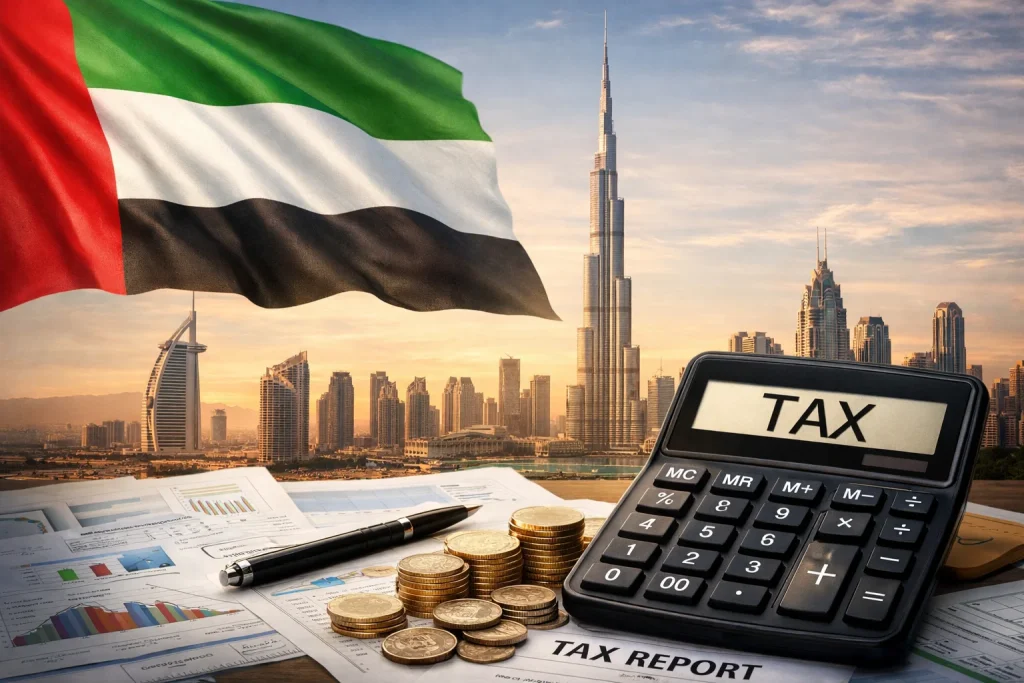
UAE corporate tax is 9% on taxable profits above AED 375,000. Businesses with profits below AED 375,000 pay 0%. Most UAE free zone companies qualify for 0% if they meet substance requirements. Registration is mandatory for all UAE businesses regardless of profit level.
The UAE introduced corporate tax on 1 June 2023 under Federal Decree-Law No. 47 of 2022. For most businesses, this means a 9% tax on net profits above AED 375,000 per financial year. If your business earns below this threshold, the rate is 0% — but registration with the Federal Tax Authority (FTA) is still mandatory.
This guide covers who pays UAE corporate tax, what qualifies as taxable income, how free zone exemptions work, registration deadlines, and the compliance steps your business needs to follow. We have written this for business owners and investors — not tax lawyers.
Free tool: for the 5% VAT side of your numbers, the UAE VAT calculator adds or removes VAT instantly.
Quick Summary: UAE Corporate Tax in 2026
- Standard rate: 9% on taxable profits above AED 375,000. Profits up to AED 375,000 are taxed at 0% under the standard rate bands; Small Business Relief is a separate election for businesses with revenue of AED 3 million or less.
- Free zone 0% rate: Available only to Qualifying Free Zone Persons that maintain substance and earn from qualifying activities — a license alone is not sufficient.
- Registration is mandatory: Every UAE business must register with the Federal Tax Authority, including those with zero tax liability. AED 10,000 penalty for late registration.
- Small Business Relief: Businesses with revenue ≤ AED 3 million can elect zero taxable income for periods ending on or before 31 December 2026.
- Multinational rate (BEPS): 15% Domestic Minimum Top-up Tax applies to multinational groups with global revenues above EUR 750 million.
- Filing deadline: Corporate tax return is due within 9 months of the financial year-end via the EmaraTax portal.
Those are the rules. To see them applied to your own numbers, enter your revenue and taxable income below. The check also tells you whether the Small Business Relief election is open to you.
Who Pays UAE Corporate Tax?
UAE corporate tax applies to all juridical persons incorporated in the UAE and foreign entities with a permanent establishment here. This includes mainland LLCs, sole establishments, civil companies, and branch offices of foreign companies.
Who is subject to corporate tax:
- UAE mainland companies (LLCs, sole establishments, civil companies)
- Foreign companies with a permanent establishment in the UAE
- Individuals conducting business under a commercial license
- Banking operations of foreign banks operating in the UAE
Who is exempt or outside scope:
- UAE government entities and government-controlled entities
- Extractive businesses (oil, gas, mining) — subject to Emirate-level tax instead
- Qualifying public benefit organisations
- Qualifying investment funds meeting FTA conditions
- Individuals earning salary income only (no business license)
The 9% Rate Explained
The UAE corporate tax rate structure has three tiers. Understanding which tier applies to your business is the first step in any compliance plan.
| Taxable Income | Rate | Who This Applies To |
|---|---|---|
| AED 0 – AED 375,000 | 0% | All taxable businesses — small business relief |
| Above AED 375,000 | 9% | Standard rate for mainland and non-qualifying free zone entities |
| Multinational groups (BEPS Pillar Two) | 15% | Groups with global revenues above EUR 750 million |
The AED 375,000 threshold is per financial year. Businesses below the threshold still register — they simply file a nil return.
Free Zone Corporate Tax — The 0% Exemption
Free zone companies can qualify for a 0% corporate tax rate — but only as Qualifying Free Zone Persons (QFZPs). Meeting this standard requires genuine economic substance, not just a registered address.
What Makes a Free Zone Company Qualifying?
- Maintains adequate substance in the free zone (office space, employees, operations)
- Derives income only from Qualifying Activities (trading with foreign clients, intra-group services, shipping, fund management)
- Does not earn Domestic State Sourced Income above the de minimis threshold (5% of total revenue or AED 5 million)
- Complies with transfer pricing rules
- Is not an individual (natural person)
What Disqualifies a Free Zone Company?
If your free zone company earns revenue from UAE mainland clients — providing services directly to Dubai-based companies without a mainland intermediary — that income becomes Domestic State Sourced Income and breaks qualifying status for the entire year. The entire entity then becomes subject to 9% on all profits above AED 375,000.
If your free zone business sells to UAE mainland customers, get a compliance review before your first tax period closes.
Corporate Tax Registration — Deadlines and How to Register
All UAE businesses — mainland and free zone — must register for corporate tax with the Federal Tax Authority, regardless of whether they will owe any tax. Failure to register results in penalties starting at AED 10,000.
Registration Deadlines
| Business Type | Registration Deadline |
|---|---|
| Incorporated before 1 March 2024 | Within 3 months of financial year-end |
| Incorporated on or after 1 March 2024 | Within 3 months of incorporation date |
| Foreign entities with UAE permanent establishment | Within 3 months of establishing the PE |
How to Register (Step by Step)
- Access the EmaraTax portal at tax.gov.ae using your UAE Pass or Emirates ID
- Select Register for Corporate Tax from the services menu
- Enter your trade license details, financial year start date, and entity type
- Upload supporting documents (trade license, MOA, proof of address)
- Submit — FTA processes registration within 20 business days
- Receive your Tax Registration Number (TRN) by email
- File your first corporate tax return within 9 months of your financial year-end
What Counts as Taxable Income?
UAE corporate tax is levied on taxable income — which starts with your accounting net profit and is then adjusted for specific add-backs and deductions permitted under the law.
- Dividends received from UAE subsidiaries: exempt (participation exemption)
- Capital gains on qualifying shareholdings: exempt
- Unrealised gains/losses: can be excluded if elected
- Entertainment expenses: 50% deductible only
- Fines and penalties: not deductible
- Interest expense: subject to a 30% EBITDA cap
- Related party transactions: must be at arm's length – UAE transfer pricing rules apply
If your business has intercompany transactions — loans, management fees, royalties — or significant interest expense, transfer pricing compliance is not optional. Document your arm's length pricing before your first filing.
Penalties for Non-Compliance
| Violation | Penalty |
|---|---|
| Failure to register | AED 10,000 |
| Late registration | AED 10,000 |
| Failure to file return | AED 500/month (first 12 months), AED 1,000/month thereafter |
| Failure to maintain records | AED 10,000 (first instance), AED 50,000 (repeat) |
| Failure to pay tax due | 14% per annum on unpaid amount |
Deductible and Non-Deductible Expenses Under UAE Corporate Tax
Understanding which expenses reduce your taxable profit is one of the most practical aspects of UAE corporate tax compliance. The general rule is that expenses are deductible if they are incurred wholly and exclusively for business purposes and are not specifically excluded by the legislation.
Deductible expenses (can reduce your taxable profit)
- Staff costs: Salaries, end-of-service gratuity, DEWS contributions, and employee benefits directly related to employment
- Rent and office costs: Commercial lease payments, utilities, and service charges for premises used in the business
- Depreciation: Wear and tear on fixed assets (plant, equipment, computers) at prescribed rates
- Finance costs: Interest on business loans, subject to a cap of 30% of EBITDA for businesses with net finance costs above AED 12 million
- Professional fees: Audit, accounting, legal, and advisory fees incurred for business purposes
- Marketing and advertising: Costs to generate revenue, including digital advertising, trade show attendance, and promotional materials
- Insurance: Premiums for business insurance policies
Non-deductible expenses (cannot reduce your taxable profit)
- Fines and penalties: Government fines, late payment penalties, and regulatory sanctions — these are never deductible
- Entertainment expenses: Only 50% of client entertainment costs (meals, events) are deductible; the remaining 50% is disallowed
- Dividends paid to shareholders: Distributions to equity owners are not a deductible expense
- Personal expenses: Any expenditure that benefits shareholders or employees personally rather than the business
- Donations to non-approved entities: Only donations to UAE-approved public benefit organisations qualify for deduction
Related party transactions — payments between connected businesses or shareholders — must be made at arm's length under UAE transfer pricing rules. If a related party charges above-market fees, only the market rate portion is deductible.
Small Business Relief: Who Qualifies and What it Means
Small Business Relief allows eligible UAE businesses to be treated as having zero taxable income for a tax period, effectively deferring corporate tax obligations while still requiring FTA registration. This is a formal election, not an automatic exemption.
Eligibility criteria for Small Business Relief
- Revenue for the tax period must not exceed AED 3 million
- The business must not be a member of a Multinational Enterprise Group subject to BEPS Pillar Two rules
- The relief must be formally elected in the corporate tax return for the relevant period
- Available for tax periods beginning on or after 1 June 2023 and ending on or before 31 December 2026 (subject to ministerial update)
Businesses using Small Business Relief still need to register with the FTA and file a return — they simply elect the relief to report a nil tax liability. If your revenue exceeds AED 3 million in any period, you cannot elect for that period and must calculate taxable income normally.
Small Business Relief does not affect VAT obligations, ESR filings, or any other regulatory requirement. It only addresses corporate tax liability for qualifying periods.
Common Corporate Tax Mistakes UAE Businesses Make
Most corporate tax errors in the UAE stem from misunderstanding, not deliberate avoidance. These are the patterns we see most frequently across business types.
Assuming free zone registration guarantees 0% tax
A free zone trade license does not automatically qualify you for the 0% Qualifying Free Zone Person rate. You must meet ongoing substance requirements, derive income only from qualifying activities, and avoid exceeding the domestic income de minimis threshold. Many businesses discovered after their first tax period that selling services to UAE mainland clients had disqualified their entire entity for that year.
Missing the FTA registration deadline
Every UAE business must register for corporate tax — including businesses that will owe zero tax. The FTA imposes an AED 10,000 penalty for late registration. Businesses incorporated after 1 March 2024 have three months from their incorporation date to register. Businesses incorporated before that date should have registered by reference to their first financial year-end. If you have not yet registered, do so immediately through the EmaraTax portal.
Treating share capital deposits as deductible expenses
Share capital contributed by shareholders is not an expense and does not reduce taxable profit. This is a capital transaction, not a revenue one. Similarly, shareholder loan repayments are not deductible — only the interest element on such loans (if at arm's length) may qualify.
Not separating qualifying and non-qualifying income in free zone entities
Free zone companies that earn even a small amount of income from UAE mainland clients must track that income separately. If domestic income exceeds the de minimis threshold (5% of total revenue or AED 5 million, whichever is lower), the entire entity loses qualifying status for that tax period and becomes subject to 9% on all profits above AED 375,000.
Ignoring transfer pricing documentation requirements
If your business transacts with related parties — parent companies, sister entities, or connected shareholders — you are subject to UAE transfer pricing rules. Transactions must be at arm's length, and businesses meeting certain size thresholds must prepare and maintain a master file and local file. Failure to maintain proper documentation can result in penalties and adjustments during an FTA audit.
Sources & Official References
The information in this guide reflects current UAE federal and emirate-level regulations. For the most up-to-date figures and procedures, consult the official sources below:
- Federal Tax Authority — Corporate Tax — Official UAE Corporate Tax regulations, rates, and EmaraTax portal.
- Ministry of Finance — Corporate Tax — Federal Decree-Law No. 47 of 2022 and Cabinet Decisions.
- FTA — Small Business Relief — Eligibility for the AED 3 million revenue threshold relief.
Frequently Asked Questions
Q: Does a UAE free zone company always pay 0% corporate tax?
No. Free zone companies pay 0% only if they qualify as a Qualifying Free Zone Person (QFZP). To qualify, they must have genuine economic substance in the free zone and must not earn income from UAE mainland sources above the de minimis threshold. If either condition is not met, the standard 9% rate applies.
Q: Do I need to register for corporate tax if my profits are below AED 375,000?
Yes. Registration is mandatory for all UAE businesses regardless of profit level. Businesses below the threshold file a nil return and pay 0% tax, but failing to register carries a AED 10,000 penalty.
Q: When does UAE corporate tax apply to me?
Corporate tax applies from the start of your first financial year that begins on or after 1 June 2023. If your financial year runs January-December, your first taxable period was 1 January 2024 to 31 December 2024, with a return due by 30 September 2025.
Q: Can I deduct my salary from taxable income?
For those who are a sole proprietor or civil company owner drawing a salary, the deductibility depends on whether the salary is at arm's length market rate. Excessive owner salaries used purely to reduce taxable income will be disallowed.
Q: What is small business relief?
Small business relief allows businesses with revenue below AED 3 million in a tax period to elect to be treated as having zero taxable income for that period. It is available for tax periods up to 31 December 2026. Businesses that elect small business relief cannot use carried-forward losses.
Not Sure How Corporate Tax Applies to Your Business?
Most compliance mistakes happen before the first filing deadline — wrong entity classification, unreported mainland revenue in a free zone company, or missed registration. Henry Club's advisory team reviews your structure before it becomes a problem.
What expenses are deductible under UAE corporate tax?
Expenses deductible against UAE corporate tax include staff costs, rent, depreciation on fixed assets, business loan interest (subject to a 30% EBITDA cap for large amounts), professional fees, marketing, and insurance. Fines, penalties, 50% of entertainment costs, and personal expenses are not deductible. Related party transactions must be at arm's length.
Who qualifies for Small Business Relief under UAE corporate tax?
Businesses with annual revenue of AED 3 million or less can elect for Small Business Relief, treating their taxable income as zero for that period. The relief must be formally elected in the tax return and is available for periods ending on or before 31 December 2026. Registration with the FTA is still required regardless of eligibility.
Does a free zone license automatically qualify a company for 0% corporate tax?
No. A free zone trade license alone is not sufficient. To qualify for 0% as a Qualifying Free Zone Person, the company must maintain adequate substance in the free zone, earn income only from qualifying activities, keep domestic UAE income below the de minimis threshold (5% of revenue or AED 5 million), and comply with transfer pricing rules.
Have a question about this?
Leave your details and a UAE expert will get back to you within 1 business day — free, no obligation.
Ready to take action?
Whether you're ready to start or still comparing options — we'll give you a straight answer.
Chat on WhatsApp
Usually replies within 2h
Get a Free Quote
Personalised in 60 seconds
Call Directly
Open daily, 10am–6pm UAE
About the Author
Dubai-based independent advisor on UAE visa, immigration, and offshore structuring. Founder of Henry Club UAE with 90+ published guides. Advisory-first — clarity before commitment.