

I help founders understand their options clearly before they commit to any structure, provider, or direction.
For remote workers, freelancers, and self-employed professionals, the UAE Digital Nomad Visa offers a legitimate pathway to reside in a major global business hub. Officially known as the "Remote Work Visa" in some emirates, this program allows you to legally live in the UAE while continuing to work for an employer or client base located outside the country. It is designed for location-independent professionals seeking the stability, infrastructure, and lifestyle of a long-term base.
The sections below cover options for skilled professionals with stable remote income, looking to establish personal and professional presence in the UAE without securing local employment or starting a local company. It is suited for software developers, digital marketers, consultants, content creators, and online entrepreneurs whose work is not tied to specific geography. For those who are seeking a compliant, renewable residency solution for 1-2 years beyond tourist visas, this program warrants consideration.
Quick Summary: UAE Digital Nomad Visa in 2026
- Validity: 1-year renewable residence visa for remote workers employed by companies outside the UAE.
- Income threshold: Minimum USD 3,500 per month (approx AED 12,850) proven via 3 most recent payslips or business income statements.
- Cost: Application fees typically AED 2,800–3,500, plus medical screening, Emirates ID and health insurance.
- Eligibility: Must hold a valid passport (6+ months), employment contract or business ownership outside the UAE, and pass medical screening.
- Family sponsorship: Spouse and children can be sponsored under the primary holder, subject to standard UAE dependent visa rules.
- Where to apply: GDRFA (Dubai) or ICP (federal) portal. Most applications can be completed without entering the UAE first.
UAE Digital Nomad Visa Cost Breakdown (2026)
Estimated per-applicant costs to obtain the UAE Digital Nomad (Remote Work) Visa, drawn directly from the guide's full cost structure.
| Item | Typical Cost (AED) | Notes |
|---|---|---|
| Government fees | AED 2,000 – 3,500 | Application, issuance and Emirates ID fees; varies by emirate and service channel |
| Mandatory health insurance | AED 1,500 – 5,000 | Annual premium per person; depends on age and coverage level |
| Professional service fees | AED 2,000 – 5,000 | Optional; typing centre or business setup consultant to manage the application |
| Medical test fee | AED 500 – 700 | In-country medical fitness testing (chest X-ray and blood test) |
Understanding the Visa: Eligibility and Core Benefits

The UAE Digital Nomad Visa has clear eligibility criteria designed to ensure applicants are financially self-sufficient and professionally established.
Primary Eligibility Requirements
To qualify, you must meet two overarching conditions:
Proof of remote employment or self-employment: You must provide evidence of your remote work arrangement. This means either a one-year contract with a current employer outside the UAE, along with proof of employment and minimum monthly salary, or proof of ownership of a company located outside the UAE that has been operational for at least one year.
Minimum income threshold: This is the critical financial requirement. Applicants must demonstrate stable monthly income of at least USD 3,500 (or equivalent). This requirement can be higher in certain emirates or for applicants with dependents. You must provide bank statements and salary documentation for the last three months as proof.
Additional universal requirements include a valid passport with at least six months' validity, health insurance valid within the UAE, and a clean criminal record from your home country.
The Lifestyle and Practical Benefits
Obtaining this visa provides significant advantages beyond legal residency status:
Legal residency status: It converts your status from short-term visitor to legal resident, allowing you to open a local bank account, sign longer-term rental agreements, and access services without constant border crossings.
Access to modern infrastructure: You gain the right to reside in cities like Dubai or Abu Dhabi, with their high safety standards, reliable internet connectivity, co-working spaces, and healthcare facilities.
Foundation for future opportunities: Living in the UAE provides networking opportunities and allows you to explore the local market, understand business culture, and potentially transition to a local business setup in the future from a position of stability.
Strategic geographic location: The UAE serves as a practical travel hub for exploring Europe, Africa, and Asia, with extensive airline connections.
The Step-by-Step Application Process
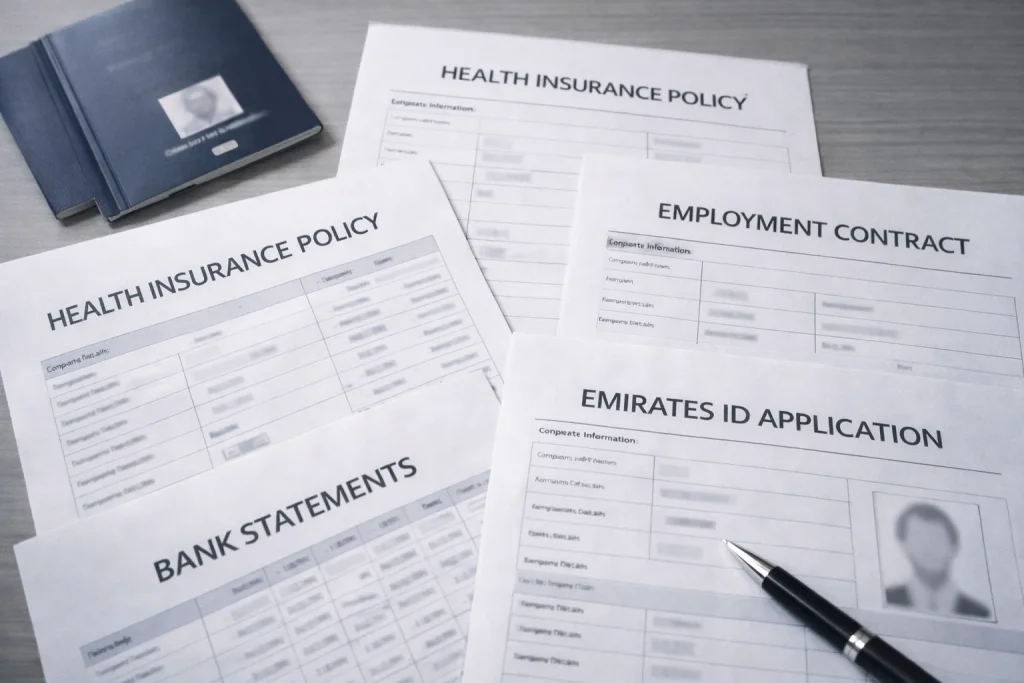
The application process is generally streamlined compared to corporate sponsorship routes, but requires meticulous preparation. The specific authority depends on the emirate (Dubai's program is run by the General Directorate of Residency and Foreigners Affairs, or GDRFA).
Pre-Application Preparation
This is the most important phase, where you gather supporting documentation.
Document collection: Assemble all required documents. This includes passport copies, passport-sized photographs, proof of health insurance, and a clean criminal record certificate. For income proof, gather six months of bank statements, employment contracts, and salary documentation or, for business owners, company registration documents and audited financials.
Document attestation: Some documents, like the criminal record certificate, may require attestation by the UAE embassy in your home country and the Ministry of Foreign Affairs in the UAE. Check the latest requirements from your chosen emirate's immigration portal.
Health insurance purchase: Secure comprehensive UAE health insurance that meets the visa's minimum coverage criteria. This is a mandatory requirement for application submission.
Official Application Submission
Online application: The process typically begins by completing a detailed online application form on the relevant government portal, uploading all scanned documents, and paying the initial application fee.
Application review: The immigration authority will review your submission. This can take several weeks. Be prepared for potential requests for additional documentation or clarification regarding your income or employment.
Entry, Medical, and Finalization
Receive entry permit: Upon preliminary approval, you will be issued an entry permit. This allows you to enter the UAE specifically to finalize your residency visa.
Complete medical screening: Once in the UAE, you must undergo mandatory medical fitness testing at an approved health centre. This includes a chest X-ray for tuberculosis and blood test for communicable diseases.
Biometrics and Emirates ID: After passing the medical examination, you will apply for your Emirates ID, which involves having your biometrics (fingerprints and photograph) captured at an authorized typing centre or service hub.
Visa stamping: The final step is having the residency visa processed in your passport. This is now often done digitally, linked electronically to your Emirates ID.
Sponsor dependents: As a digital nomad visa holder, you have the right to sponsor immediate family members (spouse and children under 18) for residency, subject to providing proof of relationship and adequate housing.
Costs, Timelines, and Key Requirements
Have questions about this?
A 10-minute call with Mirza often saves weeks of research. No obligation — ask anything about your situation.
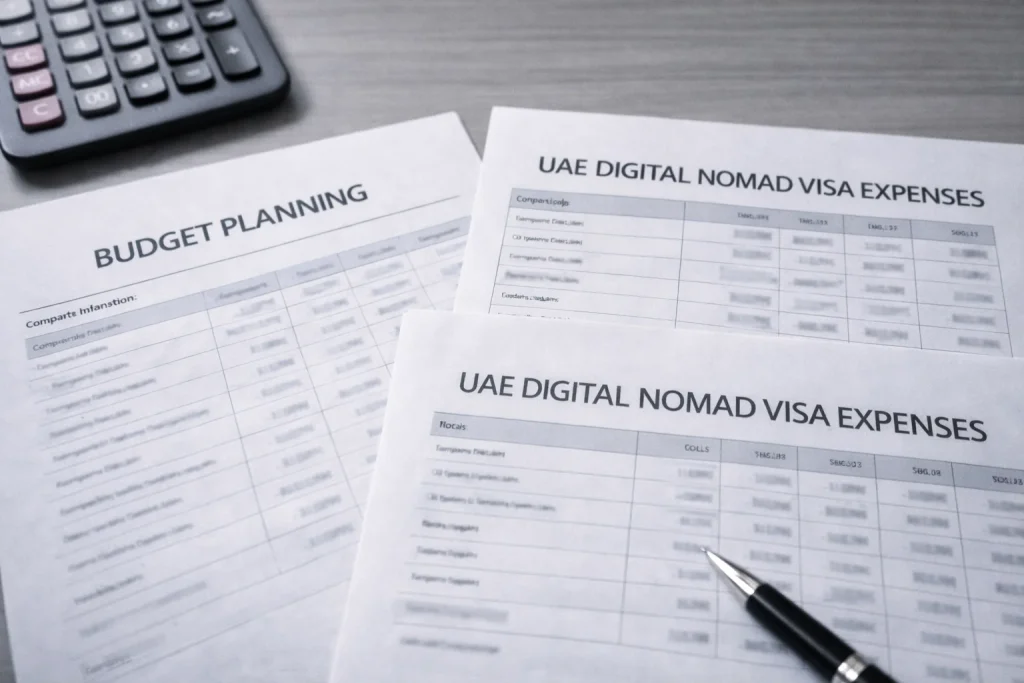
Understanding the Full Cost Structure
Accurate budgeting is important, as costs extend beyond government fees.
Government fees: These can total between AED 2,000 to AED 3,500 for the main applicant, depending on the emirate and service channels. This includes application fees, issuance fees, and Emirates ID fees.
Mandatory health insurance: Annual premiums for adequate coverage can range from AED 1,500 to AED 5,000 or more per person, depending on age and coverage level.
Professional service fees: If you engage a registered typing centre or business setup consultant to manage the application, their service fees can add an additional AED 2,000 to AED 5,000.
Other potential costs: Consider the cost of document attestation in your home country, the medical test fee (approximately AED 500-700), and any courier or translation services.
Realistic Processing Timelines
From document preparation to visa stamping, a realistic timeline is 6 to 10 weeks. The pre-application preparation (document gathering and attestation) can take 2-3 weeks. The government processing and review can take another 3-4 weeks. The final in-country steps (medical, Emirates ID) usually require 1-2 weeks.
Advantages and Inherent Limitations
Clear Advantages
Simplicity and focus: It provides a direct residency path without the complexity and cost of establishing and maintaining a local corporate entity.
Financial efficiency: For solo professionals, it is often more cost-effective than company formation, as you avoid annual license renewal fees, office rent requirements, and corporate banking complexities.
Personal flexibility: It separates your legal residency from your professional work, allowing you to change remote jobs or clients without affecting your UAE immigration status.
Important Limitations to Consider
No right to work locally: This visa explicitly does not permit you to take up employment with a UAE-based company or conduct business directly with the local market. Your income must originate from outside the UAE.
Limited commercial activity: You cannot legally invoice local UAE clients or operate a business that targets the domestic market. To do so, you would need to establish a licensed UAE company.
Renewal considerations: While renewable, the visa is granted for a fixed term (typically 1 or 2 years). Future renewal is subject to prevailing rules, income criteria, and immigration policies at the time of renewal.
No pathway to citizenship: The digital nomad visa is a residency permit. It does not lead to UAE citizenship or permanent residency status.
Common Mistakes and How to Avoid Them
Underestimating the income proof: Submitting inconsistent or unclear bank statements is a common cause of rejection.
Solution: Ensure your last 3-6 months of bank statements clearly show regular, credible deposits that meet or exceed the USD 3,500 monthly threshold from identifiable sources (employer, clients).
Applying with inadequate health insurance: Purchasing travel-style insurance that does not meet UAE residency visa requirements.
Solution: Procure a health insurance policy explicitly approved for UAE residency visas, typically requiring minimum coverage levels and in-patient coverage.
Misunderstanding the "work" limitation: Attempting to engage in local freelance work or business meetings that constitute commercial activity.
Solution: Strictly limit your professional activities to your remote, foreign-source income. If you wish to engage with the local market, consult an expert about transitioning to a proper business license.
Last-minute application: Beginning the process without attested documents or proof of insurance.
Solution: Start the document attestation and insurance purchase process at least one month before you intend to submit your visa application.
Who This Visa May Not Suit
The digital nomad visa serves a specific profile, but may not be appropriate for:
- Professionals seeking UAE employment requiring a standard employment visa sponsored by a local company
- Entrepreneurs aiming to serve the UAE market requiring a mainland or free zone trade license
- Individuals whose remote income is irregular or falls below the USD 3,500 per month threshold
- Those unwilling or unable to secure comprehensive UAE health insurance
- People requiring a guaranteed pathway to long-term permanent residency or citizenship
Practical Examples and Use Cases
The European Tech Professional
Maria, a senior software engineer from Spain, works for a Silicon Valley startup. She wants a stable base with better time-zone alignment for her European and Asian teammates. The UAE digital nomad visa allows her to rent an apartment in Dubai, open a local bank account for daily expenses, and travel freely, all while remaining a full-time employee of her US company.
The Independent Content Creator
Ahmed, a graphic designer and content creator from Egypt, earns revenue through online platforms, international client projects, and advertising. He can demonstrate the required monthly income through his business bank statements and client contracts. The visa provides him residency stability to build his personal brand from Dubai without the overhead of a company.
The Consultant Seeking a Hub
James, a UK-based management consultant, has long-term contracts with clients in Europe and Singapore. He uses the UAE visa to establish a home base in Abu Dhabi, from which he travels to client sites. He benefits from the UAE's extensive air connectivity and can host clients visiting the region in a professional setting.
Your Strategic Next Steps
If the digital nomad visa aligns with your professional and personal goals, a structured approach is essential. Begin by conducting an honest self-assessment against the core criteria: Do you have verifiable, stable remote employment or business ownership? Can you prove consistent income above the threshold?
Your first actionable step is to gather your last six months of bank statements and calculate your average monthly income. Concurrently, research the specific programs offered by different emirates (Dubai, Abu Dhabi, Ras Al Khaimah) as variations in fees, processing times, and required documents may exist.
Given the importance of documentation, many applicants find value in initial consultation with a UAE-based business setup advisor or licensed typing centre. They can provide a current checklist, advise on health insurance options, and help you navigate the attestation process, potentially increasing your chances of a smooth application. By preparing thoroughly and understanding both the opportunities and boundaries of this visa, you can make an informed decision about establishing the UAE as your base for remote work.
UAE Digital Nomad Visa FAQs
Can I work for a UAE company on a digital nomad visa?
No. The UAE Digital Nomad Visa only permits you to work remotely for an employer or clients based outside the UAE. You cannot take local employment or invoice UAE-based companies without a proper business license.
What is the minimum income required for the UAE Digital Nomad Visa?
Applicants must show stable monthly income of at least USD 3,500 (or equivalent). This is proven using recent bank statements, salary slips, or business income records.
Can freelancers apply for the UAE Digital Nomad Visa?
Yes. Freelancers and self-employed professionals can apply if they can demonstrate consistent overseas income meeting the minimum threshold and provide proof of their business or client contracts.
How long is the UAE Digital Nomad Visa valid?
The visa is typically issued for 1 to 2 years depending on the emirate. It is renewable if you continue to meet eligibility requirements.
Can I sponsor my family on this visa?
Yes. Visa holders can sponsor their spouse and children, subject to income, housing, and documentation requirements set by UAE immigration authorities.
How long does the application process take?
The full process — including document preparation, approval, medical testing, and Emirates ID issuance — usually takes 6 to 10 weeks.
Do I need UAE health insurance?
Yes. Comprehensive health insurance valid in the UAE is mandatory. Travel insurance is not sufficient for residency visa approval.
Sources & Official References
The information in this guide reflects current UAE federal and emirate-level regulations. For the most up-to-date figures and procedures, consult the official sources below:
- GDRFA Dubai — Virtual Working Programme — Official Dubai application portal for the remote work visa.
- ICP — Federal Visa Services — Federal Authority for Identity, Citizenship, Customs and Port Security.
- UAE Government Portal — Remote Work Visa — Federal page on long-term residency including the remote work visa.
Have a question about this?
Leave your details and a UAE expert will get back to you within 1 business day — free, no obligation.
Ready to take action?
Whether you're ready to start or still comparing options — we'll give you a straight answer.
Chat on WhatsApp
Usually replies within 2h
Get a Free Quote
Personalised in 60 seconds
Call Directly
Open daily, 10am–6pm UAE
About the Author
Dubai-based independent advisor on UAE visa, immigration, and offshore structuring. Founder of Henry Club UAE with 90+ published guides. Advisory-first — clarity before commitment.