
I help founders understand their options clearly before they commit to any structure, provider, or direction.
Quick Summary: UAE Partner Visa
- What it is: A renewable residence permit granting residency based on your documented ownership stake in a UAE mainland or free zone company, rather than employment.
- Validity: Mainland partner visas typically run two years; free zone visas typically run three years, renewable while the business stays active and compliant.
- Shareholding rule: No universal federal minimum percentage, but you must be formally named on the trade license and Memorandum of Association with a genuine, active stake.
- Cost: For the main applicant, government fees, medical, Emirates ID and basic insurance usually total AED 3,000 to AED 7,000.
- Timeline: Around 5 to 15 working days, or two to three weeks end to end (free zones about 5-10 days, mainland 7-15 days).
- Family sponsorship: Holders can sponsor a spouse and children, subject to housing (registered tenancy), medical fitness and valid health insurance.
Quick answer: The UAE Partner Visa is a renewable residence permit that grants residency based on your documented ownership stake in a UAE mainland or free zone company, rather than employment – mainland visas typically run two years and free zone visas three years. There is no universal federal minimum shareholding percentage, but you must be formally named on the trade license and Memorandum of Association and show a genuine, active stake. For the main applicant, government fees, medical, Emirates ID and basic insurance usually total AED 3,000 to AED 7,000, with the full process taking around 5 to 15 working days (two to three weeks end to end).
For foreign entrepreneurs and investors, establishing a business in the United Arab Emirates opens access to one of the world's most dynamic markets. A critical component of this journey is securing the right to reside in the country to manage your investment. The UAE Partner Visa addresses this need by providing residency based on your ownership stake in a UAE-based company. This guide explains the eligibility requirements, shareholding rules, documentation, and processes for shareholders, partners, and co-owners of mainland and free zone entities seeking to obtain and maintain their residency rights.
Understanding the UAE Partner Visa
A UAE Partner Visa is a residence permit available to individuals who hold a qualifying ownership share in a legally registered UAE company. Unlike an employment visa, which ties your residency to a specific job and employer, the Partner Visa links your residency status directly to your investment and role as a company owner. This provides greater independence, as you are essentially sponsored by the business entity you own, allowing you to legally live in the UAE and actively manage your business operations.
The regulatory basis for this visa stems from the company's trade license and its associated rights to sponsor owners and employees. It's important to distinguish this from long-term programs like the Golden Residency. A standard Partner Visa is typically valid for two or three years and is renewable as long as the business remains active and compliant. However, significant investors may qualify for long-term Golden Residency, which offers durations of five or ten years with different requirements.
Choosing the correct Free Zone or mainland structure plays a key role in partner visa planning. Henry Club evaluates options through its Advisory Ecosystem of UAE jurisdictions.
Company Types That Qualify for Partner Visas
The type of company you establish or invest in determines the specific pathway and authority for your Partner Visa application. The two primary structures are mainland companies and free zone companies.
Mainland LLC Partner Visas
A mainland Limited Liability Company is registered with the Department of Economic Development of the respective emirate, such as Dubai or Abu Dhabi. A key feature of mainland companies is their ability to conduct business directly anywhere in the UAE domestic market without restrictions. For visa purposes, the mainland LLC acts as the sponsor, with applications processed through the federal immigration system, typically via the General Directorate of Residency and Foreigners Affairs (GDRFA) of the emirate where the company is licensed. The standard residency visa issued through this route is usually valid for two years.
Free Zone Company Partner Visas
Free zones are specialized economic areas with their own independent authorities and regulations. Companies established in free zones—such as DMCC, DIFC, or SHAMS—offer 100% foreign ownership and various tax benefits. The sponsoring authority for your visa is the specific Free Zone Authority itself, which manages the visa application process internally, often leading to faster processing times compared to mainland routes. Understanding broader UAE business setup options helps you select the structure that best aligns with your operational and residency goals. A free zone company's trade license grants it a quota of visas it can sponsor, including visas for the company's owners or partners. The standard residence visa from a free zone is often valid for three years.
Sponsorship Authority Differences
The distinction in sponsoring authority—mainland immigration (GDRFA) versus Free Zone Authority—represents the most crucial practical difference. It affects where you submit your application, the specific forms used, and the point of contact for inquiries. However, the final residence permit issued in both cases is a federally recognized UAE residency visa, granting the holder the right to live in the country.
Shareholding Requirements and Eligibility

Eligibility for a Partner Visa depends on proving a substantive and legitimate ownership interest in the company. Authorities assess this based on shareholding percentage, documentation, and the company's operational legitimacy.
Qualifying Ownership Percentages
There is no universal federal law stating a minimum percentage for a Partner Visa. The fundamental requirement is that you are formally listed as a shareholder or partner on the company's official trade license and constitutional documents, such as the Memorandum of Association or equivalent. In practice, for standard two- or three-year partner visas, most authorities and free zones expect the applicant to hold a significant stake, often meaning you are a major or founding partner.
For long-term Golden Residency for investors, requirements are more defined, such as owning a share in a company with capital of at least AED 2 million or a company that pays taxes of no less than AED 250,000 annually.
Controlling Versus Minority Stakes
While a minority stake can qualify, especially in larger corporate structures, the emphasis is on the investment being active and genuine. Being a silent partner or purely passive investor with a very small percentage—such as 1-5%—in a large company may not, on its own, be deemed sufficient for a standard partner visa. Authorities look for a clear link between your residency and your need to be in the country to manage your investment. For significant minority stakes, be prepared to demonstrate the value of your investment and your role in the company.
Special Circumstances
For companies with multiple partners, each partner who is officially documented can be sponsored, provided the company's visa quota accommodates all applicants. The visa quota is often linked to the office space leased by the company.
Silent partners with no managerial role may face closer scrutiny of their eligibility. The application is stronger if you can show a substantial capital investment and that the business has active operations justifying your residency. In some cases, silent partners might explore alternative routes, such as a property investor visa if they have qualifying real estate investments.
Required Documentation
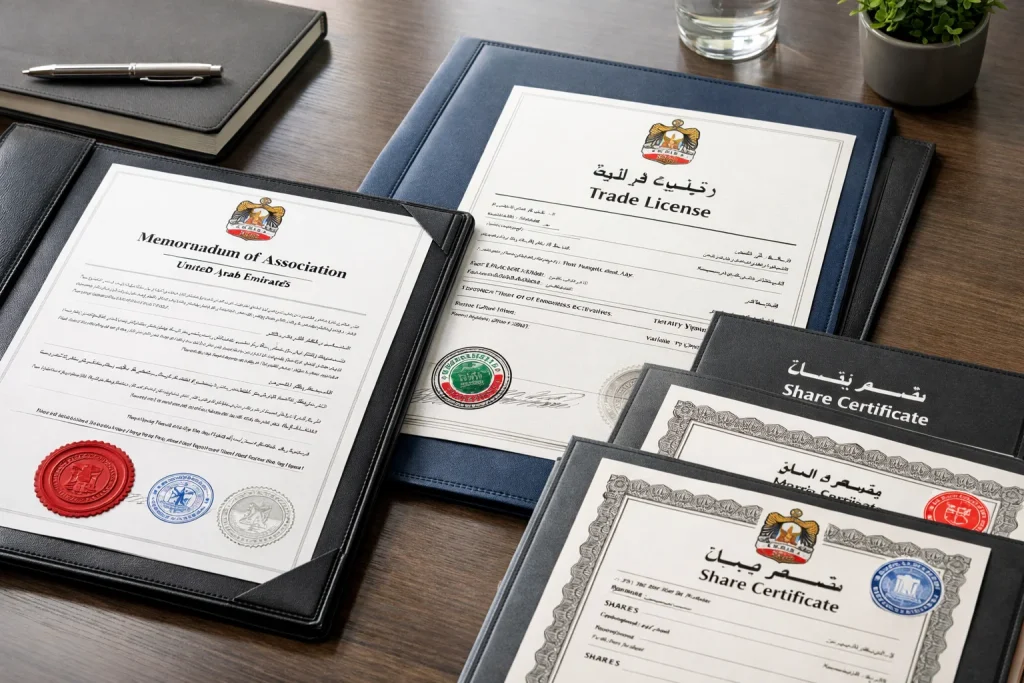
Accurate and complete documentation is the most critical factor for a successful application. Missing or incorrect paperwork is the leading cause of delays and rejections.
Core Mandatory Documents
A valid passport with copies of the information page for all applicants is essential. The passport must typically have a minimum validity of six months. Recent passport-sized photographs with a white background, meeting specific UAE immigration guidelines, are required.
The company's valid, current trade license serves as the primary document proving the business's legal right to operate and sponsor visas. The Memorandum of Association, Articles of Association, or share certificate are indispensable constitutional documents that must clearly list your name as a shareholder and specify your ownership percentage. For mainland limited liability companies, the MOA is a mandatory document. For free zone companies, it may be a similar incorporation document or share certificate issued by the authority.
Duly completed application forms specific to the sponsoring authority—either GDRFA or the Free Zone Authority portal—must be submitted as part of the entry permit application process.
Address and Financial Documentation
Proof of adequate housing for you and your family is required, typically demonstrated through a tenancy contract registered with the emirate's rental system, such as Ejari. For the company, a tenancy contract for its office space is also mandatory and often determines the number of visas the company is eligible to sponsor.
While not always mandatory for the initial visa, bank statements showing the company's active account and, in some cases, your personal financial capability may be requested to establish economic substance and genuine business operations.
Additional Requirements
For educational certificates or documents issued outside the UAE, attestation by the UAE Embassy in the country of issue and the Ministry of Foreign Affairs in the UAE may be required. All residency visa applicants must have valid UAE health insurance coverage before the visa can be processed.
Application Process Step by Step
Have questions about this?
A 10-minute call with Mirza often saves weeks of research. No obligation — ask anything about your situation.
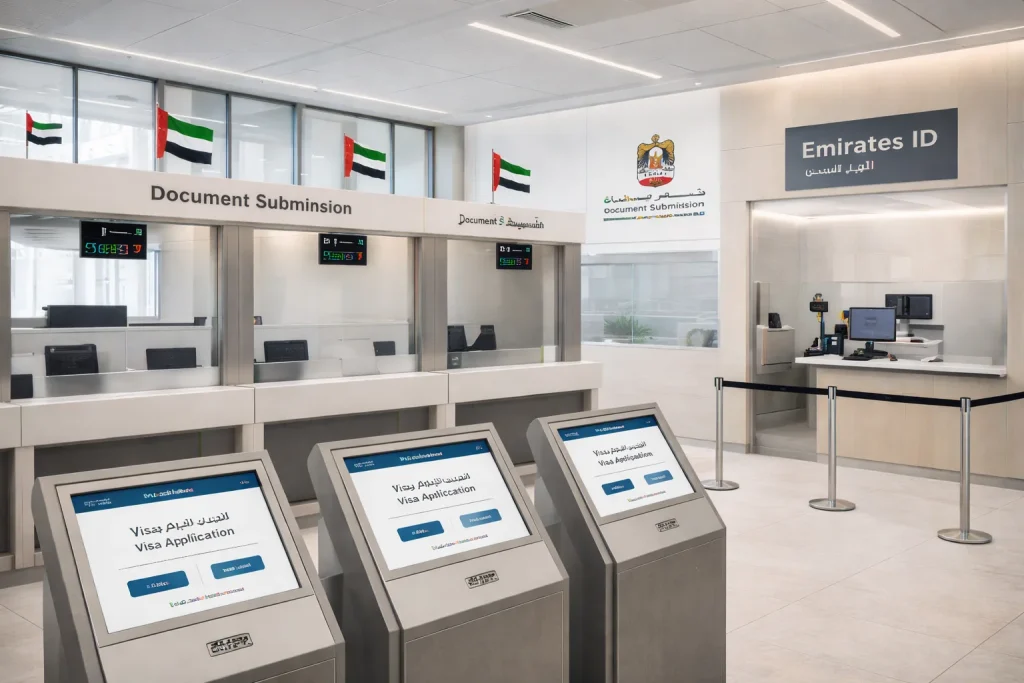
The visa application follows a logical sequence, though processing times can vary between mainland and free zone routes.
Entry Permit or Status Change
The process begins with the sponsoring company applying for your Entry Permit. For those who are outside the UAE, this permit allows you to enter the country specifically for visa processing. For those who are already in the UAE on a different status—such as a tourist visa—the company applies to change your status to a residence visa holder. This step is initiated online via the GDRFA or the relevant Free Zone Authority portal.
Medical Fitness Test
After the entry permit or status change receives approval, you must undergo a mandatory medical test at an approved health centre in the UAE. This includes screening for communicable diseases and is required for all applicants over 18 years of age.
Emirates ID Application
Upon passing the medical test, you apply for the Emirates ID, the official biometric identity card for all UAE residents. This involves visiting a designated typing centre or authorized customer happiness centre for fingerprinting and photograph capture. The Emirates ID serves as your primary identification document within the UAE.
Residency Visa Stamping
The final step is having your UAE residence visa stamped in your passport. If you entered on an entry permit, this is typically done at the airport or a designated immigration centre. Your Emirates ID card will be delivered separately once produced, completing your residency documentation.
Costs and Processing Timelines
Costs vary depending on the emirate, free zone, number of dependents, service charges if using professional assistance, and health insurance premiums.
For the main applicant, total government fees, medical tests, Emirates ID, and basic insurance typically range from approximately AED 3,000 to AED 7,000 for a standard two- or three-year visa. These costs are separate from company setup fees, including trade license fees and office rent. Long-term Golden Residency incurs higher total costs.
With complete documentation, free zones often process visas within approximately 5 to 10 working days, while mainland processing can take 7 to 15 working days. The entire process from entry permit to visa stamping typically takes two to three weeks under normal circumstances.
Family Sponsorship Provisions
A key advantage of the Partner Visa is the ability to sponsor your immediate family members, allowing them to live, study, and potentially work in the UAE.
Spouse and Children Sponsorship
You can sponsor your spouse by providing an attested marriage certificate, translated into Arabic if necessary. Sons can typically be sponsored up to the age of 18, with sponsorship often extendable for sons up to age 21 to 25 if they are enrolled in higher education within the UAE. Unmarried daughters can generally be sponsored indefinitely. Attested birth certificates are required for all child dependents.
General Sponsorship Conditions
The primary visa holder must meet minimum income or accommodation requirements as stipulated by the immigration authority. This usually involves providing a registered tenancy contract for an apartment or villa of sufficient size. All family members over 18 must also pass the medical fitness test and have valid health insurance coverage. For comprehensive guidance on UAE visa and immigration options for families, reviewing multiple pathways helps ensure the best fit for your circumstances.
Renewal Requirements and Ongoing Compliance
Maintaining your Partner Visa is directly tied to maintaining the health and compliance of your underlying business investment.
Company Status Must Remain Valid
Your visa is contingent on the company holding a valid and active trade license. If the company license is cancelled, becomes dormant, or lapses, your residency rights will be jeopardized. The company must remain in good standing, having fulfilled all its regulatory and financial obligations, including audit requirements and office space lease commitments.
Renewal Documentation
Renewal requires updated documents, including a renewed trade license, valid tenancy contract, and current health insurance for all visa holders. The renewal process should begin well before your current visa expires—typically one to two months prior to the expiry date—to avoid overstay fines and complications.
Document Validity Verification
Immigration authorities verify that all core documents remain current and accurate during renewal. This includes confirming that your shareholding status has not changed in ways that would affect eligibility, that the company's constitutional documents remain valid, and that all financial obligations have been met.
Common Application Mistakes to Avoid
Avoiding these frequent errors can save significant time, expense, and stress during the application process.
Choosing the wrong entity type—such as an offshore entity that does not carry the right to sponsor partner visas—is a fundamental error. Submitting a Memorandum of Association or share certificate that does not explicitly name the applicant as a shareholder, or that has discrepancies in name spelling compared to the passport, commonly causes rejections.
Presenting an MOA that is not properly signed by all partners and notarized by the relevant notary public or authority creates processing delays. Renting office space that is too small for the number of visas the company wishes to sponsor, including partner visas, leads to rejected quota applications.
Failing to obtain proper document attestation for certificates issued outside the UAE, or submitting applications without securing mandatory health insurance coverage first, are other common pitfalls that cause unnecessary delays.
When Alternative Visa Routes May Be More Suitable
The Partner Visa is designed for a specific purpose and may not be the optimal path in certain circumstances.
For those who are an employee without ownership stake in the company, you should seek a standard employment visa sponsored by your employer rather than a Partner Visa. For those who are a passive investor with no legal share in a UAE company, you might consider a property investor visa if you meet the real estate investment thresholds, such as AED 750,000 in Dubai for a two-year visa or AED 2 million for Golden Residency.
If you seek residency without any intention of actively managing or overseeing a business, other options such as the remote work visa or retirement visa may be more appropriate for your circumstances and goals.
Strategic Considerations for Partner Visa Applicants
The UAE Partner Visa aligns your residency status directly with your business ambitions, providing independence and control over your entrepreneurial journey in the UAE.
Start by clarifying your business plan. If you intend to serve the local UAE market, a mainland limited liability company may be advantageous due to its unrestricted ability to conduct business throughout the country. If you plan to operate internationally or require 100% foreign ownership with streamlined setup procedures, a free zone company may better suit your needs.
Ensure you are prepared for the commitment of actively managing a company, not just making a financial investment. Partner Visas are designed for individuals who play a genuine role in their business operations, whether through day-to-day management or strategic oversight.
Prioritize getting your corporate documentation absolutely correct. The trade license and Memorandum of Association form the foundation of your application. Any discrepancies, missing signatures, or incorrect shareholder listings can result in rejection or significant delays.
Consider your long-term renewal strategy from the outset. Maintaining valid office space, keeping your trade license current, and ensuring ongoing compliance with UAE business regulations are not one-time requirements but ongoing obligations that directly affect your residency status.
Review Your Partner Visa Qualification
Check whether your shareholding structure, company documents, and ownership position meet typical UAE partner visa requirements before applying.
Conclusion
The UAE Partner Visa provides a powerful mechanism for foreign entrepreneurs and investors to establish residency based on legitimate business ownership. By understanding the shareholding requirements, preparing complete and accurate documentation, and maintaining ongoing compliance with business regulations, you can secure stable residency that supports both your personal life and professional ambitions in the United Arab Emirates.
Success with the Partner Visa depends on three critical factors: selecting the right company structure for your business model, documenting your ownership stake clearly and officially, and maintaining the active status of your business entity throughout your residency period. With careful planning and attention to regulatory requirements, the Partner Visa can provide a reliable foundation for building your business and life in the UAE.
Frequently Asked Questions — UAE Partner Visa
1. Is a UAE Partner Visa the same as an employment visa?
No. An employment visa is sponsored by an employer based on a job contract. A Partner Visa is linked to ownership in a UAE company, meaning your residency is based on your shareholder status rather than employment.
2. Is there an official minimum share percentage required to qualify?
There is no universal federal percentage rule. Authorities generally expect a genuine and documented ownership stake that justifies your role in managing or overseeing the business. Very small passive holdings may be subject to additional scrutiny.
3. Can multiple partners in the same company obtain Partner Visas?
Yes, provided each partner is officially listed in the company’s constitutional documents and the company’s visa quota (often linked to office space) supports additional visas.
4. Can a silent partner apply for a Partner Visa?
It may be possible, but silent partners without a managerial role can face closer review. Authorities may assess whether the investment is substantial and whether the applicant has a legitimate reason to reside in the UAE for business oversight.
5. Does a Partner Visa lead to UAE citizenship?
No. A Partner Visa is a renewable residence permit and does not provide a pathway to UAE citizenship.
6. What happens if the company license is cancelled or becomes inactive?
Since the visa is tied to the company, cancellation or lapse of the trade license can affect the validity of the Partner Visa and may require visa cancellation or status adjustment.
7. Can Partner Visa holders sponsor family members?
Yes, subject to immigration rules. Partners can typically sponsor a spouse and children, provided housing, health insurance, and documentation requirements are met.
8. How early should renewal be started?
Renewal is generally initiated one to two months before visa expiry to avoid overstay penalties and processing delays.
9. Does owning shares in an offshore company qualify?
No. Offshore companies generally do not grant residency sponsorship rights. The entity must be licensed in the mainland or a UAE free zone with visa eligibility.
10. Is health insurance mandatory for Partner Visa issuance?
Yes. Valid UAE health insurance coverage is typically required before visa issuance and renewal.
Sources and official references
Have a question about this?
Leave your details and a UAE expert will get back to you within 1 business day — free, no obligation.
Ready to take action?
Whether you're ready to start or still comparing options — we'll give you a straight answer.
Chat on WhatsApp
Usually replies within 2h
Get a Free Quote
Personalised in 60 seconds
Call Directly
Open daily, 10am–6pm UAE
About the Author
Dubai-based independent advisor on UAE visa, immigration, and offshore structuring. Founder of Henry Club UAE with 90+ published guides. Advisory-first — clarity before commitment.