

I help founders understand their options clearly before they commit to any structure, provider, or direction.
Quick Summary: Off-Plan Property Investment in Dubai
- What it is: Committing capital to a unit that exists only as plans and developer commitments. Payments are staged over a construction period that typically runs three to four years.
- Fund protection: Payments flow through a RERA-approved escrow account. Money reaches the developer only as construction milestones are verified. The purchase is registered via the Dubai Land Department's Oqood system.
- Costs to budget: The 4% DLD transfer fee plus a 15-20% contingency reserve for delays or unforeseen expenses.
- Payment plans: Options include post-handover plans (90/10 or 80/20), milestone-linked plans (60/40 or 50/50), and extended post-completion plans where 20-30% is payable over one to three years after handover.
- Best suited for: Medium-term, capital-growth investors with four to seven-year horizons and higher risk tolerance. Unsuitable for income-dependent buyers, for traders wanting an exit within two to three years, and for low-risk profiles.
- Exit before handover: A pre-completion flip is possible, but most developers require 30-40% or more of the price paid before issuing a No-Objection Certificate to assign the contract.
Quick answer: Off-plan property in Dubai means committing capital to a future asset. That unit exists only as plans and developer commitments. Payments are staged over a construction period that typically runs three to four years. Your funds are protected through a RERA-approved escrow account that releases money only as construction milestones are verified, and your purchase is registered via the Dubai Land Department's Oqood system. It tends to suit medium-term, capital-growth investors comfortable with delay and market risk, but is unsuitable for income-dependent buyers, short-horizon traders and those who need rental income from day one. Budget for the 4% DLD transfer fee and a 15–20% contingency reserve, and treat developer track record as your primary risk filter.
Investing in off-plan property in Dubai represents a distinct approach to real estate investment. It requires understanding structured timelines, staged capital deployment, and the gap between purchase commitment and physical delivery. This framework provides clarity on the core decision pillars, risk factors, and strategic considerations that shape off-plan investment outcomes.
The information presented reflects market conditions and regulatory frameworks accurate as of January 2026. Off-plan investment is neither universally suitable nor unsuitable; its appropriateness depends entirely on your financial profile, timeline, risk tolerance, and investment objectives.
Free tool: check the monthly cost with our Dubai mortgage calculator.
Understanding Off-Plan Investment: What You're Actually Buying

When you invest in off-plan property, you are committing capital to a future asset. It is a residential or commercial unit existing only as architectural plans, projected timelines and contractual commitments from a developer. This is fundamentally different from purchasing a completed property where you can inspect the physical asset, verify its condition, and take immediate ownership.
Off-plan investment is essentially a capital staging exercise. Your funds are deployed in scheduled tranches over a construction period that typically spans three to four years, aligned with development milestones rather than immediate asset acquisition. The core uncertainty lies in the gap between what is promised at purchase and what is ultimately delivered. That gap covers construction delays, market fluctuations during the build, and variations in final build quality against initial representations.
Success in this investment approach is not determined by market trends alone. It requires structured decision-making, rigorous verification of developer credentials, careful contract review, and strategic alignment between the property's delivery timeline and your broader financial planning. The Dubai market offers regulatory safeguards that support investor protection, but these protections function as frameworks for managing risk, not guarantees against it.
Core Decision Pillars: What Drives Investment Outcomes
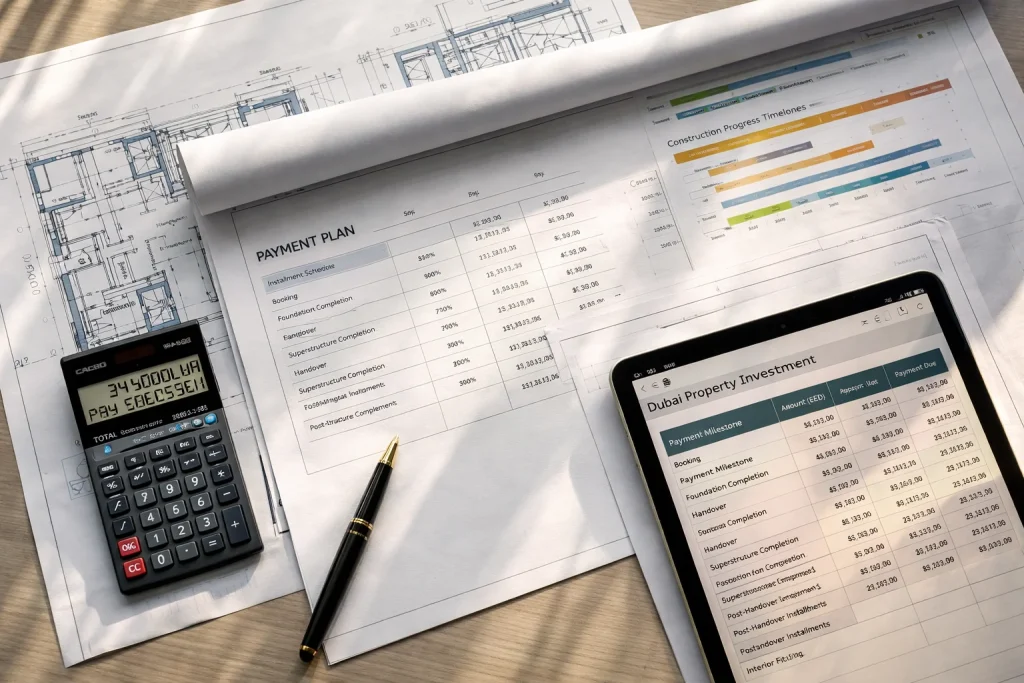
Your off-plan investment decision should rest on evaluating five interconnected pillars. Treating any in isolation—such as focusing solely on payment terms while overlooking developer track record—significantly increases exposure to unfavorable outcomes.
Payment Plan Structures and Cash Flow Management
Payment plans are not merely a financing convenience; they function as a critical cash flow management tool throughout the construction period. The structure of your payment obligations directly impacts your liquidity position, opportunity cost of capital, and financial flexibility during the multi-year holding period.
Common payment structures in the Dubai market include:
- Post-handover plans (often structured as 90/10 or 80/20): These minimise your capital outlay during construction, with the majority of the purchase price due at or shortly after completion. This structure preserves liquidity but may limit availability to specific projects or phases.
- Milestone-linked plans (such as 60/40 or 50/50): Payments are triggered by verified construction progress—foundation completion, structural topping out, MEP installation, and final handover. This aligns your capital deployment with tangible development progress.
- Extended post-completion plans: Some developers defer part of the price, commonly 20-30%, over one to three years after you receive the keys. That gives additional cash flow breathing room.
There is no universally "best" payment plan. The optimal structure depends on your current liquidity position, income stability, competing investment opportunities, and comfort with staged capital lockup. In strong market conditions with high demand, developers typically reduce the availability of favourable post-handover terms, as market dynamics allow them to require earlier payment.
Developer Reliability: Your Primary Risk Filter
Developer selection represents the single most significant non-financial risk factor in off-plan investment. A developer's track record, financial stability, and operational competence serve as your primary hedge against construction delays, project cancellation, specification deviations, and quality deficits.
Effective developer assessment requires verification beyond marketing materials and sales presentations. Essential due diligence steps include:
- Confirming the developer holds a valid license issued by Dubai's Real Estate Regulatory Agency (RERA), which regulates real estate activities in the emirate
- Reviewing their historical delivery record—specifically examining whether previous projects of similar scale and type were completed on schedule and met stated specifications
- Assessing financial stability, often indicated by the scale of their active portfolio, backing from established financial institutions, and transparency in project financing
- Verifying that your payment deposits are protected through a RERA-approved escrow account, which releases funds to the developer only upon verified completion of construction milestones
Dubai law mandates the escrow mechanism for off-plan transactions. It ensures your payments fund actual construction progress, rather than sitting freely available to developers. However, this protection operates within defined parameters and does not eliminate all developer-related risks.
Construction Timeline and Handover Risk
Delays in property completion are a recurring industry reality rather than an exceptional circumstance. Your contractual protections and legal recourse options are therefore fundamental components of risk management, not merely administrative formalities.
The Sales and Purchase Agreement (SPA) serves as your legal foundation. It should clearly specify the scheduled completion date, define construction milestones with precision, and outline remedies and penalties that apply if the developer fails to meet contractual timelines. Dubai's regulatory framework provides mechanisms for addressing undue delays, including filing formal complaints with RERA's dispute resolution channels or pursuing contract cancellation and damages through the emirate's civil court system.
Proactive monitoring of construction progress—through site visits, milestone verification, and regular communication with the developer—represents a fundamental investor responsibility rather than optional oversight. When projects experience delays, early awareness allows you to assess your options and make informed decisions about continuing, seeking remedies, or potentially exiting the investment if contractual exit clauses exist.
Pre-Completion Exit Strategy and Resale Options
Off-plan investment does not necessarily result in complete illiquidity until handover. Many investors employ a "pre-completion flip" strategy, where they sell their purchase contract during the construction period to capture early capital appreciation without taking ownership of the completed unit.
However, this exit route is governed by developer-specific policies and contractual restrictions. Most developers require that a substantial portion of the purchase price—commonly 30-40% or more—has been paid first. Only then will they issue a No-Objection Certificate (NOC) permitting assignment to a new buyer. Additionally, some developers impose transfer fees or restrict resale rights until certain construction milestones are achieved.
The viability of a pre-completion exit is highly sensitive to market conditions at the time you wish to sell. In strong markets with rising prices, this strategy can generate attractive returns. In softening markets, you may face limited buyer interest or need to price below your total invested capital to complete a sale. This exit strategy should be incorporated into your initial investment thesis, not treated as an improvised response to changing circumstances.
Off-Plan Versus Ready Property: Strategic Positioning
Choosing between off-plan and ready property represents a fundamental strategic decision between two different asset profiles with distinct risk-return characteristics:
Off-plan properties typically offer lower entry prices against market comparables, plus staged capital deployment. There is also scope for appreciation during construction, as the market develops and the property becomes a physical asset. This approach suits investors with medium-term horizons (typically four to seven years), higher risk tolerance, and a focus on capital growth rather than immediate income. Market data from early 2025 indicated divergence in the luxury segment. Sales of completed prime properties surged while off-plan luxury volumes moderated. Some high-net-worth investors appear to prioritise certainty for substantial deployments.
Ready properties command premium pricing but deliver immediate legal ownership, rental income generation from day one, and certainty regarding the asset's physical condition and location attributes. This profile suits investors seeking stable cash flow, those with lower tolerance for construction and market uncertainty, or buyers who need immediate occupancy or rental returns to service financing obligations.
Sophisticated investors often deliberately structure portfolios that blend both off-plan and ready assets, balancing capital growth potential against income stability and risk diversification. Your choice depends on your specific financial situation, timeline, and strategic objectives rather than a universal "better" option. For broader context on Dubai real estate investment approaches, considering both ready and off-plan markets provides strategic perspective.
Investor Profiles: When Off-Plan Investment Aligns
Off-plan investment tends to align effectively with specific investor characteristics and objectives:
Medium-term capital growth focus: Investors with four to seven-year investment horizons who prioritise building equity through market appreciation and the off-plan to completion transition, rather than requiring immediate rental income.
Capital staging preference: Individuals who prefer deploying capital in scheduled tranches rather than single lump-sum commitments, aligning property payments with business cash flows, salary cycles, or maturity of other investments.
Higher risk-adjusted return seekers: Those who accept the uncertainties of construction delay and market movement during the build. They pursue potentially higher returns than the ready market typically offers.
Non-yield-dependent buyers: Investors measuring success by long-term capital accumulation rather than immediate rental income. They can stay financially stable through construction without relying on property income.
For investors considering how off-plan property might align with broader residency objectives, understanding the Dubai property Golden Visa pathway can provide additional strategic context.
When Off-Plan Investment Is Unsuitable
Have questions about this?
A 10-minute call with Mirza often saves weeks of research. No obligation — ask anything about your situation.
Off-plan investment represents an inappropriate vehicle for certain investor profiles, regardless of market conditions or specific project attributes:
Income-dependent buyers: Individuals who need immediate rental income from the property to service loan payments, cover living expenses, or meet other financial obligations. The construction period generates no income while requiring continued capital outlay.
Short-horizon traders: Investors seeking quick exits within two to three years face significant challenges, as construction timelines and resale restrictions create substantial illiquidity during the early project phases.
Low risk tolerance profiles: Those who experience significant stress from uncertainty, potential timeline extensions, or market volatility should consider ready properties, which offer more predictable outcomes and immediate asset control.
First-time buyers without professional advisory: Those new to property investment, approaching off-plan without conflict-free professional guidance, face disproportionate risk. Contracts, developer assessment and market timing all require experience.
Structuring Your Off-Plan Investment Approach
A disciplined off-plan investment strategy typically follows this structured sequence:
Budget planning with contingency: Define total available capital across every payment stage. That means the initial deposit, milestone payments, the Dubai Land Department transfer fee of 4%, and related transaction costs. Hold a minimum 15-20% contingency for delays or unforeseen expenses.
Area selection with growth thesis: Choose locations on infrastructure pipelines, such as those in Dubai's long-term master plans. Then weigh demonstrated demand patterns, community maturity, and fit with your target tenant or buyer. Different areas serve distinct market segments—luxury, yield-focused, or affordable growth segments—each with different risk and return characteristics.
Developer assessment as primary filter: Shortlist projects only from developers with proven on-time delivery. That record should cover several projects of similar scope and scale in your target location. Developer reliability should function as a mandatory threshold criterion, not a negotiable factor.
Timeline alignment verification: Ensure the construction schedule and handover date align with your broader financial planning and life circumstances. A three-year project that delivers keys precisely when you need liquidity for other commitments represents a strategic misalignment that creates unnecessary pressure.
Financial structuring for property investment often intersects with broader banking relationships. Understanding business banking options in Dubai can support comprehensive financial planning around property commitments.
The Advisory Framework: Professional Guidance as Risk Management

Working through the decision pillars above is fundamentally an advisory-led process rather than a transactional one. For the transaction itself, our guide to how to buy off-plan property in Dubai walks the seven steps from reservation to handover. Professional guidance plays a critical role in several areas:
Legal structure and contract scrutiny: Interpreting the Sales and Purchase Agreement to clearly understand your rights regarding delays, specification compliance, quality standards, and developer default scenarios. Contract terms are often complex and contain conditions that significantly impact your position.
Holistic financial planning: Integrating staged property payment obligations with your broader investment portfolio, cash flow requirements, currency exposure management, and tax planning considerations across your resident and non-resident jurisdictions.
Exit strategy formulation: Developing realistic scenarios for both pre-completion and post-completion exits, based on contractual clauses, current market conditions, and your specific investment objectives and constraints.
Due diligence execution: Verify developer credentials and confirm project registration with the Dubai Land Department's Oqood system, which registers off-plan properties and buyer rights. Then validate the escrow account and review construction progress against stated timelines.
An effective advisor functions as your strategic risk manager, providing objective analysis of opportunities and pitfalls while maintaining independence from sales incentives. For comprehensive support across the investment structuring process, exploring specialised real estate advisory services can provide the strategic partnership this investment approach requires.
Regulatory Framework: Protection Within Parameters
Dubai's regulatory environment provides structural investor protections through several mechanisms:
The mandatory escrow system is overseen by RERA-approved trustees. Developer access to investor funds is tied to verified construction milestones, not freely available before delivery.
Registration of off-plan properties through the Dubai Land Department's Oqood system creates an official record of your purchase rights and provides a framework for dispute resolution if conflicts arise.
RERA's regulatory oversight of developers, including licensing requirements and complaint resolution mechanisms, establishes baseline standards for market participants.
These protections establish a framework for managing investment risk but do not eliminate it. Market fluctuations, construction delays within contractually permitted timeframes, and variations in final specifications can still impact investment outcomes despite regulatory safeguards being in place. The regulatory environment supports informed decision-making but does not guarantee specific investment results.
What the escrow law actually says
The protection above is not custom. It sits in Law No. 8 of 2007 on escrow accounts for real estate development, and the detail is worth knowing before you sign.
The developer must be registered. Article 4 is blunt. No developer may carry on the business unless recorded in the Register of Real Estate Developers and licensed. Ask for the registration, and check the project is registered too.
The account is ring-fenced to your project. It is opened by written agreement between developer and escrow agent under Article 7. Article 9 dedicates it exclusively to construction of that development. Money cannot be moved to another project, or paid out as profit.
Five per cent is held back after completion. This is the provision buyers rarely hear about. Article 14 requires it. Once the completion certificate is issued, the escrow agent must retain 5% of the account total. It is released to the developer one year after units are registered in purchasers' names. In practice it works as a defects retention. That makes the first year after handover the moment to raise snagging properly.
The penalties are criminal, not just civil. Articles 16 and 17 provide for a jail sentence and a fine of at least AED 100,000, or either. A developer can also be struck from the register for bankruptcy, for delaying construction, or for having its license revoked.
None of this protects you from a project completing late within its contractual window, or from the market moving. It protects your money from being spent on something else.
Verified against Law No. 8 of 2007 on the Dubai Legislation Portal and RERA on 12 August 2026.
What buyers get wrong
Four beliefs that cost people money, and what is actually the case.
“The developer is well known, so the money is safe.”
Reputation is not the protection. The escrow account is. Payments belong in the project escrow account held under Law No. 8 of 2007, not in a developer's general account and not in cash. Ask which account your instalment is going to, and check the project itself is registered, not just the developer. A payment made outside escrow sits outside the protection described above.
“Snagging can wait until I move in properly.”
It cannot wait long. Article 14 makes the escrow agent hold back 5% of the account after the completion certificate. It is released to the developer a year after units register to purchasers. That year is your leverage. Defects raised inside it are raised while money is still held. Raised afterwards, they are a request rather than a claim.
“Handover is scheduled for Q3, so I will have it in Q3.”
Read what your own contract permits. Most sale agreements allow the developer a grace period beyond the anticipated date, and the length varies by contract. The date in the brochure is a projection. The date that matters is the one your agreement makes enforceable. So is the remedy it gives you if that passes.
“Costs stop once I have paid the final instalment.”
They start. From handover you are an owner in a jointly owned building. That means an annual service charge, approved by RERA and calculated from your unit area. Budget for it in the first year, not the second.
Escrow and retention provisions verified against Law No. 8 of 2007 on the Dubai Legislation Portal, 12 August 2026. Contract terms vary by developer. The grace period point is a prompt to read your own agreement, not a statement of what it says.
Moving Forward: Structured Evaluation Before Commitment
This framework has outlined the systematic approach required for off-plan property investment—a process of calculated risk management through rigorous evaluation rather than speculative opportunity-seeking. The Dubai market offers a regulated platform with established protections. Outcomes still depend on your preparation, the depth of your due diligence, and the fit with your broader financial position.
Your next step is not toward making a deposit, but toward structured evaluation. Use this framework to audit your financial readiness, prepare informed questions for developers and advisors, and assess whether this investment approach aligns with your risk tolerance, timeline, and objectives. The difference between a successful investment and an expensive learning experience lies in the thoroughness of your preparation before you commit capital.
Requesting a Consultation
For investors ready to begin with professional support, a consultation is the starting point. It gives structured analysis of your situation and objectives against current market opportunities.
One practical step before signing. Model the payment plan against what a mortgage would cost on a completed unit. The comparison often changes which option looks better. To review a project with someone who has watched that developer deliver, arrange a consultation.
Frequently Asked Questions
What does buying off-plan property in Dubai actually mean?
You are committing capital to a future asset that exists only as architectural plans, projected timelines and contractual promises from a developer. Unlike a completed home you can inspect, your funds are deployed in scheduled tranches over a construction period that usually runs three to four years, tied to development milestones. The core uncertainty sits in the gap between what is promised at purchase and what is finally delivered, covering possible delays, market shifts and build-quality variations.
How long does an off-plan project in Dubai take to complete?
Construction typically spans three to four years, with your payments released against development milestones rather than at a single point. Delays beyond the scheduled handover date are a recurring industry reality, not an exception, so the completion date in your Sales and Purchase Agreement matters. Treat the timeline as part of your wider financial planning: a project that hands over keys exactly when you need liquidity elsewhere creates avoidable pressure, so verify alignment before committing.
What payment plans are available for off-plan property in Dubai?
Common structures include post-handover plans such as 90/10 or 80/20, which keep your construction-period outlay low with most of the price due near completion. Milestone-linked plans like 60/40 or 50/50 trigger payments as construction progresses, from foundation to handover. Some developers also offer extended post-completion plans where 20 to 30 percent is payable over one to three years after you get the keys. There is no single best plan; it depends on your liquidity and income stability.
Can I sell my off-plan property before it is completed?
Yes, many investors use a pre-completion flip, selling the purchase contract during construction to capture early appreciation without taking ownership. The route is governed by developer policy. Most require a substantial share of the price paid first, commonly 30 to 40 percent or more, before issuing a No-Objection Certificate to assign the contract. Some also apply transfer fees or milestone restrictions. Returns depend heavily on market conditions when you sell; in softening markets buyer interest can be limited.
How are my payments protected when buying off-plan in Dubai?
Dubai law requires off-plan payments to flow through a RERA-approved escrow account. It releases funds only as construction milestones are verified, so your money funds actual progress. The developer must also hold a valid RERA license, and the purchase is registered through the Dubai Land Department's Oqood system, which records your buyer rights. These frameworks manage risk but do not eliminate it, so due diligence still matters.
Is off-plan or ready property the better choice in Dubai?
Neither is universally better; they are different risk-return profiles. Off-plan usually carries lower entry prices, staged payments and capital-growth potential, suiting medium-term horizons of four to seven years and higher risk tolerance. Ready property costs a premium but gives immediate ownership, rental income from day one and certainty on condition and location, suiting income-focused or lower-risk buyers. Early-2025 data showed completed prime sales surging while off-plan luxury volumes moderated. Many investors blend both to balance growth and income.
Who should avoid off-plan property investment in Dubai?
It is unsuitable for income-dependent buyers who need rent to service loans or living costs, since the construction period produces no income while still requiring outlay. Short-horizon traders wanting an exit within two to three years face illiquidity from build timelines and resale restrictions. Those with low risk tolerance are better served by ready property. First-time buyers without conflict-free advice face disproportionate exposure, given the complexity of contracts and developer assessment.
Disclaimer
Off-plan purchase carries risks that no guide removes, including completion delay and variation in final specification. Nothing here is a forecast of price or yield, and nothing here is legal or investment advice. Escrow and retention provisions are quoted from Dubai law as at the date shown, and contract terms vary by developer. Read your own sale agreement and take advice on it. HenryClub is an advisory firm and is not a licensed real estate brokerage. We do not list or sell property. Where a transaction proceeds, it is executed through a RERA-registered broker, disclosed to you beforehand.
Sources and official references
For verifying developer licensing, escrow protection, ownership registration and residency pathways referenced on this page, consult the official UAE authorities below.
- Dubai Land Department (DLD) - official property transactions, RERA developer licensing, mandatory escrow accounts, the Oqood off-plan registration system and the 4% transfer fee referenced throughout this page
- UAE Government Portal - overview of property ownership rules and how a Dubai property investment can support residency and Golden Visa eligibility
- Federal Authority for Identity & Citizenship (ICP) - golden visa and residency eligibility criteria relevant to investors weighing off-plan property against residency objectives
- Dubai Legislation Portal - Law No. 8 of 2007 concerning escrow accounts for real estate development, including Articles 4, 7, 9, 14, 16 and 17
Which developers we'd buy from — and which we wouldn't.
Send us what you want to spend and what you want the property to do — rental income, a Golden Visa, somewhere to live. You get back a shortlist of the areas, buildings and unit types that fit, the approved service charge on each, and the ones we would avoid. Within one business day, free.
Get my property shortlistWe hold no listings and take no commission on a sale. That is why we can tell you when a deal does not stack up. When you are ready to transact, we introduce you to a RERA-licensed partner.
About the Author
Dubai-based independent advisor on UAE visa, immigration, and offshore structuring. Founder of Henry Club UAE with 90+ published guides. Advisory-first — clarity before commitment.