

I help founders understand their options clearly before they commit to any structure, provider, or direction.
Welcome to your central navigation point for commercial property in Dubai. This hub is designed for founders, investors, and businesses actively planning their operational footprint in one of the world's most dynamic markets.
For those who are an entrepreneur relocating a business, an SME seeking a strategic office, an investor evaluating warehouse assets, or a company comparing mainland and free zone options, you are in the right place. A "commercial property" search in Dubai fundamentally involves aligning a physical space with your business license, operational needs, and growth strategy. A critical first decision is understanding the commercial lease versus purchase dynamic: leasing offers flexibility and lower capital outlay, while buying is a long-term asset play often suited to stable, expanding operations.
Key Takeaways for 2026
Strategy Dictates Location: Your choice between a Mainland or Free Zone license is the primary driver for where you can and should locate your business, affecting everything from market access to office requirements.
Demand is Focused: Current investor and occupier demand is strongest for Grade A offices, modern logistics warehouses, and community-centric retail, driven by business expansion, e-commerce, and population growth.
Leasing is Regulated & Transparent: All commercial leases must be registered via the Ejari system under RERA. Rent increases are governed by the Smart Rental Index, with appropriate advance notice required.
Due Diligence is Non-Negotiable: Beyond location, successful leasing requires understanding fit-out obligations, service charges, maintenance responsibilities, and ensuring the property's zoning aligns with your licensed activity.
The "Correct" Property is Functional: The best commercial asset is one that enables your business operations—prioritize functional layout, connectivity, and compliance over aesthetics alone.

Quick Navigation: Choose Your Path
- I need an office for licensing / visa / staff location. Proceed to our detailed guide on office leasing, which breaks down space calculations, free zone vs. mainland office mandates, and visa eligibility links.
- I need a warehouse / logistics base. Proceed to our warehouse investment and leasing guide, covering key zones like Jebel Ali and Dubai South, specifications for modern logistics, and automation trends.
- I'm comparing free zone vs mainland locations. This is your first strategic decision. The section below and our dedicated comparison guide detail the trade-offs in market access, ownership, cost, and flexibility.
- I want to understand leasing contracts and fit-out obligations. Proceed to our commercial lease deep-dive, explaining standard terms, RERA clauses, and how to negotiate capex and fit-out responsibilities.
- I want to buy commercial property for long-term holding. Proceed to our investment analysis guide, covering yield expectations, tenant covenant strength, and management complexity compared to residential assets.
- I want to shortlist zones based on business activity. Use the "Where Businesses Usually Lease" section below as a starting point, then proceed to our area profiles for sector-specific clusters.
Commercial Property Types in Dubai: A Simple Breakdown
Offices: Ranging from flexible desks in free zones to full floors in Grade A towers. Demand is for quality spaces with smart infrastructure and transit links.
Suitability: All business services.
Risk: Choosing a building with poor management or inadequate specifications for your team.
Warehouses / Industrial Units: Evolving from basic storage to automated, high-spec logistics hubs. Critical features include clear height, truck access, and power capacity.
Suitability: Logistics, e-commerce, manufacturing, storage.
Risk: Leasing an obsolete facility or one in a location disconnected from transport corridors.
Retail Shop Units: Shift towards daily-needs community retail over large malls. Footfall depends on surrounding residential density and accessibility.
Suitability: F&B, clinics, services, convenience retail.
Risk: Choosing a location with poor catchment population or visibility.
Mixed-Use Commercial Units: Combine uses (e.g., office with ground-floor retail). Offers operational synergy but requires clear zoning approval.
Suitability: Businesses wanting an integrated customer and operational presence.
Risk: Regulatory complexity if uses are not properly permitted.
Beyond location and rent, operators must consider licensing rules, Ejari registration, and visa capacity. This operator-focused Dubai office leasing guide breaks down the practical side of choosing workspace.
Where Businesses Usually Lease in Dubai: A Zones Overview
Your location is a function of your license type and operational logistics.
Proximity to Clients (CBD & Mainland Hubs)
For mainland companies serving the local market, established districts like Business Bay, Downtown Dubai, and Barsha Heights offer central access. Newer communities like Jumeirah Village Circle (JVC) are emerging with dedicated commercial stock.
Logistics & Industrial Access
Warehouse demand clusters around infrastructure. Key hubs include:
- Jebel Ali Free Zone (JAFZA): A premier logistics hub directly connected to Jebel Ali Port.
- Dubai South: Strategically located near Al Maktoum International Airport.
- Dubai Industrial City & Al Quoz: Major industrial areas benefiting from decentralization and highway access.
Free Zone Alignment
If you hold a free zone license, you must lease premises within that specific zone (e.g., a DMCC company leases in Jumeirah Lakes Towers). Each zone caters to specific industries.
Compliance Constraints
A mainland trade license typically requires a physical office space, while many free zones offer flexible options from virtual offices to fitted space. Your licensed activity must match the property's approved use. Professional business setup advisors can help ensure compliance alignment.
Leasing Strategy: What Investors and Operators Must Understand
Lease Terms & Renewal Risk: Commercial leases commonly run for one to three years. Understand the renewal process and the landlord's right to increase rent as per the RERA Smart Rental Index. Vacancy risk can be higher for highly customized spaces.
Fit-Out Costs Concept: A "shell and core" unit requires a full tenant fit-out. Negotiate who pays—landlords may contribute a fit-out allowance for strong tenants. You are typically responsible for returning the unit to its original state at lease end.
Service Charges Concept: These are separate annual fees for building maintenance, common area cooling, and security. Always review historical service charge statements before leasing.
Payment Structure: Rent is typically paid via post-dated cheques. The number of cheques per year can vary based on negotiation. A security deposit is standard practice.
Compliance Requirements: Ensure the property has a valid Occupancy Certificate and that your business activity is permitted. You are responsible for obtaining any necessary civil defense or other operational approvals.
Buying vs. Leasing Commercial Property
Have questions about this?
A 10-minute call with Mirza often saves weeks of research. No obligation — ask anything about your situation.
| Factor | Buying Commercial Property | Leasing Commercial Property |
|---|---|---|
| Cost & Flexibility | High upfront capital requirement (purchase price + DLD fees). Illiquid asset. | Lower initial capital. High operational flexibility to relocate or expand. |
| Timeline | Lengthy process for due diligence, transfer, and registration. | Faster occupancy, especially in fitted or serviced spaces. |
| Risk & Control | Bears full market and vacancy risk. Full control over the asset and its improvement. | Limited control over the asset. Exposed to rental increases at renewal. |
| Suitability | Long-term investors, owner-occupiers with stable space needs, those seeking asset appreciation. | Startups, growing businesses, companies testing the market, or those prioritizing cash flow. |
| Best Use Case | A strategic long-term hold in a high-growth location for a stable business. | Securing operational space aligned with a current business plan without major capital deployment. |
Risk & Compliance Notes
Unlicensed Brokers: Only engage with RERA-licensed real estate brokers. Verify their license number on the official RERA portal.
Contract Issues: Never sign a lease not registered in Ejari. An unregistered contract is unenforceable at the Rental Disputes Center. Ensure all verbal agreements are written into the contract.
Hidden Costs: Budget beyond the base rent for service charges, utilities, fit-out, and potential reinstatement costs at lease end.
Activity-Location Mismatch: The most common error is leasing a space in the wrong zone for your license type. Confirm with your licensing authority (DED or Free Zone) before committing.
Avoiding Scams: Be cautious of any promised rental yields or pressure to sign quickly. Conduct independent due diligence on the property, landlord, and market rates.
Recommended Next Reads
- The Full Commercial Property Guide: An exhaustive manual covering advanced lease negotiations, financial modeling for purchases, sector-by-sector analysis, and detailed case studies.
- Dubai Real Estate Services: An overview of professional advisory services, including commercial brokerage, buyer representation, due diligence checks, and property management support.
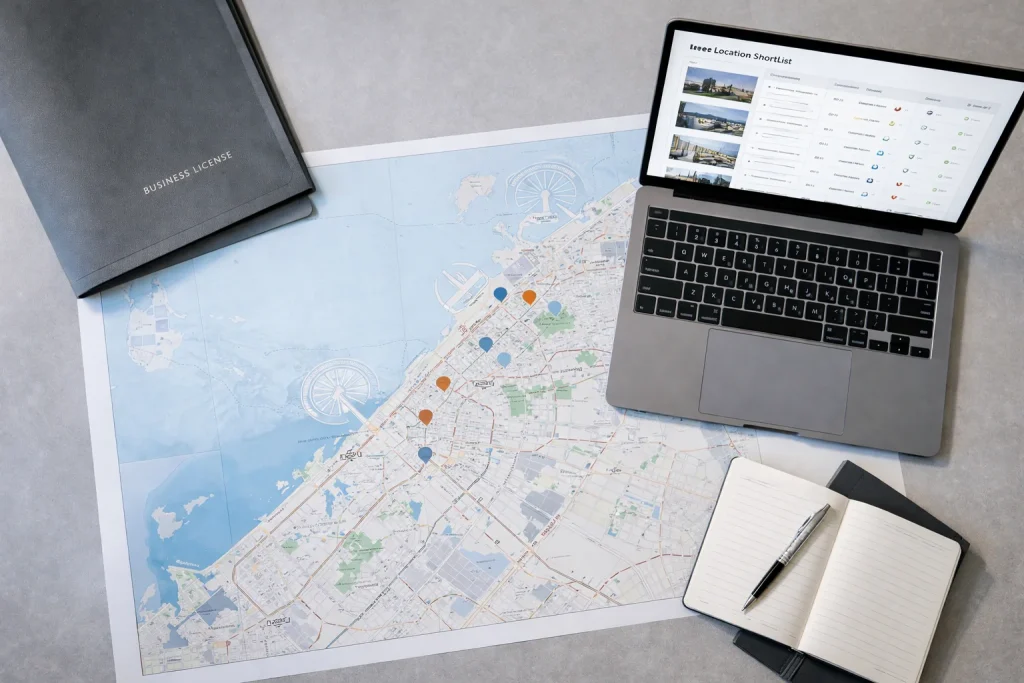
Next Step: Request a Strategic Location Shortlist
Navigating zones, regulations, and market availability requires expert insight. Our advisory shortlist service begins with a review of your business license (or intended activity), headcount, growth projections, and operational non-negotiables. You will receive a curated, actionable shortlist of zones and property types that align with your commercial and compliance objectives.
For transaction execution, we work with trusted, licensed partners including RERA-certified commercial brokers and registered property consultants.
Contact our Advisory Team.
To request your strategic location shortlist, please contact our advisory team.

Investor & Operator Notes
In 2026, quality and functionality trump sheer size. A well-located, efficient space often outperforms a poorly connected larger unit.
For free zone companies, your office square meterage directly dictates your visa quota. Plan headcount growth against space requirements.
The Smart Rental Index is publicly accessible. Use it to verify the fairness of proposed rent increases during renewal negotiations.
Maintenance responsibilities are legally defined: landlords handle structural issues, while tenants typically cover internal maintenance and repairs.
In warehouse leasing, features like clear height, cross-docking, and three-phase power are now standard requirements, not luxuries.
When buying, conduct an engineering audit separate from the valuation. Factor in potential capital expenditures for building upgrades or sustainability retrofits.
Exit strategy is part of the entry decision. Understand the typical buyer pool or tenant profile for your asset type to gauge future liquidity.
Frequently Asked Questions
1) Can a business lease commercial property in Dubai before finalizing the license?
Yes, in many cases you can shortlist and negotiate first, but you should confirm your intended activity and license route early. Some landlords, zones, or approvals may require proof of licensing or an initial license step before final contract registration.
2) Is Ejari mandatory for commercial leases in Dubai?
In most common mainland leasing scenarios, leases are expected to be registered under Ejari (RERA system). Registration requirements can vary depending on property type, authority, and licensing route, so confirm the exact registration requirement before signing.
3) How do I choose between mainland and free zone for commercial space?
Start with your business model. Mainland is often better for direct local market access and broader operating flexibility. Free zones are often preferred for specific industry ecosystems, simplified setups, and zone-based benefits—but your premises generally need to be within the chosen free zone.
4) What is the biggest mistake businesses make when leasing an office in Dubai?
Leasing a space that does not match licensing requirements or operational approvals (activity-location mismatch). Always confirm that the building and unit allow your activity type before committing.
5) What costs should I budget beyond base rent?
Typical add-ons include security deposit, agency fees (if applicable), service charges (building/common area), DEWA or utilities, fit-out costs, signage approvals, and potential reinstatement costs at lease end.
6) What is “shell and core” vs fitted office space?
Shell and core means the unit is unfinished and requires full fit-out (partitioning, ceilings, flooring, MEP work). Fitted offices are ready or semi-ready, which usually reduces setup time but may cost more.
7) Are warehouses in Dubai suitable for e-commerce and logistics companies?
Yes—Dubai has strong logistics infrastructure and multiple industrial zones. The key is choosing warehouse specs that match your operational needs (clear height, loading docks, power capacity, truck access) and ensuring the unit’s approved use matches your activity.
8) Can commercial property location impact visa quota or staffing capacity?
Yes, in many setups—especially free zones—office size and facility type can influence visa eligibility or quota. Always plan headcount growth against workspace requirements and confirm the rules with the licensing authority.
9) Is it better to buy or lease commercial property in Dubai?
It depends. Leasing is usually better for flexibility and lower upfront capital. Buying can be suitable for stable operations or long-term investors, but carries higher capital commitment and vacancy/market risk.
10) Can Henry Club help shortlist the right commercial zones for my business?
Yes. We support founders and investors by shortlisting compliant locations aligned with licensing route, business activity, and operational needs—then coordinate execution through trusted, licensed partners.
Advisory Disclaimer
This hub page is for informational purposes only and does not constitute legal, financial, or real estate advice. Regulations, market conditions, and free zone policies are subject to change. You must verify all information regarding licensing, zoning, and contracts with the relevant authorities (DED, RERA, Free Zone Authority) and seek independent professional counsel before making any commitment. We do not guarantee outcomes, returns, or visa approvals.
Sources and official references
For licensing, registration and ownership rules behind commercial leasing and buying in Dubai, check these official bodies directly.
- Dubai Land Department (DLD) - the authority behind RERA, Ejari lease registration, the Smart Rental Index, broker licensing and DLD transfer fees referenced throughout this page.
- UAE Government Portal - overview of commercial and property ownership rules, including how leasing and buying intersect with business setup and residency.
- GDRFA Dubai - the Dubai residency-visa authority for confirming how office space and facility type feed into staff visa eligibility and quotas.
Ready to take action?
Whether you're ready to start or still comparing options — we'll give you a straight answer.
Chat on WhatsApp
Usually replies within 2h
Get a Free Quote
Personalised in 60 seconds
Call Directly
Sat–Thu, 9am–7pm UAE
About the Author
Dubai-based independent advisor on UAE visa, immigration, and offshore structuring. Founder of Henry Club UAE with 90+ published guides. Advisory-first — clarity before commitment.