

I help founders understand their options clearly before they commit to any structure, provider, or direction.
Quick Summary: Commercial Property in Dubai
- Start with your license, not the unit: Your Mainland (DED) or Free Zone license legally dictates where you can operate. A Mainland office must sit in a commercially zoned building; a Free Zone business must operate within that zone's boundaries, such as a DMCC company in Jumeirah Lakes Towers.
- Property types: Offices come as serviced, fitted, or shell & core; warehouses range from traditional stock to modern logistics hubs (clear heights commonly 10-12 metres) and last-mile delivery centres.
- Leasing is a regulated framework: All commercial leases must be registered in the Ejari system, and renewal rent increases are governed by the RERA Rental Index. An unregistered lease leaves no recourse at the Rental Disputes Centre.
- Budget beyond base rent: Account for security deposit, broker commission, annual service charges, utilities and cooling, plus fit-out and reinstatement costs at lease end.
- Buy vs lease: Buying carries the 4% DLD transfer fee and full market/vacancy risk; leasing needs lower upfront capital and suits startups and growing businesses.
- Free zone office size sets your visa quota: Leased square meterage directly dictates the visa quota, so plan space with future headcount in mind.
Quick answer: Choosing commercial property in Dubai starts not with the unit but with your business license. Whether you hold a Mainland (DED) or Free Zone license legally dictates where you can operate. All commercial leases must be registered through the Ejari system, with rent increases governed by the RERA Rental Index. Budget for service charges, fit-out and reinstatement on top of base rent. Whether you buy or lease, verify zoning, landlord credibility and every cost clause through proper due diligence before you sign.
Navigating Dubai's commercial real estate market is a critical step for any business entering or expanding within the UAE. The sections below cover options for founders relocating their operations, SMEs scaling their teams, logistics and e-commerce operators securing distribution hubs, and investors evaluating tangible industrial assets. The decision you make goes beyond mere square footage; it directly impacts your operational efficiency, regulatory compliance, and long-term financial health. Here, we provide the clarity and strategic framework needed to make an informed, confident choice in a dynamic market.
Key Takeaway Summary
License Dictates Location: Your first decision is not the property, but your business license—Mainland or Free Zone. This legally determines where you can operate and fundamentally shapes your property search.
Demand Defines Opportunity: The strongest market segments are Grade A offices in prime districts and modern, high-specification logistics warehouses, driven by corporate expansion and e-commerce growth.
Leasing is a Regulated Framework: All commercial leases must be registered via the Ejari system, with rent increases governed by the RERA Rental Index. Understanding standard terms, fit-out obligations, and service charges is non-negotiable.
Due Diligence is Your Best Investment: Verify a property's zoning, the landlord's credibility and all cost clauses before signing. That is the single most effective way to mitigate risk and avoid costly mistakes.
Function Trumps Aesthetics: Especially for industrial and warehouse assets, prioritize functional specifications like clear height, power capacity, and truck access over superficial appearances.

Commercial Property Options in Dubai: An Overview
Offices
Serviced Offices: Fully furnished, managed spaces with shared amenities and flexible terms. Ideal for market entry, small teams, or project-based work.
Fitted Offices: Semi-finished units with basic partitions, lighting, and AC. Balances customization with faster move-in times.
Shell & Core Offices: Empty concrete spaces requiring full tenant fit-out. Offers maximum branding and layout control but involves significant upfront capital and time.
Suitability & Risk: Serviced and fitted offices suit agile businesses. Shell & core is for established companies with specific needs. The primary risk is underestimating fit-out costs and timelines or choosing a building with poor management, affecting staff retention.
Warehouses & Industrial Units
Traditional Warehouses: Older stock, often with lower clear heights and basic specifications. Suitable for storage with less frequent movement.
Modern Logistics Hubs: Designed for supply chain efficiency, featuring high clear heights (commonly 10-12 metres or more), cross-docking, ample trailer parking, and three-phase power. The standard for e-commerce and distribution.
Last-Mile Delivery Centres: Smaller units within urban areas for final-stage delivery. Focus on city access over large footprint.
Suitability & Risk: Modern logistics hubs are essential for efficient operations. The key risk is leasing a functionally obsolete facility or one in a location with poor highway or port connectivity, which erodes operational savings.
Retail Commercial Units
This category serves businesses requiring direct customer footfall, from showrooms to clinics and community retail. Success hinges on catchment area density, visibility, and accessibility. The major risk is selecting a location based on low rent alone, without analysing actual pedestrian or vehicular traffic patterns relevant to your customer base.
The First Strategic Decision: License Alignment
Before viewing a single property, you must resolve your business licensing structure, as it legally restricts your location options.
Mainland (DED) License: Allows you to trade directly anywhere in the UAE and bid on government contracts. It requires a physical office lease for company setup and visa sponsorship. Your office must be in a commercially zoned building.
Free Zone License: Provides 100% foreign ownership, tax benefits, and simplified setup. However, your business must physically operate within the geographical boundaries of that specific free zone (e.g., a DMCC company must lease in Jumeirah Lakes Towers or its approved buildings).
The Costly Mismatch: The most common and expensive error is falling in love with a perfect office in Dubai Marina. You then discover your chosen free zone license does not permit operation there. The same applies to leasing a warehouse in Jebel Ali when your mainland license requires a different approval process. Always finalise your license jurisdiction first.
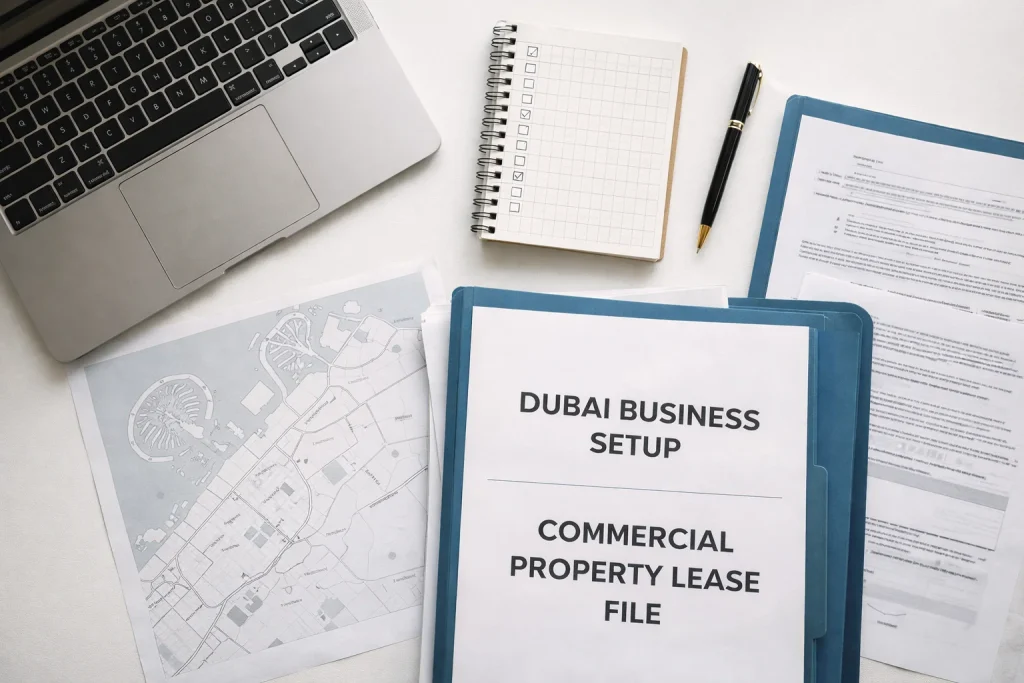
Buying vs. Leasing: Investor Decision Framework
| Factor | Buying Commercial Property | Leasing Commercial Property |
|---|---|---|
| Capital & Cash Flow | High upfront capital (purchase price plus DLD transfer fees). Capital is illiquid. Potential for asset appreciation. | Significantly lower initial capital. Preserves cash for core business operations. Rent is a predictable operating expense. |
| Control & Flexibility | Full control over the asset, modifications, and long-term use. Illiquid; selling can be slow. | High flexibility to relocate, upsize, or downsize as business needs change. Subject to landlord rules and renewal risks. |
| Risk Profile | Bears full market volatility and vacancy risk. Responsible for all maintenance, repairs, and service charges. | Limited exposure to market value shifts. Maintenance of structure is typically the landlord's responsibility. |
| Suitability | Long-term owner-occupiers with stable space needs, or investors with a multi-year horizon seeking yield and capital growth. | Startups, growing businesses, companies testing the market, or those who prioritize operational agility over asset ownership. |
| Primary Use Case | A strategic, long-term hold for a business with certainty about its space requirements for several years. | Securing operational space that aligns with a current business plan without a major long-term capital commitment. |
Office Leasing Guide
Office Types and Strategic Fit
Your choice should mirror your operational maturity. Serviced offices offer plug-and-play simplicity for new market entrants. Fitted offices provide a balance for growing teams. Shell & core spaces are for established corporations requiring specific branding and layout.
Location Strategy: The Triple Balance
Balance three factors: Client Access means proximity to partners or customers in hubs like DIFC or Business Bay. Cost favours emerging areas like JVC or Al Quoz. Staff Commute covers access to metro, highways and affordable housing. Prioritize based on your business model.
Where Businesses Usually Lease in Dubai: A Zones Overview
Your location is a function of your license type and operational logistics.
Proximity to Clients (CBD & Mainland Hubs)
For mainland companies serving the local market, established districts like Business Bay, Downtown Dubai, and Barsha Heights offer central access. Newer communities like Jumeirah Village Circle (JVC) are emerging with dedicated commercial stock.
Logistics & Industrial Access
Warehouse demand clusters around infrastructure. Key hubs include:
- Jebel Ali Free Zone (JAFZA): A premier logistics hub directly connected to Jebel Ali Port.
- Dubai South: Strategically located near Al Maktoum International Airport.
- Dubai Industrial City & Al Quoz: Major industrial areas benefiting from decentralization and highway access.
Free Zone Alignment
If you hold a free zone license, you must lease premises within that specific zone (e.g., a DMCC company leases in Jumeirah Lakes Towers). Each zone caters to specific industries.
Compliance Constraints
A mainland trade license typically requires a physical office space, while many free zones offer flexible options from virtual offices to fitted space. Your licensed activity must match the property's approved use. Professional business setup advisors can help ensure compliance alignment.
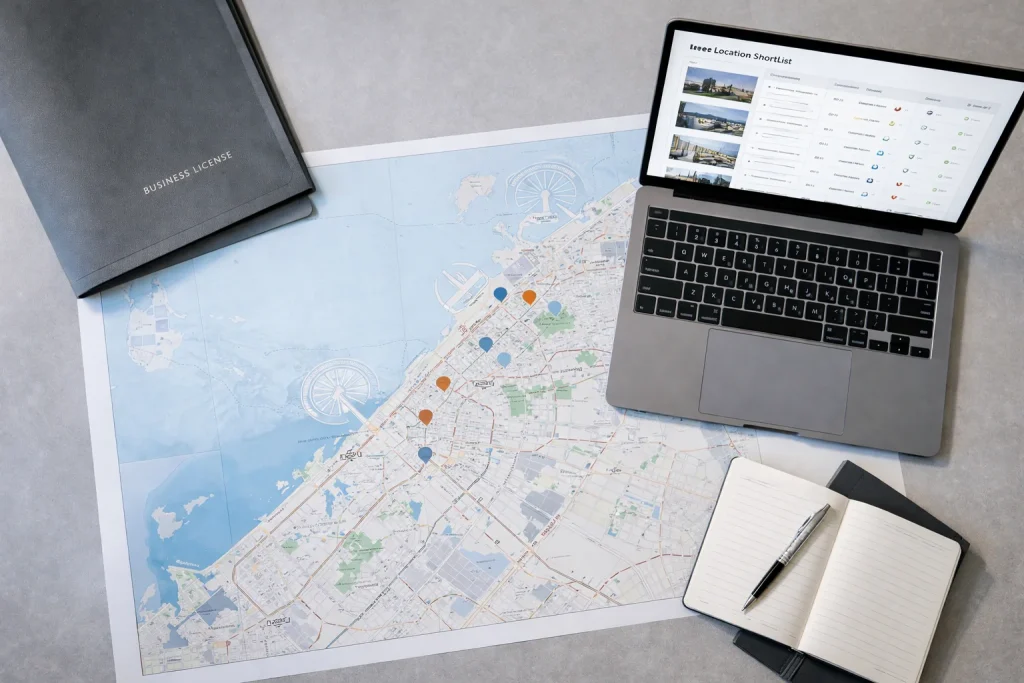
Understanding Lease Terms
All commercial leases must be registered in the Ejari system for legal protection. Standard terms are one to three years. At renewal, landlords can increase rent only as per the RERA Rental Index, with appropriate advance notice. Understand the notice period for vacating.
Fit-Out Obligations
In a shell & core unit, the tenant funds the complete fit-out. In fitted spaces, clarify what is included. Negotiate a fit-out contribution or rent-free period from the landlord to offset your setup costs. The lease will specify who owns the fit-out at termination.
Service Charges
This is an annual fee paid separately from rent, covering building maintenance, common area cooling, security, and insurance. Request historical service charge statements to budget accurately and avoid buildings with poorly managed, escalating costs.
Common Negotiation Points
Key negotiable items include the number of annual rent cheques, since more cheques improve cash flow. Also negotiate the rent-free period for fit-out, the scope of the landlord's fit-out contribution, and clear clauses on service charge caps and reinstatement obligations at lease end.
Office selection is not just a real estate decision — it directly impacts your trade license, visa eligibility, and operational approvals. See this practical breakdown of office leasing in Dubai for business setup before choosing a space.
Warehouse / Industrial Leasing Guide
Have questions about this?
A 10-minute call with Mirza often saves weeks of research. No obligation — ask anything about your situation.
Key Specifications Checklist
Clear Height: Modern logistics facilities typically feature clear heights of 10-12 metres or more for vertical storage racking.
Floor Loading Capacity: Ensure it supports your equipment and storage density (commonly specified in tons per square metre).
Dock Doors & Levelers: Essential for efficient truck loading and unloading. Check the ratio of doors to square footage.
Power Capacity: Ample three-phase power is critical for automation, cold storage, or manufacturing.
Office & Amenity Space: Verify the percentage of air-conditioned office space allowed within the unit.
Truck Access & Logistics
Assess the ease of access for the largest trucks you will use. Check for sufficient manoeuvring space, trailer parking spots, and avoid locations prone to traffic congestion. Proximity to major highways (Sheikh Mohammed Bin Zayed Road, Emirates Road) and ports is a primary value driver.
Compliance & Approvals
Before signing, confirm the warehouse is approved for your intended activity by the relevant authorities (e.g., Dubai Municipality, Civil Defence). The unit must have a valid Occupancy Certificate. You will likely need to obtain your own Civil Defence NOC for operations.
Critical Risks
The major risk is leasing an outdated facility that cannot support efficient modern logistics, erasing any rental savings. The other is zoning mismatch—ensuring the land is designated for industrial or warehouse use and your specific activity (e.g., food storage, chemicals) is permitted.
Leasing Costs & Budgeting
When budgeting, account for all cost components beyond the base rent:
Security Deposit: Typically a percentage of the annual rent, refundable at lease end subject to property condition.
Broker Commission: Usually paid by the tenant, calculated as a percentage of the annual rent value.
Service Charges: As outlined above, a separate and variable annual cost that varies by building quality and management.
Utilities & Cooling: For offices, district cooling charges can be significant. For warehouses, clarify if power is sub-metered.
Fit-Out & Reinstatement: The largest variable cost. Budget for both initial fit-out and the potential cost of returning the unit to its original state at lease termination.
Due Diligence Checklist
Broker Verification: Confirm your broker is RERA-licensed. Ask for their license number and verify it on the official RERA portal.
Zoning & Activity Permit: Obtain written confirmation from the landlord or free zone authority that your licensed business activity is permitted in the specific unit.
Landlord Credibility: Research the landlord's reputation. For buildings, check the management company's track record for maintenance and responsiveness.
Fit-Out Condition & Snagging: For fitted spaces, conduct a thorough snagging inspection. Create a list of defects for the landlord to rectify before move-in.
Hidden Cost Checks: Scrutinize the service charge history. Confirm what is included and request an estimate for the next year. Check if there are any pending building-wide renovation fees.
Critical Contract Clauses: Ensure the contract clearly states fit-out responsibilities, service charge caps, renewal terms, reinstatement obligations, and procedures for sub-letting or assignment.

Common Mistakes (Business & Investor)
- Selecting a location based on personal preference rather than employee commute or client proximity
- Not physically visiting the property at different times of day to assess traffic, noise, and congestion
- Signing a lease that is not Ejari registered, leaving you without legal recourse at the Rental Disputes Centre
- Underestimating the total cost of occupancy by ignoring service charges, cooling costs, and fit-out
- For warehouses, prioritizing low rent over functional specifications like column spacing or power supply, which dictates operational efficiency
Who This Is NOT Suitable For
This commercial property pathway is not suitable for sole proprietors or very early-stage startups needing only a virtual address, which can be obtained at a fraction of the cost. It is also ill-advised for investors seeking quick, speculative returns, as commercial assets require a longer-term hold. Those unwilling to conduct thorough due diligence or engage professional advisors expose themselves to significant regulatory and financial risk.
Next Steps: Request a Strategic Office / Warehouse Shortlist
To navigate this complex landscape efficiently, a targeted shortlist is invaluable. Our advisory process begins with a review of your specific parameters:
What you provide: Your business license type (or intended activity), required square footage, headcount and growth plans, operational non-negotiables (e.g., truck access, power needs), and budget framework.
What you receive: A curated, actionable shortlist of zones and specific property types aligned with your commercial, compliance and financial objectives. It saves significant research time and mitigates location risk.
Investor Notes
In 2026, sustainability specifications (e.g., LEED certification, energy efficiency) are increasingly impacting corporate leasing decisions and asset valuations.
For free zones, your leased square meterage directly dictates your visa quota. Plan your space with future headcount growth in mind.
The RERA Smart Rental Index is publicly accessible. Use it to verify the fairness of any rent increase during renewal negotiations.
Always budget a contingency on top of estimated fit-out costs for unforeseen expenses.
When considering a purchase, factor in ongoing capital expenditures for building upgrades, which are the owner's responsibility, and conduct an independent engineering survey.
Sources and official references
Frequently Asked Questions
1) Is Ejari required for commercial leases in Dubai?
In most common commercial leasing scenarios in Dubai, the lease is expected to be registered through Ejari under the RERA system. Registration requirements can vary based on licensing route and authority, so it is best to confirm the exact registration and documentation requirements before signing.
2) Should I choose Mainland or Free Zone first, before leasing an office?
Yes. Your licensing route typically determines where you can legally operate and what type of premises may be required. Finalizing the jurisdiction and activity early helps avoid costly mistakes where a unit does not match licensing or compliance requirements.
3) What is the safest way to shortlist office locations in Dubai?
Start with a compliance-first approach: confirm your business activity, licensing route, and headcount planning, then shortlist areas based on client access, staff commute, and operating costs. A professional shortlist can reduce risk by filtering out non-compliant buildings and mismatched zones.
4) What costs should I budget beyond the rent?
Beyond base rent, businesses should typically budget for security deposit, broker commission where one is involved, service charges, and utilities and cooling (district cooling in particular). Add fit-out costs, signage approvals where needed, and reinstatement costs at lease end.
5) What does “shell and core” mean in Dubai commercial property?
Shell and core typically refers to an unfinished unit that requires full fit-out work by the tenant (partitioning, ceilings, flooring, MEP modifications). It allows maximum customization, but usually requires more time, approvals, and higher upfront budget compared to fitted or serviced offices.
6) What should I check before leasing a warehouse in Dubai?
Key checks include zoning suitability for your activity and unit specifications: clear height, floor loading capacity, dock access and power. Also confirm truck access and manoeuvring space, approvals including Civil Defence requirements, and whether the landlord’s terms match your operational needs.
7) Is it better to buy or lease commercial property in Dubai?
Leasing typically offers flexibility and lower upfront cost, which is ideal for growing businesses or market entry. Buying can suit stable operations or long-term investors, but requires higher capital commitment and involves vacancy and resale liquidity risks.
8) Can office size affect visa quota or business setup eligibility?
In many free zones, office size and facility type can influence visa quota eligibility. Requirements vary by authority and package, so businesses should plan headcount growth against space requirements and confirm the latest conditions with the licensing authority.
9) What are the biggest mistakes businesses make when leasing commercial property?
Common mistakes include choosing a unit that does not match licensing requirements, underestimating fit-out and occupancy costs, and signing contracts without proper registration or recognition. Another is failing to verify service charges, building management quality and renewal conditions.
10) Can Henry Club help with office or warehouse shortlisting?
Yes. We help founders and investors shortlist commercially suitable zones and unit types based on licensing route, activity, and operational requirements. Execution is handled through trusted, licensed partners to ensure compliance and negotiation support.
Advisory Disclaimer
The sections below cover options for informational purposes only and does not constitute legal, financial, or real estate advice. Regulations, market conditions, and free zone policies are subject to change. You must verify all information regarding licensing, zoning, and contracts with the relevant authorities (DED, RERA, Free Zone Authority) and seek independent professional counsel before making any commitment. We do not guarantee outcomes, returns, or visa approvals. All investment and leasing decisions carry inherent risk.
Tell us your budget. We'll tell you what to buy.
Send us what you want to spend and what the space is for — rental income, owner-occupation, or premises for your own business. You get back a shortlist of the areas, buildings and unit types that fit, the approved service charge on each, and the ones we would avoid. Within one business day, free.
Get my property shortlistWe hold no listings and take no commission on a sale. That is why we can tell you when a deal does not stack up. When you are ready to transact, we introduce you to a RERA-licensed partner.
About the Author
Dubai-based independent advisor on UAE visa, immigration, and offshore structuring. Founder of Henry Club UAE with 90+ published guides. Advisory-first — clarity before commitment.