
I help founders understand their options clearly before they commit to any structure, provider, or direction.
SME lending in the UAE gives small and medium businesses access to working-capital loans, business overdrafts, equipment and asset finance, invoice financing and term loans – from both traditional banks and newer digital lenders. Approval turns mainly on your trading history, cash flow and how well-prepared your financials are, and the process typically runs from a few weeks to a few months.
This guide explains how UAE SME financing works in 2026 – the loan types available, what lenders assess, the step-by-step application journey, realistic rates and fees, the common mistakes that get applications rejected, and how to improve your chances – so you can approach the right lender with a fundable file.
Quick Summary: UAE SME Lending in 2026
- Typical loan range: AED 100,000 to AED 5 million unsecured business loans, scaling higher for secured/asset-backed facilities.
- Eligibility: Most lenders require 12–24 months trading history, a UAE corporate bank account, and consistent monthly business turnover.
- Common product types: Working capital loans, asset and equipment finance, invoice factoring, trade finance, and revolving overdrafts.
- Interest range: Typically 8–18% per annum effective rate for unsecured SME facilities, depending on tenor, business profile and bank.
- Top SME lenders: Emirates NBD, Mashreq NEO Biz, RAKBank Business, ADCB Business Banking, and digital lenders like Wio Business.
- Approval timeline: 7–21 working days for standard SME facilities. Larger or secured facilities may extend to 30–45 days with full underwriting.
UAE SME Financing: What to Know Before You Apply
Growth in the UAE often requires capital. For businesses looking to finance new equipment, bridge a cash flow gap, or launch expansion initiatives, understanding the SME lending environment is important. The sections below cover options for established SME owners, startup founders with operational history, and entrepreneurs who have moved past the initial setup phase and are now focused on scalable growth.
The UAE's SME lending market has developed considerably. While challenges remain, a combination of traditional banks, government-backed initiatives, and alternative financiers now offers a diverse range of products. However, securing appropriate funding is not just about completing an application. It is a strategic process that requires preparation, clear understanding of your business finances, and knowledge of what lenders evaluate. This guide will explain the process, clarify real eligibility criteria, and provide transparent information on costs and options available to UAE businesses.
Understanding SME Lending: More Than Just a Bank Loan
SME lending encompasses various forms of debt financing provided to small and medium-sized enterprises. In the UAE, an SME is typically defined as a company with annual turnover up to AED 250 million, though most programs target businesses with turnover below AED 50 million. It's important to view lending not as a single product, but as a toolkit, each tool designed for specific purposes.
Core Types of Business Loans
Working Capital Finance: This supports day-to-day operations. It includes overdrafts, revolving credit facilities, and invoice discounting (where you borrow against accounts receivable). It's designed to smooth cash flow fluctuations from seasonality or extended payment terms.
Asset Finance: Used specifically to purchase physical business assets. This includes equipment finance (for machinery, vehicles, IT hardware) and commercial property mortgages. The asset itself usually serves as collateral for the loan.
Trade Finance: Facilitates import and export activities. Key instruments include Letters of Credit (LCs), which guarantee payment to suppliers, and trade loans that finance inventory purchases.
Project Finance: For funding specific projects with clear parameters, such as a restaurant fit-out, new branch launch, or major marketing campaign. Lenders assess the project's standalone cash flow potential.
Government-Backed Loans: Programs like the Mohammed Bin Rashid Fund for SMEs, the Khalifa Fund, and the Emirates Development Bank (EDB) offer financing with favourable terms, often requiring specific equity participation or personal guarantee structures.
The Lender's Perspective: What Banks and Institutions Evaluate
Understanding eligibility requires seeing your business through the lender's perspective. Their primary concerns are risk assessment and repayment certainty. Whether you've recently completed your business setup in Dubai or operate an established enterprise, these evaluation criteria remain consistent.
1. Business Track Record and Stability
Most traditional banks require minimum operational history, typically two to three years of audited financial statements. This provides them with trend analysis for profitability, debt management, and growth. Businesses below this threshold may need to explore alternative lenders, venture debt, or founder-based financing.
2. Financial Health and Cash Flow
Lenders analyse financial statements carefully. Key metrics include:
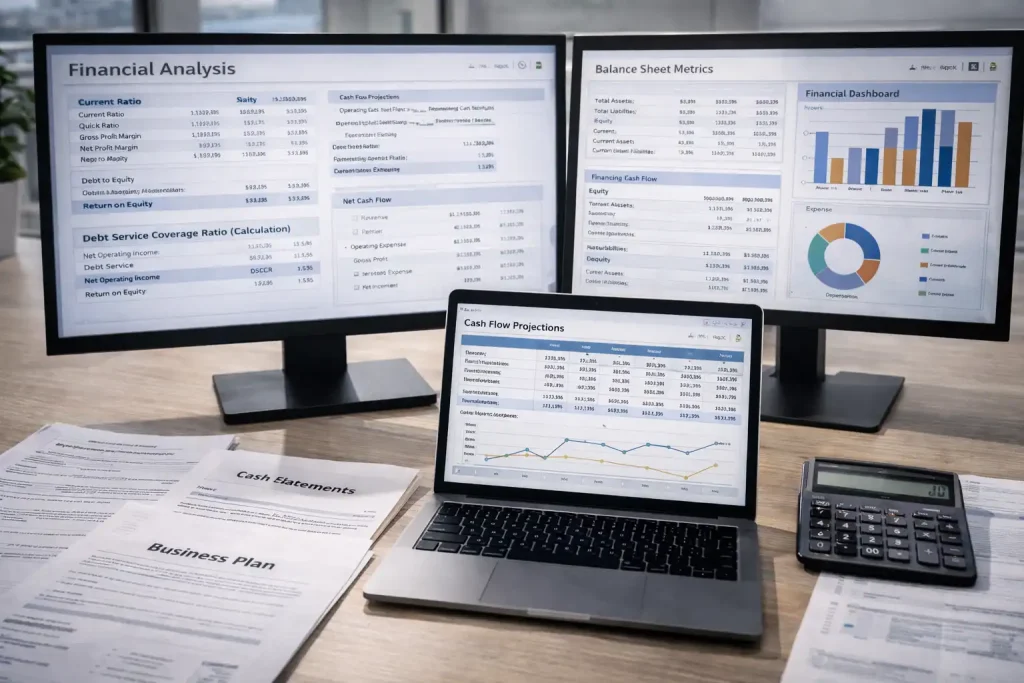
Debt Service Coverage Ratio (DSCR): This measures operating income against existing debt obligations. A ratio above 1.25 is often a minimum threshold, indicating sufficient cash flow to cover new and existing debt.
Profitability Trends: Consistent or growing net profits are positive indicators.
Balance Sheet Strength: A healthy ratio of assets to liabilities is important.
3. Credit History
This applies to both the business and its owner(s). Banks check the company's credit report with the Al Etihad Credit Bureau (AECB). They also check the personal credit history of major shareholders and guarantors. Poor personal credit scores can affect an otherwise healthy business's eligibility.
4. Collateral and Security
While unsecured loans exist, they are less common and typically more expensive. Most SME lending requires some form of security. This can be:
- A registered mortgage on business property or equipment
- A lien on accounts receivable or inventory
- A personal guarantee from business owner(s), often backed by post-dated cheques. This personal commitment is a standard requirement for the majority of SME loans in the UAE
5. Business Plan and Loan Purpose
You must articulate clear use for the funds. A professional business plan outlining how the loan will generate additional revenue or profit to facilitate repayment is essential. Understanding UAE accounting and financial reporting requirements helps in preparing credible financial projections. Specific purposes are more attractive than vague requests like "general working capital."
The Step-by-Step Journey to Securing a Loan
Internal Preparation (1-2 Months)
This is an important phase you control.
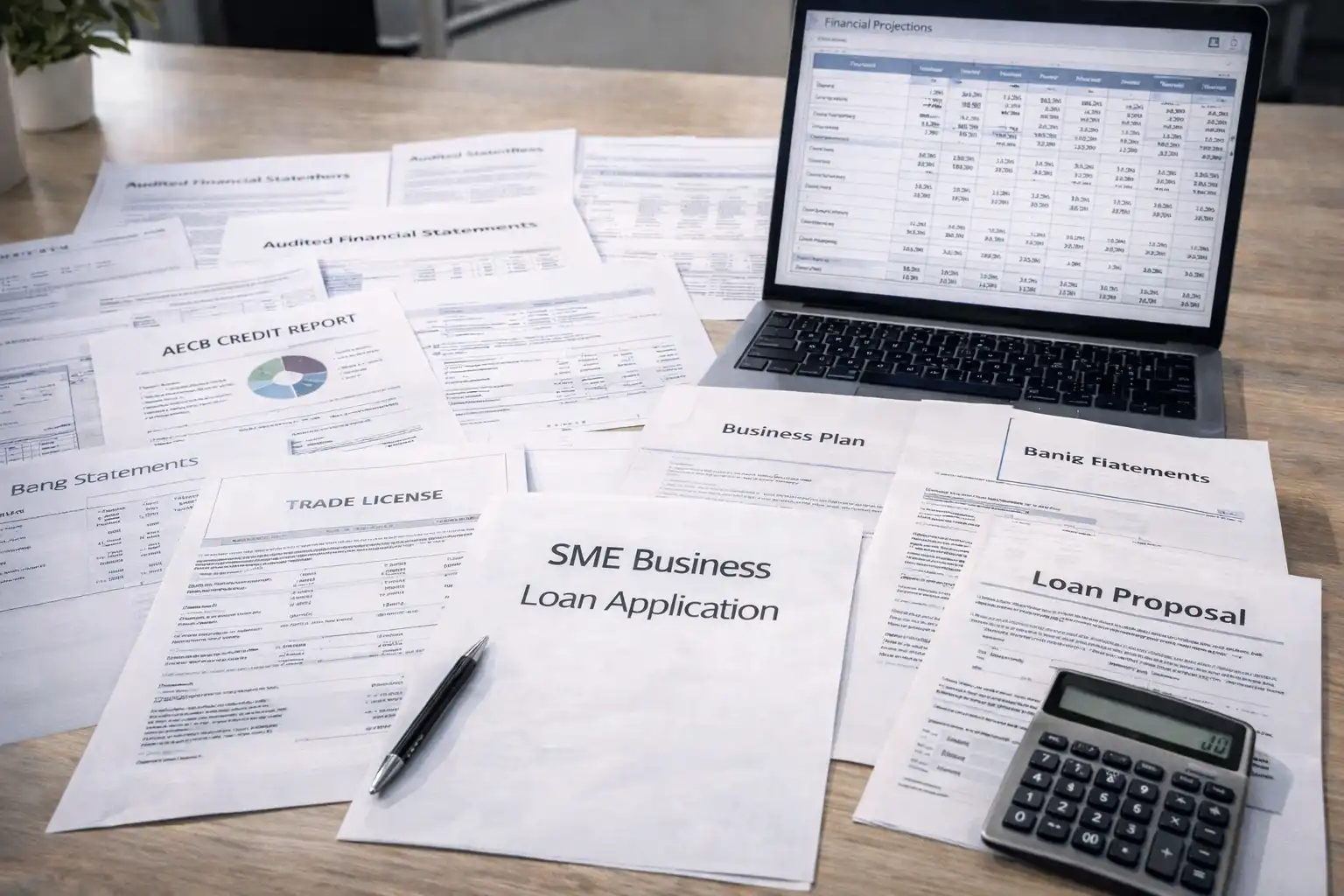
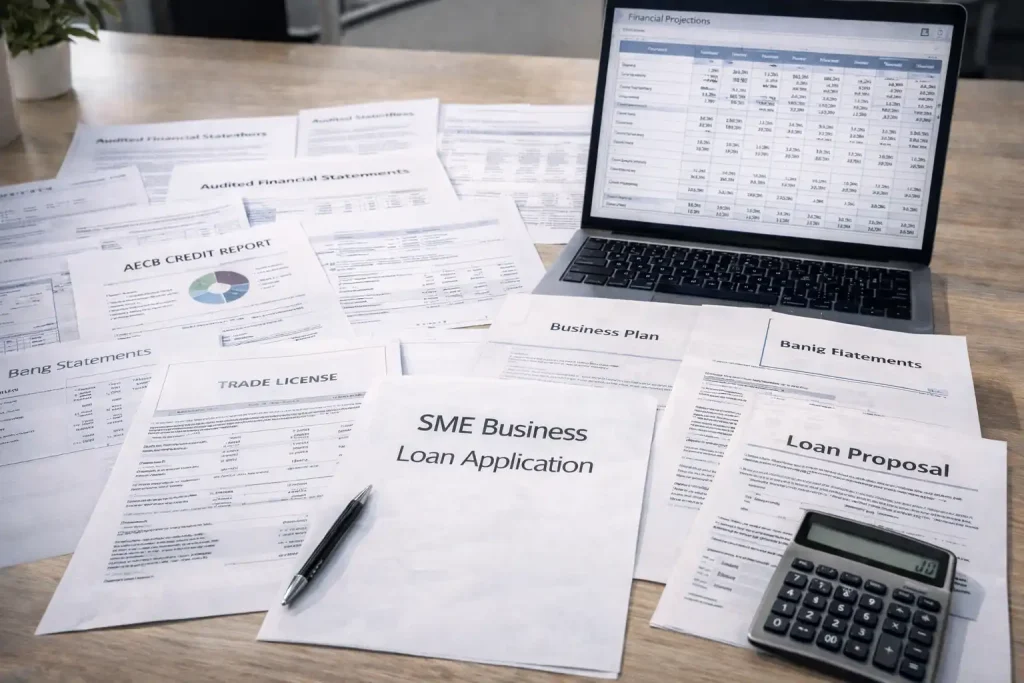
Audit Your Readiness: Gather your last 2-3 years of audited financials, 6 months of bank statements, and trade licenses. Check your and your business's AECB credit reports for any errors.
Define Your Need: Calculate the exact amount needed and decide on the loan type (e.g., AED 300,000 for 5-year equipment finance).
Prepare a Loan Proposal: Create a concise document: executive summary, business overview, purpose of the loan, repayment plan (using financial projections), and details of offered collateral.
Lender Screening & Application (1 Month)
Research Lenders: Don't limit yourself to one bank. Research options from commercial banks, Islamic banks, the EDB, and digital lenders.
Initial Discussions: Have preliminary meetings with loan officers. Present your proposal and get initial feedback on eligibility and terms. This is a fact-finding phase.
Formal Application: Submit the full, formal application package to your chosen 1-2 lenders. This includes all prepared documents plus the lender's own application forms.
Due Diligence & Approval (1-3 Months)
Bank Analysis: The lender's credit team analyses your finances, may visit your business premises, and assess your market position.
Term Sheet Offer: If approved, you receive a formal term sheet outlining the loan amount, interest rate, tenor, fees, and all security requirements. Review this carefully.
Negotiation: While major terms may be fixed, there may be room to negotiate on fees or specific covenants.
Disbursement (2-4 Weeks)
Documentation & Security: You sign the loan agreement and complete collateral registration (e.g., mortgage, lien). This often requires notarization.
Fulfil Conditions Precedent: The bank may require specific conditions before releasing funds, such as proof of insurance on a purchased asset.
Funds Disbursed: Once all paperwork is complete, funds are transferred to your account. Understanding UAE business banking procedures helps manage this process effectively.
Costs, Rates, and Fees: The Total Cost of Capital
Have questions about this?
A 10-minute call with Mirza often saves weeks of research. No obligation — ask anything about your situation.
The interest rate is only one component. The total cost includes several fees that can add 1-3% to your effective borrowing cost.
Interest Rates
As of current market conditions, interest rates for SMEs in the UAE are often priced as a spread over the Emirates Interbank Offered Rate (EIBOR). For well-established, profitable SMEs with strong collateral, rates might start from approximately EIBOR + 3% (approximating 6-8% annual percentage rate). For smaller or higher-risk businesses, rates can rise to 12-18% APR. Islamic finance products (Murabaha, Ijara) will have similar overall profit rates.
Common Fees
- Processing/Administration Fee: Typically 1-2% of the loan amount, usually deducted upfront
- Valuation Fee: For asset-based loans, paid to the bank's appointed valuator
- Registration Fee: For registering a mortgage or lien with the relevant registry
- Early Settlement Fee: A penalty (often 1-3% of the outstanding balance) for repaying the loan before maturity
- Bank Guarantee Commission: If providing a guarantee instead of cash collateral (typically 1-3% per annum of the guarantee value)
| Loan Type | Typical Purpose | Tenor | Security Required | Best For |
|---|---|---|---|---|
| Working Capital OD | Daily operations | Revolving | Personal Guarantee, Receivables | Businesses with seasonal sales cycles |
| Equipment Finance | Buying machinery/vehicles | 3-5 years | The equipment itself, PG | SMEs needing to upgrade productive assets |
| Commercial Mortgage | Buying office/warehouse | 10-15 years | Mortgage on property, PG | Stable businesses seeking to own premises |
| Invoice Financing | Improving cash flow | 30-90 days | Lien on specific invoices | B2B businesses with reliable corporate clients |
Advantages and Limitations of SME Debt Financing
Advantages
- Retain Ownership: Unlike equity financing, you do not give up a share of your company
- Tax Efficiency: Interest payments are generally tax-deductible business expenses under UAE corporate tax law
- Builds Credit History: Successfully servicing a loan strengthens your business credit profile for future borrowing
- Predictable Repayment: Fixed instalments aid in financial planning and budgeting
Limitations & Risks
- Personal Liability: The requirement for personal guarantees puts personal assets at risk if the business faces difficulties
- Fixed Obligation: Loan repayments must be made regardless of business performance, which can strain cash flow in downturns
- Collateral Requirement: Using business or personal assets as security can limit other financial opportunities
- Restrictive Covenants: Loan agreements may include covenants, such as maintaining certain financial ratios or limiting further borrowing
Common Mistakes and How to Avoid Them
Mistake 1: Seeking Funding as a Last Resort
Approaching a bank during a cash crisis is typically unsuccessful. Lenders fund growth, not emergency situations. Start conversations 6-12 months before you critically need capital.
Mistake 2: Not Knowing Your Numbers
If you cannot readily explain your DSCR, gross margins, and monthly cash burn, you need more preparation. Understand your financials thoroughly before applications.
Mistake 3: Prioritizing Speed Over Terms
While digital lenders promise fast approval, their rates can be substantially higher. The urgency of "fast cash" can lead to accepting unfavorable terms. Always compare the total cost of capital.
Mistake 4: Underestimating the Personal Guarantee
Do not sign a personal guarantee without careful consideration. It is a legally binding commitment. Seek legal advice to understand the full implications before signing.
Mistake 5: Incomplete or Inconsistent Applications
Submitting inconsistent bank statements, outdated licenses, or unprofessional business plans signals poor management. A well-prepared application demonstrates credibility.
Who Might Consider Alternatives?
SME lending may not be optimal for every business:
- Pre-Revenue Startups: Businesses without revenue or operational track record typically don't qualify. They should focus on equity (angel investors, venture capital), grants, or bootstrapping
- Businesses with Credit Challenges: If the owner's AECB score is low or the business has default history, time is better spent repairing credit before applying
- Companies Needing Very Large Sums (>AED 10-15M): At this scale, debt structures become more complex (syndicated loans, bonds) and require specialized corporate finance advice
- Businesses Facing Fundamental Challenges: Debt is typically not appropriate for businesses with failing models. This requires operational restructuring, not additional liabilities
Practical Use Cases and Scenarios

Case 1: The Growing Trading Company
A trading firm with 4 years of solid profits secures a large new contract requiring purchase of AED 500,000 of additional inventory. Cash flow will be constrained until the client pays in 90 days.
Solution: A Trade Finance Loan or Invoice Finance Facility. The bank finances the inventory purchase against the security of the purchase order and subsequent invoice from the creditworthy client. This addresses the cash flow gap without diluting ownership.
Case 2: The Manufacturing SME
A manufacturer needs a new specialized machine costing AED 750,000 to increase production capacity and meet demand.
Solution: Asset Finance. The bank finances 80% of the machine cost over a 4-year term. The machine serves as primary collateral. The increased production generates revenue to cover monthly instalments, and the business owns the asset outright at the end.
Case 3: The Tech Service Scale-up
A profitable software-as-a-service company, 3 years old, wants to hire 5 new developers and expand marketing. It needs AED 1 million but wants to avoid equity dilution.
Solution: A Growth Capital Term Loan. The bank assesses the company's recurring revenue, strong margins, and contracts. It offers a 3-year loan based on a personal guarantee from the founders and a lien on company assets. The loan fuels growth while founders keep 100% equity.
Taking Your Next Steps
Begin with an honest assessment of your business's financial health. Pull your AECB reports, organize your last two years of audited financials, and calculate key ratios like DSCR.
Next, draft a one-page summary of your loan request: how much, for what exact purpose, and how it will generate repayment. Use this to start informal conversations with your relationship manager at your bank and one other institution to gauge their interest.
If your business is young or your credit needs improvement, research government-backed programs like the EDB or Khalifa Fund, which may have more flexible criteria. Simultaneously, consult with a financial advisor who specializes in SME finance. They can help you prepare a credible proposal and navigate the options.
Securing SME lending represents an important milestone for a growing business. It is a process that benefits from and ultimately strengthens financial discipline. By approaching it with preparation, clarity, and strategic patience, you can secure the capital needed to build your business vision.
Sources & Official References
The information in this guide reflects current UAE federal and emirate-level regulations. For the most up-to-date figures and procedures, consult the official sources below:
- Central Bank of the UAE — SME — Central Bank oversight of UAE banking and lending.
- Khalifa Fund — Abu Dhabi SME development support.
- Emirates Development Bank — SME Loans — Federal SME finance programmes.
- UAE Government Portal - Banking
Frequently Asked Questions ? SME Business Loans in the UAE
Who qualifies for an SME loan in the UAE?
Most banks require businesses to have at least 2?3 years of operational history, audited financial statements, stable cash flow, and acceptable credit records for both the company and its owners.
What is the minimum operational history required by banks?
Traditional banks usually expect two to three years of trading history supported by audited financial statements. Newer businesses may need to explore government-backed schemes or alternative lenders.
Do SME loans in the UAE require collateral?
In many cases, yes. Security can include equipment, property, receivables, or inventory. Personal guarantees from business owners are also commonly required.
What is a Debt Service Coverage Ratio (DSCR)?
DSCR measures a company?s ability to service its debt. It compares operating income to total debt obligations. Lenders often look for a DSCR above 1.25 as a comfort level.
What types of SME financing are available?
Common options include working capital facilities, equipment finance, trade finance, invoice financing, commercial mortgages, project loans, and government-supported SME funding programs.
What interest rates do SME loans typically carry in the UAE?
Rates are usually linked to EIBOR plus a margin. Well-established SMEs may see effective rates in the mid to high single digits, while higher-risk or unsecured lending can exceed this range.
Are personal guarantees mandatory?
For most SME lending in the UAE, personal guarantees from owners or major shareholders are standard. This creates personal liability if the business cannot meet repayment obligations.
How long does the SME loan approval process take?
The full process, from preparation to disbursement, often takes between one and four months, depending on documentation quality, lender due diligence, and collateral arrangements.
What documents are required for an SME loan application?
Typically required documents include audited financial statements, trade license, bank statements, company constitutional documents, business plan, AECB credit reports, and details of proposed collateral.
Can startups get SME loans in the UAE?
Pure startups without revenue or financial history usually struggle to obtain traditional SME loans. Equity funding, grants, or founder capital are more common at early stages.
What fees are charged besides interest?
Common charges include processing fees, valuation fees, security registration costs, and early settlement penalties. These can add noticeably to the total cost of borrowing.
What happens if a business cannot repay the loan?
The lender may enforce security, call on personal guarantees, or take legal action depending on the loan agreement. Early communication with the bank is important if financial stress arises.
Have a question about this?
Leave your details and a UAE expert will get back to you within 1 business day — free, no obligation.
Ready to take action?
Whether you're ready to start or still comparing options — we'll give you a straight answer.
Chat on WhatsApp
Usually replies within 2h
Get a Free Quote
Personalised in 60 seconds
Call Directly
Open daily, 10am–6pm UAE
About the Author
Dubai-based independent advisor on UAE visa, immigration, and offshore structuring. Founder of Henry Club UAE with 90+ published guides. Advisory-first — clarity before commitment.