

I help founders understand their options clearly before they commit to any structure, provider, or direction.
Quick Summary: Dubai Real Estate Investment
- Foreigners can buy in designated freehold areas: Non-UAE nationals purchase in freehold areas. The Dubai Land Department (DLD) regulates the whole transaction, including escrow accounts for off-plan and formal title-deed registration.
- Budget 7-10% for transaction costs: This covers the 4% DLD transfer fee and roughly 2% agency commission plus 5% VAT. Add the trustee office fee (AED 2,000-4,000), title-deed issuance (AED 580), and any NOC or mortgage fees.
- Typical rental yields: Established areas generally offer gross rental yields of 5-8%, though net yield depends on service charges, vacancy, and management fees.
- Off-plan vs ready: Off-plan entry pricing is generally 10-40% lower with milestone payment plans but generates no income until handover; ready property allows immediate rental income from day one.
- Golden Visa pathway: A DLD-registered property value of AED 2 million or more can qualify for the UAE's 10-year Golden Visa. It is the DLD's assessed valuation that counts, not only the stated purchase price.
- Financing: Non-resident mortgages typically require down payments starting at 20-25%, plus a mortgage registration fee of 0.25% of the loan amount with the DLD.
Dubai Property Purchase Transaction Costs (2026)
Transaction fees a foreign buyer should budget when purchasing property in Dubai, on top of the purchase price, as stated in the guide.
| Item | Typical Cost (AED) | Notes |
|---|---|---|
| DLD transfer fee | AED 4% of purchase price | Legally split buyer/seller, but often paid in full by buyer |
| Agency commission | AED 2% of purchase price + 5% VAT | Paid by buyer to the real estate agent |
| Trustee office fee | AED 2,000 – 4,000 | Registration/administrative fee at DLD trustee office |
| Title deed issuance fee | AED 580 | Charged on issuance of the new title deed |
| Developer NOC fee | AED 500 – 5,000 | For ready properties in managed communities, to approve transfer |
| Property valuation fee | AED 2,500 – 3,500 | If financing; charged when arranging a mortgage |
| Mortgage registration fee | AED 0.25% of loan amount | Registered with the DLD; lenders may add arrangement fees |
| Total transaction costs | AED 7 – 10% of purchase price | Guide's overall budgeting range for acquisition costs |
Those are the line items. The calculator below applies them to a price, carries the ranges through to a total, and adds what the first year of ownership costs.
Quick answer: Foreigners can buy property in Dubai's designated freehold areas. The whole transaction is regulated by the Dubai Land Department (DLD) – including escrow accounts for off-plan and formal title-deed registration. Budget around 7–10% of the price for transaction costs. That is a 4% DLD transfer fee, roughly 2% agency commission plus VAT, and trustee, NOC and any mortgage fees. Weigh off-plan flexibility against the immediate income of a ready property. A DLD-registered property value of AED 2 million or more can also open the route to the UAE's 10-year Golden Visa. Always run your own due diligence on the building, service charges and net yield before committing.
For those who are reading this, you are likely considering one of the most significant financial decisions of your life: investing in international real estate. The Dubai market, with its unique dynamics, rental yields, and residency incentives, stands apart. My role over the past 15 years has been to cut through the noise and provide investors with clear, strategic, and transparent advice. This guide is designed not to sell you a property, but to equip you with the foundational knowledge required to make a confident, informed decision.
Free tool: model the financing with our Dubai mortgage calculator before you commit.
Who Should Consider This
This resource is crafted for the discerning international investor, the relocating professional or family, and the forward-looking end-user. Your goal may be portfolio diversification, a long-term residence pathway, or a tangible asset in a globally significant city. In each case, understanding the fundamentals of Dubai's market is the first step. Many of our clients are establishing businesses in Dubai while simultaneously planning their property investments as part of a comprehensive relocation strategy.
Key Considerations: The Dubai Proposition

Dubai's real estate market presents several distinctive characteristics that merit careful evaluation:
Demand-Driven Growth: Dubai's population continues to expand, adding thousands of new residents monthly, which directly influences long-term rental demand and occupancy patterns across various communities.
Competitive Rental Yields: The market typically offers gross rental yields of 5-8% in established areas. Short-term leasing can return more in select locations. Actual yields depend on property type, location and market conditions.
Long-Term Planning Framework: Value considerations are informed by the Dubai 2040 Urban Master Plan and the D33 Economic Agenda. Both focus on sustainable infrastructure and economic diversification over the coming decades.
Residency Pathway: Property investment is one route to the UAE's 10-year Golden Visa, subject to the thresholds and regulatory requirements in force. It offers medium to long-term residency for qualifying investors and their families.
Regulated Transaction Process: The Dubai Land Department (DLD) oversees the framework. Escrow account requirements for off-plan and formal title deed registration are structured to protect buyers through the acquisition.
Is Dubai Real Estate Right for You? Investor Profiles
A successful investment begins with alignment between your goals and the asset class. This strategy typically suits: HenryClub is an advisory firm and is not a licensed real estate brokerage. We do not list or sell property. Where a transaction proceeds, it is executed through a RERA-registered broker, disclosed to you beforehand.
The Portfolio Diversifier: Seeking dollar-pegged assets outside their home country to balance a global portfolio and gain exposure to a growing Middle Eastern hub.
The Yield-Focused Landlord: Interested in consistent rental income. Gross yields in certain Dubai areas compare favourably with many mature Western markets, though net yields need careful analysis of all holding costs.
The Future Resident: Planning a medium-to-long-term move to Dubai, and treating the purchase as both a home and a financial entry. Often exploring residency and visa pathways aligned with the relocation timeline.
The Growth-Oriented Investor: Comfortable with a longer horizon, using off-plan for capital appreciation as communities mature. Market cycles and development timelines introduce variables that demand patience and risk tolerance.
The Purchase Process: A Step-by-Step Overview

The process in Dubai follows a regulated pathway. Here is the standard sequence for a ready property transaction:
Define Strategy and Budget: Clarify your goals—whether yield-focused, capital growth oriented, or residency-driven. Then set a budget covering all acquisition costs, which typically run to 7-10% of the property price.
Select an Area and Property: Use the evaluation criteria outlined later in this guide to shortlist areas that match your strategy. Engage a RERA-licensed real estate agent for professional viewings and market guidance.
Due Diligence and Offer: Conduct necessary property and developer checks, review community service charges, and verify title status. Once satisfied, make a formal offer through your agent.
Sign the Memorandum of Understanding (MOU/Form F): This legally binding sales contract outlines transaction terms and typically requires a deposit of around 10% of the purchase price.
Secure Financing (If Applicable): Finalize your mortgage pre-approval with a UAE-licensed local or international bank. Non-resident mortgages typically require down payments starting at 20-25%, though terms vary by lender and property type.
Complete Conveyancing: Your agent and the seller will obtain a No Objection Certificate (NOC) from the developer and ensure any existing mortgages are cleared from the title.
Final Transfer at DLD: Both parties, or their authorised representatives, attend a DLD trustee office. The buyer pays the remaining balance and applicable fees, and the DLD issues a new title deed in the buyer's name, completing the legal transfer of ownership.
Note on Off-Plan Purchases: For properties under construction, you sign a Sales and Purchase Agreement (SPA) directly with the developer. The unit is then registered with the DLD's Oqood system. Payments are structured around construction milestones, with funds held in project-specific escrow accounts as mandated by DLD regulations.
Understanding the Full Investment: Costs and Fees
Beyond the property's purchase price, budgeting for transaction costs is essential for accurate return calculations and avoiding unexpected financial pressure.
DLD Transfer Fee: 4% of the purchase price. While legally intended to be split between buyer and seller, market practice in many transactions sees the buyer covering the full amount—this should be confirmed during negotiations.
Agency Commission: Typically 2% of the purchase price plus 5% VAT, paid by the buyer to the real estate agent facilitating the transaction.
Registration and Administrative Fees: Includes a trustee office fee ranging from AED 2,000 to AED 4,000, plus a title deed issuance fee of AED 580.
Developer NOC Fee: For ready properties in managed communities, the developer charges a fee to process and approve the transfer. It typically ranges from AED 500 to AED 5,000.
Mortgage-Related Fees: If you are financing, expect a property valuation fee of roughly AED 2,500 to AED 3,500. The DLD also charges a mortgage registration fee of 0.25% of the loan amount. Lenders may also charge arrangement and processing fees.
Factor the ongoing costs into your net yield projections. Those are annual service charges, which vary widely by community and building, property management at typically 8-10% of annual rent, and maintenance reserves. Those establishing corporate banking structures for property holding may encounter additional account maintenance requirements.
Off-Plan vs. Ready Property: A Strategic Comparison
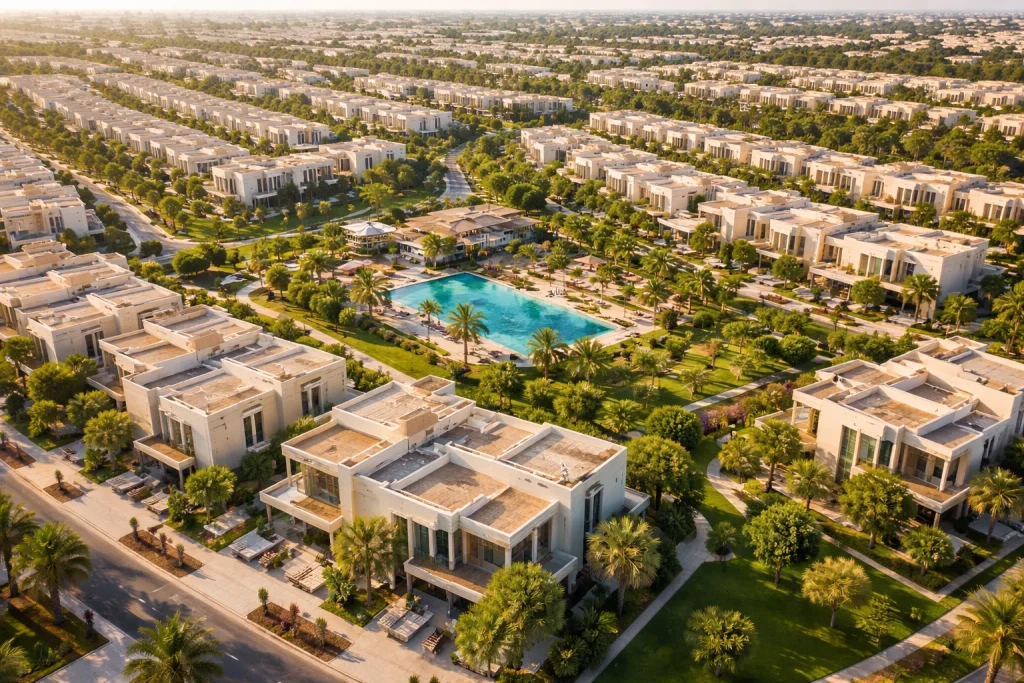
The choice between off-plan and ready properties is not about which option is inherently superior, but which aligns with your specific investment objectives, risk tolerance, and timeline. The comparison below outlines core strategic differences:
- Off-Plan Property – Primary Investor Goal: Capital appreciation potential and accessing modern developments at entry pricing, typically suited for longer-term investment horizons.
- Off-Plan Property – Entry Price: Generally positioned 10-40% lower than comparable ready properties in the same area, depending on developer, payment plan, and market conditions at launch.
- Off-Plan Property – Payment Structure: Flexible, milestone-based plans spread over the construction period, often structured as 60/40, 70/30, or post-handover schemes, easing initial capital requirements.
- Off-Plan Property – Cash Flow: Negative during construction phase as the property generates no rental income until completion and handover, requiring investors to maintain payment commitments without offsetting returns.
- Off-Plan Property – Key Risk Factors: Construction delays affecting handover timelines, market value shifts between purchase and completion, final community quality differing from initial marketing, and developer delivery track record.
- Off-Plan Property – Best Suited For: Long-term investors comfortable with deferred returns, those with lower initial capital seeking payment flexibility, and buyers prioritising modern architectural designs and new community amenities.
- Ready Property – Primary Investor Goal: Immediate rental yield generation and investment stability with a fully visible, operational asset.
- Ready Property – Entry Price: Current market price, fully transparent and reflective of actual community value, demand levels, and comparable sales data.
- Ready Property – Payment Structure: Typically requires a substantial upfront sum or full mortgage drawdown at transfer, demanding greater initial liquidity.
- Ready Property – Cash Flow: Potentially positive from acquisition, as the property can be leased immediately, generating rental income to offset holding costs and mortgage payments.
- Ready Property – Key Risk Factors: Lower immediate risk, because the asset already exists. Community quality, building management and tenant demand are verifiable through inspection and market data.
- Ready Property – Best Suited For: Relocating individuals requiring immediate occupancy, yield-focused landlords seeking stable income streams, and investors prioritising certainty and quick tenancy over long-term capital plays.
Related Dubai Real Estate Guide
Real-World Investment Scenarios
The "Future Footprint" Investor: A European entrepreneur plans to relocate to Dubai in 3-4 years. They purchase an off-plan villa in an emerging community like Dubai South, leveraging a developer payment plan that aligns with their financial timeline and business exit strategy. The property may appreciate during the construction period, and upon handover, it serves as their family home while having potentially built equity through market growth in that corridor.
The "Income Now" Portfolio Builder: A UK-based investor seeks to diversify with an asset generating immediate, tax-efficient income. They acquire a ready apartment in an established area such as Dubai Marina or Jumeirah Beach Residence, markets with consistent tenant demand and deep rental pools. The property is tenanted within weeks, providing a stable yield stream from day one to support their broader investment portfolio.
The "Golden Visa Anchor" Strategy: A family from Asia wants long-term residency security combined with a tangible asset. They purchase one or multiple ready properties with a combined DLD-registered value exceeding AED 2 million in designated freehold areas. This investment not only qualifies them for the 10-year Golden Visa residency program, but also provides rental income from a liquid, globally recognised asset class.
Risk Factors and Proactive Mitigation
Acknowledging and managing risk is fundamental to sophisticated real estate investing.
Developer Risk (Off-Plan): Mitigate by focusing exclusively on RERA-registered developers with demonstrated track records of on-time, on-specification delivery. Research their portfolio of completed projects, financial stability, and customer reviews before committing capital.
Market and Handover Risk: Understand that off-plan capital gains are realised only at handover when the property enters the resale or rental market. Stress-test your investment model against scenarios where market appreciation is minimal or flat. Prioritise areas with fundamental demand drivers—such as infrastructure development, employment hubs, and school catchments—rather than purely speculative projects.
Hidden and Ongoing Costs: A common miscalculation involves underestimating total acquisition costs and annual holding expenses. Service charges can vary significantly between buildings and may increase over time. Factor in realistic vacancy periods (typically 1-2 months annually), professional property management fees if leasing remotely, and maintenance reserves when modelling your net yield expectations.
Escrow Protection: For off-plan purchases, verify that all payments are directed into a project-specific, DLD-regulated escrow account. Funds held in escrow are released to the developer only upon independent verification of construction milestone completion, providing a regulatory safeguard for your committed capital throughout the development cycle.
The Golden Visa: Aligning Investment with Residency
Property investment represents one of the most direct pathways to securing the UAE's 10-year renewable Golden Visa, subject to meeting defined criteria and following the proper application process.
Investment Threshold: A minimum property investment value of AED 2 million is required for Golden Visa eligibility. This threshold can be met through a single property or a combination of properties, provided they are located in government-designated freehold areas and properly registered with the DLD.
Ready vs. Off-Plan for Visa Purposes: A ready property with a DLD-registered value of AED 2 million or above typically offers immediate eligibility for visa application upon transfer completion. An off-plan property from an approved developer may also qualify. Visa processing generally follows once a substantial portion of the price is paid and construction milestones are verified.
Valuation Considerations: The qualifying investment value for Golden Visa purposes is determined by the DLD's assessed valuation and registration records, not solely the stated purchase price in the sales agreement. Ensuring your property transaction is correctly structured and documented is essential to meet all regulatory requirements without complications or delays.
Residency Flexibility: The Golden Visa does not mandate full-time residency in the UAE. That makes it useful for global professionals and families who want residency security, travel flexibility, and ties across several jurisdictions.
Common Mistakes Buyers Make
Choosing the Wrong Building in the Right Area: Two apartments on the same street can deliver very different net yields and tenant experiences. Building quality, management responsiveness, facilities maintenance and service charge structures all vary. Always inspect and research the specific building and its management history, not just the broader community reputation.
Focusing Only on Purchase Price: A unit with a slightly lower acquisition cost may carry high, unpredictable service charges. Poor building management or costly maintenance will erode net returns over time. Calculate and compare net yields after all expenses, not just gross rental percentages.
Poor Currency Planning: Transferring large sums internationally without a strategic foreign exchange plan can result in significant, avoidable losses due to unfavorable rates and unnecessary bank fees. Engage reputable, specialised currency services or treasury advisors to optimise cross-border transactions.
Neglecting Professional Property Management: Particularly for overseas investors, a competent, licensed property management company is crucial for tenant screening, lease administration, maintenance coordination, and legal compliance. Quality management directly impacts occupancy rates, tenant retention, and long-term asset preservation.
Who This Strategy Is NOT Suitable For
This investment approach is generally not appropriate for:
- Investors seeking short-term, speculative property flips with high returns in under 12 months, as Dubai's market dynamics favour medium to long-term strategies.
- Those with very low risk tolerance who are uncomfortable with any degree of market cyclicality, currency fluctuations, or regulatory changes inherent to international real estate.
- Buyers who cannot commit to thorough independent due diligence or who expect to navigate the complex legal, tax, and regulatory landscape without professional advisory support from qualified experts.
How to Choose the Right Area and Property Type: Evaluation Framework
Use this systematic framework to assess opportunities and align them with your specific objectives:
Investment Objective Alignment: Decide first what you are optimising for. For rental yield, consider areas with strong tenant demand such as Dubai Marina, Jumeirah Village Circle or Business Bay. For capital growth, evaluate master plans like Dubai Creek Harbour or emerging corridors. For lifestyle and residency, explore established family communities such as Dubai Hills Estate, Arabian Ranches, or Mudon).
Comprehensive Budget Reality: Include all acquisition costs, transaction fees, financing charges, and realistic holding expenses in your budget model. Accessible entry points exist in well-planned communities like DAMAC Hills 2, Town Square, or Remraam, which offer villas and townhouses at moderate price points while maintaining reasonable service charge structures.
Tenant Profile Matching: Align your property type with documented demand patterns. Studios and one-bedroom apartments typically attract young professionals, expatriate singles, and couples working in nearby business districts. Townhouses and villas cater to families prioritising school proximity, green spaces, and community facilities.
Connectivity and Infrastructure: Evaluate proximity to Dubai Metro lines, major highway access (Sheikh Zayed Road, Emirates Road, Mohammed bin Zayed Road), reputable international schools, healthcare facilities, and retail centres. Strong connectivity remains a consistent value driver and directly influences tenant appeal and rental pricing power.
Developer and Building Quality: For off-plan investments, the developer's reputation, financial stability, and delivery history are paramount to mitigating construction and handover risk. For ready properties, investigate the building's maintenance track record, owner association responsiveness, facilities management quality, and long-term service charge trends.
Your Next Steps: From Knowledge to Action
If the strategic framework outlined in this guide aligns with your investment goals and risk profile, the logical next step is a tailored consultation focused on your specific situation.
- Your primary investment objective (for example: "Golden Visa-focused with rental income," "Maximum net yield priority," "Long-term capital growth in emerging areas").
- Your total budget range, inclusive of all acquisition costs and initial holding reserves.
- Your preferred property type (apartment, townhouse, villa) and any area preferences or exclusions.
- Your ideal timeline for purchase completion and any residency or relocation goals.
This allows our advisory team to dedicate consultation time to strategic alignment, opportunity evaluation, and actionable options that respect the value of your time and investment capital.
Frequently Asked Questions (FAQ)
Is Dubai real estate a good investment in 2026?
Dubai can be a strong market for international buyers. Ownership rules in designated freehold areas are investor-friendly, rental demand in key communities is comparatively high, and the Dubai Land Department (DLD) regulates the purchase process. However, outcomes depend on area selection, property quality, service charges, tenant demand, and market cycles.
What is the typical rental yield in Dubai?
Gross rental yields can vary widely depending on community, building quality, unit size, and the type of leasing (long-term vs short-term). Investors should evaluate both gross yield and net yield after factoring in service charges, maintenance, vacancy periods, and management fees.
How much extra cost should I budget when buying property in Dubai?
In most cases, buyers should budget for transaction costs such as DLD fees, trustee/admin fees, agent commission, and possible NOC charges. If financing is used, valuation and mortgage registration charges may apply. It’s best to calculate total acquisition costs before estimating ROI.
Is it better to buy off-plan or ready property in Dubai?
Off-plan can offer flexible payment plans and modern communities, but involves risks such as construction delays and market movement at handover. Ready property offers higher visibility, immediate occupancy, and potential rental income from day one. The best choice depends on your timeline, risk tolerance, and strategy.
Can foreigners buy property in Dubai?
Yes. Non-UAE nationals can buy property in Dubai in designated freehold areas. The buying process typically includes a sales agreement (Form F / MOU), transfer through a DLD trustee office, and issuance of a title deed under the buyer’s name.
What is the minimum investment for UAE Golden Visa through property?
The Golden Visa property pathway generally requires a qualifying property investment value meeting the official threshold, subject to DLD records and regulatory criteria. Requirements and processes can change, so investors should verify the latest eligibility rules at the time of application.
Can I get UAE Golden Visa with off-plan property?
In some cases, off-plan property may qualify depending on project eligibility, purchase structure, and the portion paid/registered with the authorities. The practical process can differ from ready property, so structured guidance is recommended.
Do I need to be in Dubai to buy property?
Not always. Many transactions can be handled through authorised representatives and standard conveyancing processes, but investors should ensure all documentation is verified, and the transaction is processed through regulated channels.
What are the biggest risks for property investors in Dubai?
Key risks include overpaying in the wrong building, underestimating service charges and holding costs, poor tenant demand in weak locations, unrealistic ROI expectations, and off-plan project delays. Due diligence and conservative ROI modelling are essential.
How do I choose the best area in Dubai for investment?
Area selection should be based on tenant demand, connectivity, building quality, service charge levels, and your investment objective (yield vs growth vs residency). In many cases, the “right building” matters more than the “right area.”
Advisory Disclaimer
This guide is provided for informational and educational purposes only and does not constitute financial, legal, tax, or real estate advice. The Dubai property market is dynamic, and regulations, fees, processes, and market conditions are subject to change. You must conduct your own independent due diligence. Consult qualified professional advisors—including legal counsel, financial advisors, and tax specialists licensed to practice in the UAE—before making any investment decision. We operate as an advisory consultancy and may, upon your explicit request, refer you to trusted, RERA-licensed partner agencies for transaction facilitation. All real estate investments carry inherent risk, and past market performance or historical yields are not indicative of future results. No content in this guide should be interpreted as a guarantee of investment returns, property values, rental income, visa approvals, or regulatory outcomes.
An investment case is only as good as its assumptions. If you want yours challenged before you act on it, discuss it with an advisor.
Sources and official references
For the official rules behind ownership, registration, fees and residency referenced above, verify the current details directly with these UAE government authorities.
- Dubai Land Department (DLD) - official property transactions, title-deed registration, RERA-licensed agents/developers, escrow accounts and service charges
- UAE Government Portal - foreign property ownership in freehold areas, residency and an overview of the Golden Visa property pathway
- Federal Authority for Identity & Citizenship (ICP) - current Golden Visa and long-term residency eligibility criteria and thresholds
- GDRFA Dubai - Dubai residency visas, including property-investor and Golden Visa applications processed locally
Tell us your budget. We'll tell you what to buy.
Send us what you want to spend and what you want the property to do — rental income, a Golden Visa, somewhere to live. You get back a shortlist of the areas, buildings and unit types that fit, the approved service charge on each, and the ones we would avoid. Within one business day, free.
Get my property shortlistWe hold no listings and take no commission on a sale. That is why we can tell you when a deal does not stack up. When you are ready to transact, we introduce you to a RERA-licensed partner.
About the Author
Dubai-based independent advisor on UAE visa, immigration, and offshore structuring. Founder of Henry Club UAE with 90+ published guides. Advisory-first — clarity before commitment.