
I help founders understand their options clearly before they commit to any structure, provider, or direction.
Quick Summary: Escrow Account Verification
- What it is: A mandatory statutory protection under Dubai Law No. (8) of 2007 holding off-plan payments in a project-dedicated bank account, released to the developer only against verified construction milestones.
- Who controls it: A tripartite agreement between RERA, the developer and an authorised UAE bank, removing unilateral developer access to investor capital.
- What it protects: Ring-fences capital against fund misappropriation and segregates project funds from developer insolvency in unrelated business operations.
- What it does not cover: Project feasibility and budget overruns, developer execution competence, market and valuation risk, and post-handover obligations.
- How to verify: Confirm the project's RERA registration, obtain the project-specific escrow account number, cross-check it appears in your SPA, and pay only into that account by bank transfer.
- Investor responsibility: RERA conducts periodic audits but does not monitor every transaction in real time – treat verification as the start of due diligence, not the end.
Quick answer: For Dubai off-plan property, the escrow account is a mandatory statutory protection under Dubai Law No. (8) of 2007, holding your payments in a project-dedicated bank account and releasing funds to the developer only against verified construction milestones under a tripartite agreement between RERA, the developer and an authorised UAE bank. It ring-fences your capital against fund diversion, but it does not guarantee project completion and offers no cover for feasibility, developer execution, market or post-handover risks. Verify the project's RERA registration, confirm the escrow account number appears in your SPA, and pay only into that account by bank transfer – treat this as the start of due diligence, not the end.
The Foundation of Transactional Security
For investors allocating capital to off-plan real estate in Dubai, the escrow account represents the primary statutory mechanism designed for capital protection. It is a mandatory component of the investment architecture, structured to align developer incentives with construction progress and reduce counterparty risk. However, the existence of an escrow account serves as a binary starting point. Its correct implementation, oversight, and the investor's verification of these elements constitute the critical due diligence workflow.
This analysis examines the escrow system from an institutional risk perspective, detailing its protections, its limitations, and the verification procedures that sophisticated investors should consider undertaking within a comprehensive risk and due diligence framework.
The Legal and Regulatory Framework
The mandatory use of escrow accounts for off-plan property sales is established under Dubai Law No. (8) of 2007 and its subsequent amendments. The Dubai Land Department (DLD) and its regulatory division, the Real Estate Regulatory Agency (RERA), maintain authority to regulate, enforce, and audit this system.
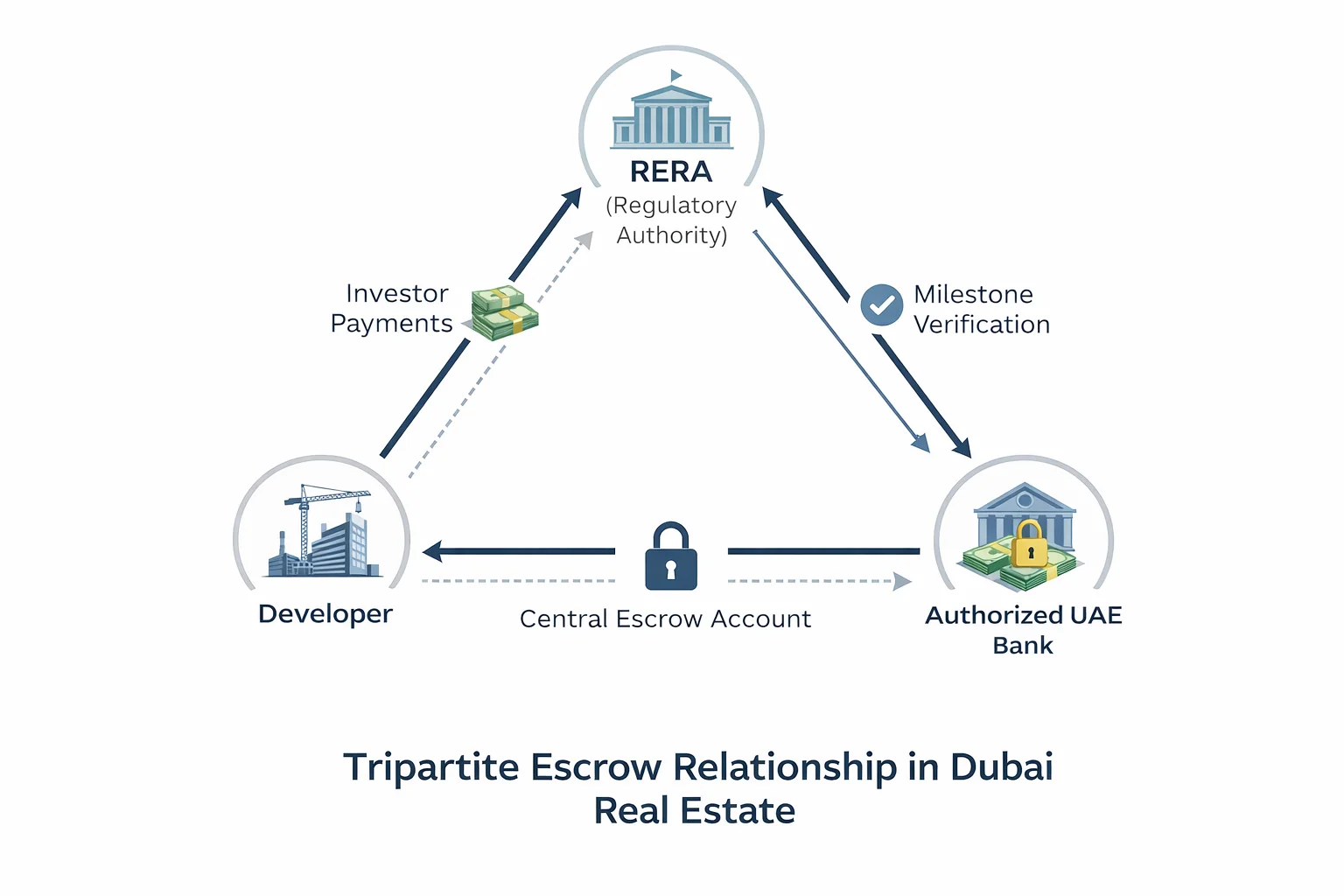
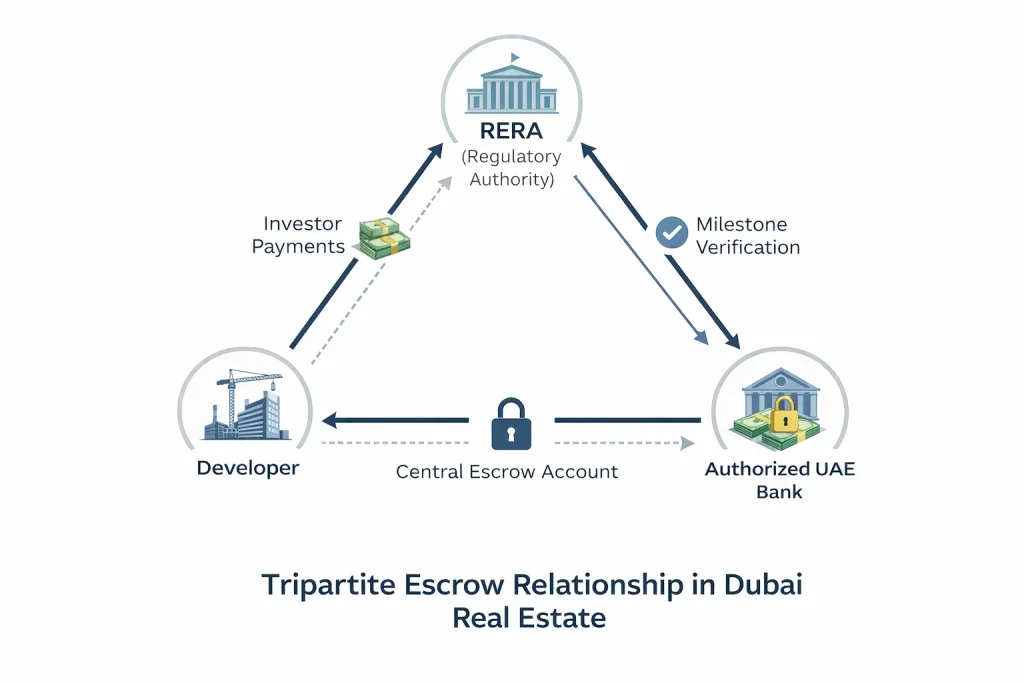
RERA's oversight encompasses project registration approvals, the mandating of project-dedicated escrow accounts with authorized UAE banks, and the establishment of rules governing fund disbursements. The escrow agreement functions as a tripartite instrument between RERA, the developer, and the bank. This structure removes unilateral developer access to investor capital, placing control under a regulated disbursement schedule tied to verified construction milestones.
Structural Mechanics of an Off-Plan Escrow Account
Upon project launch approval, developers are required to open a distinct bank account exclusively for that specific project. All purchaser payments for that project must be routed into this account. Developers cannot commingle funds from different projects or access the pool for general corporate purposes.
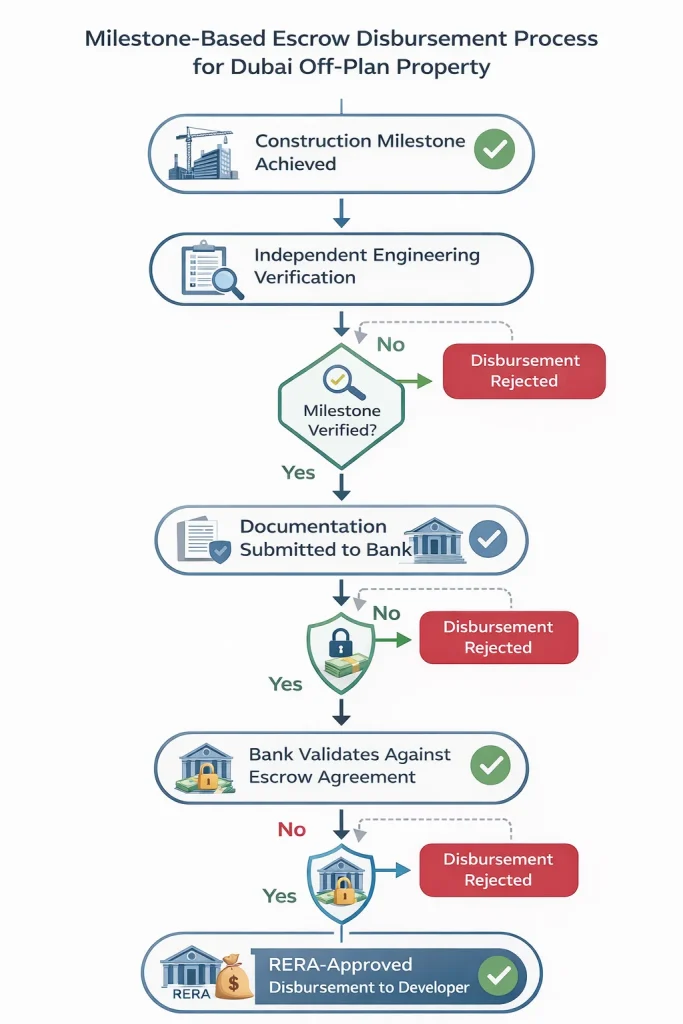
Disbursements to the developer are not made at their discretion. The bank, acting under the instructions of the RERA-approved escrow agreement, releases funds only upon receiving authenticated evidence of completed construction stages. This evidence often requires verification through independent engineering reports. The payment plan in the Sales Purchase Agreement (SPA) links directly to a physical construction timeline, creating a pay-for-progress model.
Scope of Investor Protection
The escrow system addresses several fundamental investor risks within its designed parameters.
Capital Ring-Fencing
The system protects against fund misappropriation. Investor capital designated for a specific project cannot be redirected toward land acquisition, corporate overhead, marketing costs for other projects, or dividend distributions. This ring-fencing ensures that capital paid for a specific asset is reserved for its associated construction costs.
Project-Level Financial Segregation
The mechanism mitigates the risk of developer insolvency in unrelated business operations. Should a developer face financial difficulties elsewhere in its corporate structure, the escrow funds for a given project are legally segregated and typically cannot be claimed by general creditors.
Milestone-Based Discipline
The progressive release mechanism provides a disciplinary framework, supporting continuous funding for construction and reducing the likelihood of project abandonment due to cash flow diversion.
Critical Limitations: What Escrow Does Not Protect Against
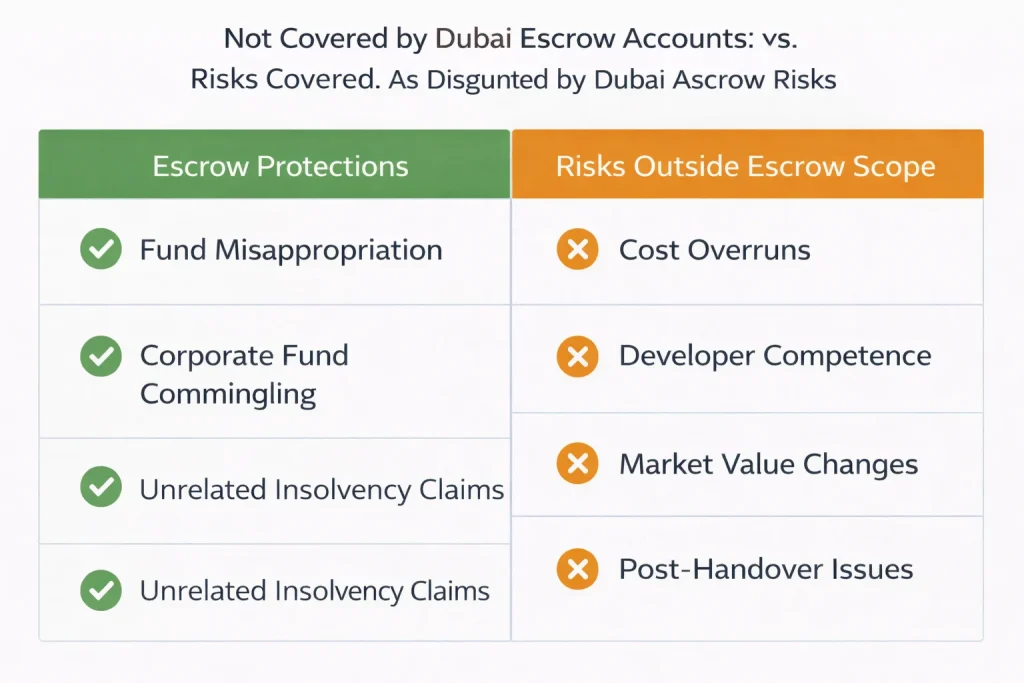
Prudent investors recognize that escrow functions as a risk mitigant within a defined scope, not a comprehensive risk eliminator. It does not constitute a guarantee of project completion. The following key risks remain outside escrow protection:
Project Feasibility and Budget Risk
Escrow does not ensure that developers have accurately projected total construction costs. If cost overruns exceed the budget funded by the escrow pool and the developer's equity contribution, projects may stall regardless of escrow compliance.
Developer Competence and Execution Risk
The system does not guarantee competent project management, construction quality, or adherence to specifications. Execution deficiencies can lead to delays, defects, or value deterioration even with compliant financial controls.
Market and Economic Risk
Investor capital remains exposed to market fluctuations. The property value at handover may differ materially from the purchase price. Escrow provides no protection against this economic risk.
Post-Handover Obligations
Escrow governance typically ceases upon project completion and unit handover. It provides no assurance regarding the fulfilment of developer warranties, management of common areas, or the establishment of effective owners' associations.
Common Investor Misconceptions
Have questions about this?
A 10-minute call with Mirza often saves weeks of research. No obligation — ask anything about your situation.
Several persistent misconceptions can create a false sense of security and undermine effective risk assessment.
Escrow Compliance Equals Developer Financial Health: Developers can be fully escrow-compliant on one project while experiencing financial stress as a corporate entity. This can materially impact their ability to resolve issues or deliver on commitments beyond milestone-based construction payments, making independent assessment of developer financial health essential.
Real-Time RERA Monitoring: While RERA establishes the framework and conducts periodic audits, the primary responsibility for initial verification falls on the investor. RERA does not actively monitor every transaction in real-time.
Escrow Prevents All Delays: While escrow prevents fund diversion, it cannot accelerate construction if developers face supply chain constraints, labour shortages, or management challenges.
Practical Escrow Verification Framework
Verification is a multi-step process that should be completed before contract execution or fund release. The following framework represents standard verification practices within an advisory-led investment strategy approach:
Project Registration Verification
Confirm the project holds official registration with RERA. This can typically be verified through the DLD or RERA digital platforms by searching for the project name or registration number. Unregistered projects cannot legally operate escrow accounts or sell units.
Escrow Account Number Confirmation
Obtain the project-specific escrow account number from the developer or authorized marketing agent. This should be a unique identifier, distinct from any corporate bank account. Cross-reference this number in the official SPA; it must be explicitly stated within the contract documentation.
Payment Routing Discipline
Direct all payments exclusively to the verified escrow account via bank transfer. Avoid making payments to developer corporate accounts, marketing company accounts, or any third-party accounts. Payment receipts should clearly state the project name and escrow account details.
Sales Purchase Agreement Review
Engage legal counsel experienced in UAE real estate to review the SPA. The contract should stipulate the escrow account number and bind the developer to accept payments only into that account. It should also clearly link payment milestones to specific construction phases.
Bank Confirmation Protocols
For significant investments, investors may, through legal representatives, seek confirmation from the escrow bank regarding the account's active status and its governing structure. While not always routine, this step represents thorough institutional-grade due diligence.
Execution Risk and Broader Due Diligence Context
The theoretical protection of escrow intersects with real-world execution variables. The system's integrity depends on consistent enforcement by all parties: developer adherence to account restrictions, rigorous bank validation of milestone evidence, and RERA's supervisory oversight.
Institutional investors typically layer escrow verification within a broader assessment framework that evaluates developer financial health, delivery track record, and the realism of the project's budget and construction timeline. They understand that escrow manages the symptom of cash flow diversion but does not address the underlying risk of a fundamentally non-viable project or inadequate developer capability.
Conclusion: Escrow as a Necessary, but Not Sufficient, Condition
For investors allocating capital to Dubai's off-plan market, verification of a properly constituted and RERA-mandated escrow account represents the baseline of transactional due diligence. It is the statutory system that transforms a purchase from an unsecured commitment into a structured obligation with defined safeguards.
However, escrow verification should mark the beginning of risk assessment, not its conclusion. A comprehensive investment framework treats escrow compliance as a necessary condition for proceeding, while simultaneously conducting independent analysis of developer capability, project economic fundamentals, and inherent market risks that no custodial mechanism can mitigate. Effective risk management combines disciplined adherence to verification protocols with clear understanding of the system's deliberate boundaries.
Frequently Asked Questions
What is the purpose of an escrow account in Dubai off-plan property transactions?
An escrow account is a mandatory statutory mechanism established under Dubai Law No. (8) of 2007 that ring-fences investor capital for a specific development project. It is designed to prevent fund misappropriation by ensuring that payments are held in a project-dedicated bank account and released to developers only upon verified completion of construction milestones. The escrow structure is a tripartite agreement between RERA, the developer, and an authorized UAE bank.
Does the presence of an escrow account guarantee that my property investment is safe?
No. While escrow accounts provide important protections against fund diversion and misappropriation, they do not constitute a guarantee of project completion or investment success. Escrow does not protect against project feasibility risks, developer execution competence, market value fluctuations, or post-handover obligations. Investors remain exposed to these risks regardless of escrow compliance.
How can I verify that a project has a legitimate escrow account?
Investors should undertake a multi-step verification process: First, confirm the project is officially registered with RERA through the DLD or RERA digital platforms. Second, obtain the project-specific escrow account number and verify it appears in your Sales Purchase Agreement. Third, ensure all payments are directed exclusively to this verified escrow account via bank transfer. Fourth, have legal counsel review your SPA to confirm escrow account details and payment milestone linkages. For significant investments, consider seeking bank confirmation of the account's active status through your legal representative.
What happens to escrow protections after my property is completed and handed over?
Escrow governance typically ceases upon project completion and unit handover. The escrow mechanism does not extend to post-handover matters such as developer warranty fulfilment, common area management, or owners' association establishment. Investors should address these concerns through separate contractual provisions and legal frameworks beyond the escrow system.
If a developer is escrow-compliant, does that mean the company is financially healthy?
Not necessarily. A developer can maintain full escrow compliance on one project while experiencing financial stress in other parts of its corporate structure. Escrow compliance addresses project-level fund segregation but does not reflect overall corporate financial health, management competence, or the company's ability to handle issues beyond milestone-based construction payments. Investors should conduct independent assessment of developer financial strength separately from escrow verification.
Does RERA actively monitor every escrow transaction to ensure compliance?
RERA establishes the regulatory framework and conducts periodic audits of the escrow system, but it does not monitor every transaction in real-time. The primary responsibility for initial verification and ongoing payment discipline falls on the investor. RERA's role is regulatory and supervisory rather than transactional monitoring of each individual payment.
Sources and official references
The bodies that set and enforce the rules behind escrow accounts and off-plan investment in Dubai and the wider UAE:
- Dubai Land Department (DLD) - regulator of RERA, project registration and off-plan escrow accounts
- Securities and Commodities Authority (SCA) - UAE regulation of investments, securities and funds
- Central Bank of the UAE - oversight of the authorised banks that hold escrow accounts
- UAE Government Portal - official guidance on investing and doing business in the UAE
Ready to take action?
Whether you're ready to start or still comparing options — we'll give you a straight answer.
Chat on WhatsApp
Usually replies within 2h
Get a Free Quote
Personalised in 60 seconds
Call Directly
Open daily, 10am–6pm UAE
About the Author
Dubai-based independent advisor on UAE visa, immigration, and offshore structuring. Founder of Henry Club UAE with 90+ published guides. Advisory-first — clarity before commitment.