
I help founders understand their options clearly before they commit to any structure, provider, or direction.
Quick Summary: Dubai Aviation License in 2026
- Regulatory authority: General Civil Aviation Authority (GCAA) federally, plus Dubai Civil Aviation Authority (DCAA) for Dubai-specific approvals. Free zone setups also fall under DAFZ regulation for airport-adjacent operations.
- License categories: Air operator (AOC), maintenance and repair organisation (MRO), flight training (ATO), ground services, drone operations, aviation consultancy — each with distinct GCAA approvals.
- Setup cost range: AED 25,000–310,000+ first year depending on category. AOC and MRO require substantial capital (AED 2,000,000+) and operational infrastructure.
- Best jurisdiction: DAFZ (Dubai Airport Free Zone) for airport-adjacent operations, DMCC for aviation consultancy/trading, mainland for ground services and training.
- Timeline: Non-regulated aviation activities (consultancy, parts trading) 3–6 weeks. Regulated AOC/MRO 6–12 months due to GCAA technical and safety inspections.
- Insurance & bonds: Mandatory aviation liability insurance per GCAA requirements; AOC operators also post operational bonds.
Aviation Business Licensing in Dubai
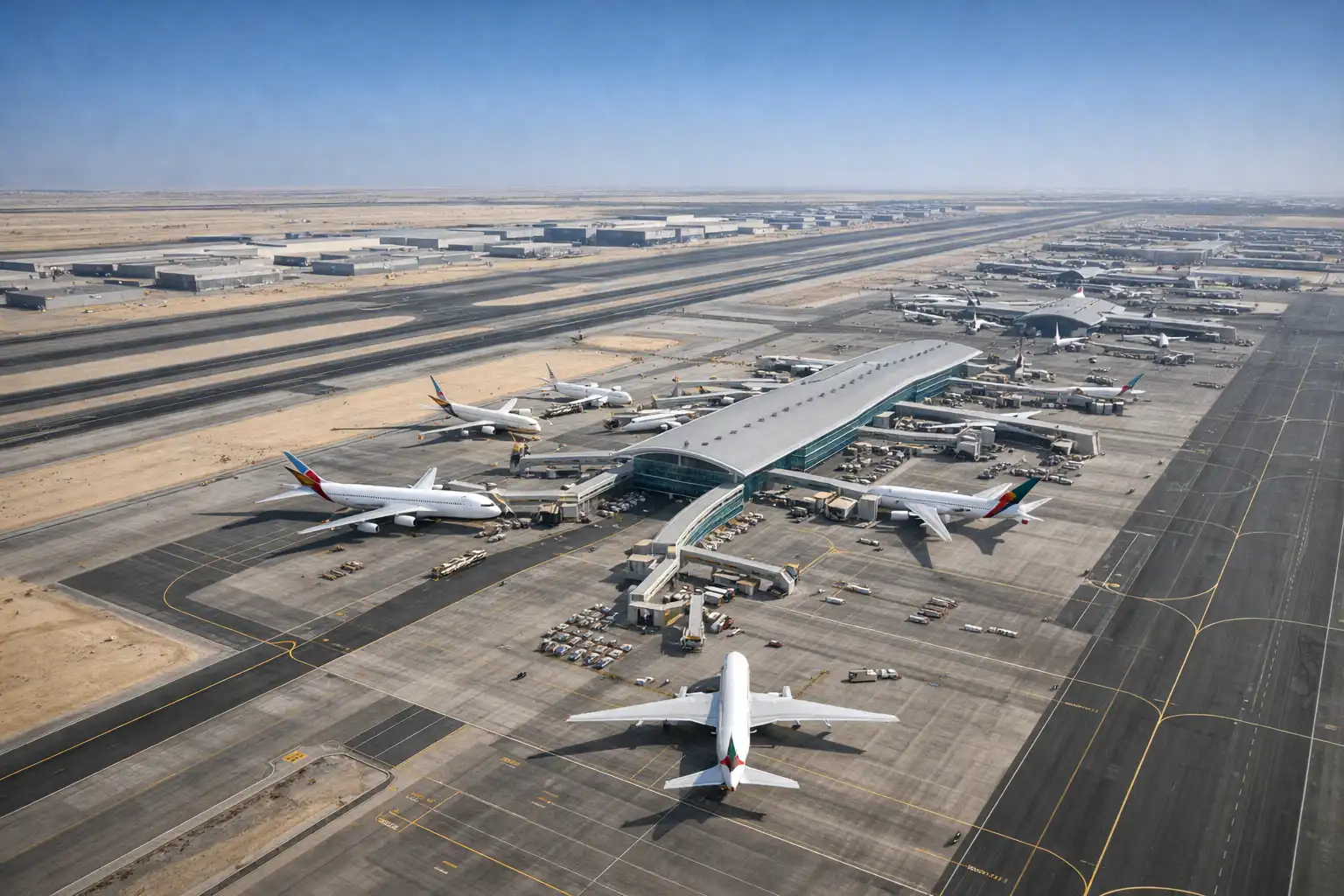
Dubai maintains a significant position in global aviation with substantial infrastructure and connectivity. For professionals, investors, and entrepreneurs, this represents opportunities in a specialized sector. The sections below cover options for those considering entry into aviation—whether launching a private charter service, an aircraft maintenance centre, an aviation consultancy, or a specialized parts trading business.
Securing an aviation license in Dubai is a detailed process that demands precision, regulatory understanding, and strategic planning. It differs fundamentally from obtaining standard commercial licenses. The framework involves multiple regulatory bodies, each with specific mandates. This guide demystifies that framework, providing a clear path from concept to operational approval, while being candid about investment requirements, timelines, and common challenges.
Understanding the Aviation License: Scope and Authority
An aviation license in Dubai is formal approval to conduct commercial activities related to aircraft, their operations, or support services. The critical distinction lies in which authority grants final approval. Your business setup entity (a Free Zone or the Dubai Department of Economy and Tourism) issues your trade license, but your operational capability comes from the aviation regulator.
There are two primary regulatory authorities:
The General Civil Aviation Authority (GCAA): This is the federal authority of the UAE. It holds oversight over civil aviation in the country, including air operator certificates, aircraft registration, and crew licensing. For many activities, GCAA approval is required and represents the most stringent part of the process.
The Dubai Civil Aviation Authority (DCAA): This emirate-level body regulates aviation activities within Dubai's territory, focusing on airspace management, airport operations, and oversight of certain service providers based in Dubai.
Your specific activity determines which regulator takes the lead and affects the complexity of your licensing journey.
Types of Aviation Licenses and Core Activities
Aviation businesses fall into two broad categories: operational and non-operational. Your category significantly affects the entire setup process.
Non-Operational (Support Services) Licenses
These involve supporting the aviation industry without directly operating aircraft. They are generally less complex to secure.
- Aviation Consultancy: Providing expert advice on safety, regulations, operations, or startup planning.
- Aircraft/Aviation Parts Trading: Sourcing, selling, and supplying components. This often requires demonstrating secure storage and traceability systems.
- Aviation Training Simulator Services: Operating flight simulation devices for training purposes (different from a full flight school).
- Corporate Aviation Management: Managing aircraft assets, crew, and logistics for private owners or corporations.
Operational Licenses
These involve the direct operation, maintenance, or charter of aircraft. They are complex, capital-intensive, and require demonstrated technical and financial competency.
- Air Operator Certificate (AOC) for Charter/Airline: Allows you to operate aircraft for commercial hire (charter) or scheduled flights (airline). The process is comprehensive, involving detailed manuals, proven procedures, and rigorous GCAA audits.
- Aircraft Maintenance Organization (AMO) License: Allows you to perform certified maintenance, repair, and overhaul (MRO) on aircraft. Requires approved facilities, tools, and GCAA-certified personnel.
- Ground Handling Services: Providing services like baggage handling, ramp operations, and passenger services at airports. Requires approval from both the regulator and the specific airport authority.
- Flight Training Organization (FTO) License: Operating a flight school. Requires approved aircraft, training curricula, simulators, and certified instructors.
The Foundational Choice: Jurisdiction and Business Structure
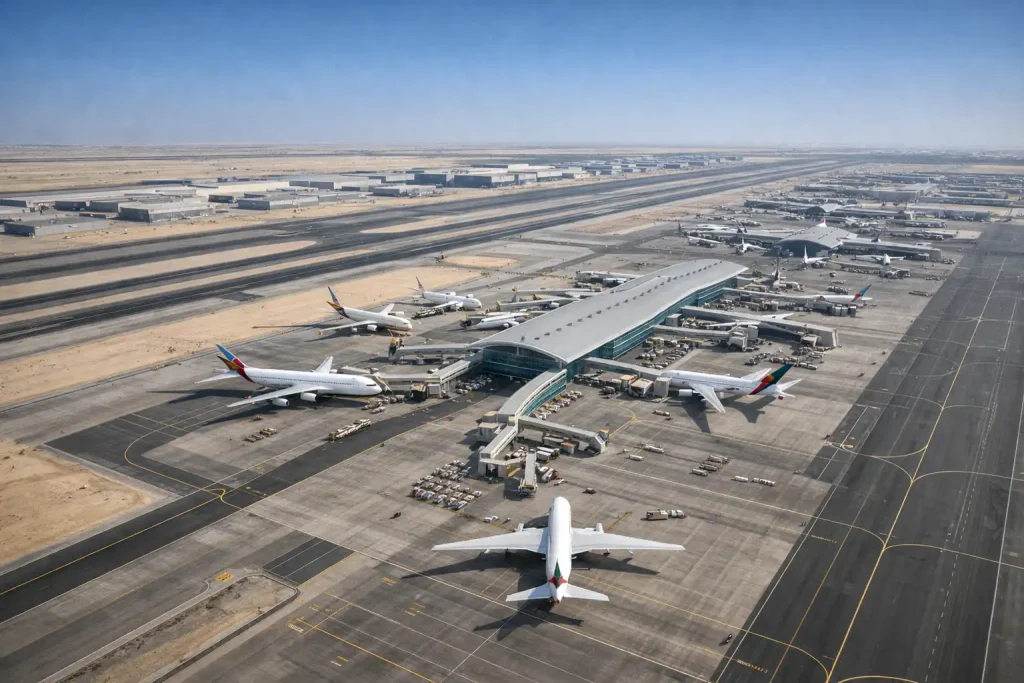
Your choice of where to establish your company is an important strategic decision.
Mainland Dubai (DED License)
A mainland company licensed by the Dubai Department of Economy and Tourism allows you to operate across the UAE. This is typically necessary for businesses that need to serve clients at all UAE airports or provide nationwide services. For operational licenses like an AOC or AMO, the GCAA works with your mainland entity. The mainland allows for 100% foreign ownership in the aviation sector.
Free Zone Establishment
When evaluating UAE free zone options, many zones offer tailored packages for aviation businesses. They provide 100% ownership, streamlined administration, and often proximity to airport infrastructure. However, a key consideration is that free zone companies are legally domiciled within that zone. For an operational license, the GCAA will still require you to demonstrate a physical operational base, such as a hangar or office, that meets their standards. That base may or may not be inside the free zone itself.
Popular aviation-focused jurisdictions include:
- Dubai South (Dubai World Central): A significant aviation free zone, built around Al Maktoum International Airport. It suits MROs, FBOs, cargo operators, and logistics operations. It offers direct runway access and integrated logistics parks.
- Dubai International Airport Free Zone (DIAFZ): Located at Dubai International (DXB), suitable for businesses serving the passenger hub, such as catering, parts supply, and corporate aviation services.
- Dubai Silicon Oasis (DSO): While technology-focused, DSO has attracted aviation technology startups, drone service providers, and software firms specializing in aviation solutions.
For comprehensive evaluation of zone options, reviewing a detailed comparison of UAE free zones can help inform your decision.
The Step-by-Step Licensing Process
The process is sequential and milestone-driven. Stages cannot typically be skipped. For operational licenses, expect a timeline of approximately 9 to 18 months from inception to certification, though this can vary significantly based on complexity.
Pre-Application & Feasibility (Months 1-3)
This phase focuses on validation and planning.
Define Your Exact Activity: Precision is critical. "Aviation services" is insufficient. You must specify, for example, "Non-Scheduled Commercial Air Transport (Charter) of Helicopters."
Develop a Comprehensive Business Plan: This must include a detailed operational plan, financial projections for at least three years, proof of funding, and a clear organizational structure. For an AOC, this plan undergoes thorough GCAA review.
Select and Secure Your Jurisdiction: Incorporate your legal entity (LLC or FZCO) on the mainland or in a free zone. This provides the legal vehicle to apply for aviation approvals.
Pre-application Meeting with the GCAA: This is a formal, recommended step. You present your business plan and proposed operations to the GCAA. They provide initial feedback and a roadmap of specific requirements.
Documentation & Formal Application (Months 4-8)
You develop your certification package.
Appoint Key Personnel: The GCAA requires pre-approval of key post-holders (Accountable Manager, Head of Operations, Chief Engineer for AMO, etc.). Their CVs and qualifications are submitted for vetting.
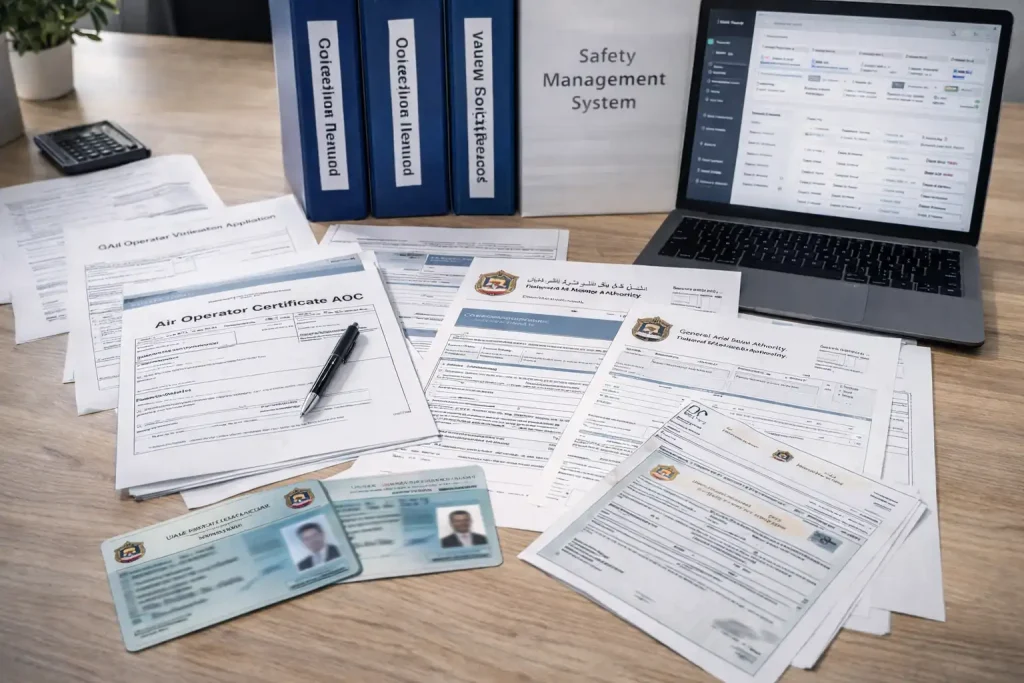
Develop the Required Manuals: This is central to your application. You must write and submit company manuals (Operations Manual, Safety Management System Manual, Maintenance Control Manual, etc.) that demonstrate you have documented, compliant procedures.
Secure Infrastructure: Present evidence of your approved office, operations centre, and for MROs/airlines, your hangar or maintenance facility lease agreements.
Submit Formal Application: Submit the complete documentation package to the GCAA (and DCAA if applicable) along with required fees.
Audit, Demonstration & Certification (Months 9-18+)

The regulator verifies your readiness.
Document Compliance Audit: GCAA auditors review your submitted manuals in detail, requesting clarifications or changes as needed.
Facility and Infrastructure Audit: Regulators conduct on-site audits of your offices, facilities, and equipment to ensure they match your manuals and regulations.
Demonstration Flights or Practical Assessments (For AOC/FTO): You must demonstrate operational competency. For an AOC, this involves proving flights under GCAA observation.
Certificate Issuance: Upon successful completion of all audits and demonstrations, the GCAA issues your operational certificate (AOC, AMO License, etc.). Your business can then commence commercial activities.
Costs: A Realistic Investment Breakdown
Have questions about this?
A 10-minute call with Mirza often saves weeks of research. No obligation — ask anything about your situation.
Costs are highly variable. A non-operational trading license may cost under AED 100,000, while an AOC can require substantially more. The table below provides a framework for different activity levels. These figures are estimates and can vary significantly based on specific requirements and complexity.
| Cost Component | Non-Operational (e.g., Trading) | Operational (e.g., MRO Startup) | Notes |
|---|---|---|---|
| Government & Entity License Fees | AED 25,000 - AED 50,000 | AED 50,000 - AED 120,000 | Includes DED/Free Zone license and initial GCAA application fees |
| Regulatory & Certification Fees | AED 15,000 - AED 30,000 | AED 200,000 - AED 500,000+ | GCAA/DCAA fees for document review, audits, and certificate issuance |
| Professional & Consultancy Fees | AED 40,000 - AED 80,000 | AED 150,000 - AED 300,000 | Essential for navigating regulations and drafting compliant manuals |
| Facility Lease (Annual) | AED 70,000 - AED 150,000 | AED 300,000 - AED 1,000,000+ | Office vs. Hangar. Airport-adjacent space commands premium rates |
| Key Personnel Costs | N/A | AED 500,000+ | Salaries for pre-approved, certified managers and staff (excluded from setup capital) |
| Estimated First-Year Setup Capital | AED 150,000 - AED 310,000 | AED 1,200,000 - AED 2,000,000+ | Excludes aircraft purchase/lease, heavy equipment, or large workforce salaries |
For detailed cost planning, a business setup cost calculator can help estimate total investment requirements. Aviation businesses typically require substantially higher investment than standard commercial setups.
Advantages and Limitations
Strategic Advantages
- Hub Positioning: Direct access to a major aviation network with strong East-West connectivity.
- Regulatory Standards: The GCAA maintains international aviation standards (ICAO compliant), and holding a UAE certificate carries international recognition.
- Growing Market: A substantial tourism sector, expanding fleets, and strategic location drive demand for aviation services.
- Tax Framework: Understanding UAE corporate tax requirements is important, as competitive provisions exist for internationally focused businesses, with benefits for aircraft trading or leasing in certain free zones.
Practical Limitations
- High Barriers to Entry: Significant capital, expertise, and time are required. The process is designed to ensure only well-prepared entities succeed.
- Ongoing Compliance Requirements: The industry is heavily regulated. You will face regular surveillance audits, mandatory training, and constant updates to procedures.
- Competitive Market: You are entering a market with established international and local operators. Clear specialization is often important for success.
- Dependence on Key Personnel: Your license is tied to GCAA-approved post-holders. Losing a Chief Pilot or Accountable Manager can affect operations significantly.
Common Mistakes and How to Avoid Them
Mistake 1: Underestimating the Role of the Business Plan
Viewing the business plan as just a funding document is an error. The GCAA treats it as a primary source for evaluating your operational and financial viability. It must be aviation-specific and exceptionally detailed.
Mistake 2: Using Generic Manual Templates
Using generic templates or inexperienced writers for your operations manuals typically leads to rejection. These documents must be bespoke, reflect your actual planned procedures, and be fully understood by your team.
Mistake 3: Appointing Key Personnel Too Late
Your post-holders are not employees you hire after getting the license; they are integral to the application. Engage your Accountable Manager and technical leads from the earliest phase. Their expertise shapes your application.
Mistake 4: Confusing Trade License with Aviation Certification
Securing a Free Zone trade license with an aviation activity listed does NOT permit you to operate aircraft. It is merely the first step. The GCAA certificate is the critical, separate authorization that grants operational authority.
Mistake 5: Inadequate Financial Planning
Many applicants budget for setup but fail to secure the 6-12 months of working capital required. That capital sustains the company through the pre-certification phase and early operations, before revenue stabilizes.
Who Might Consider Alternatives?
A dedicated Dubai aviation license may not be necessary for:
- Drone Service Providers: Small-scale commercial drone operations may fall under different regulatory categories handled by the DCAA, not requiring a full GCAA commercial aviation license.
- General Sales Agents (GSAs) for Airlines: If you are selling tickets on behalf of a foreign airline, you typically operate under that airline's existing AOC. That requires a standard commercial sales license, not an aviation operational license.
- Aviation Media or Publishing Companies: If your business is reporting on or creating content about aviation, a standard media or publishing license is appropriate.
- Individuals Seeking Only a Private Pilot License: This is a personal certification, not a business license. You would train at an existing, licensed FTO.
Practical Use Cases and Scenarios
Case 1: The European MRO Company Establishing a Regional Hub
An established European maintenance company wants a centre in the Middle East to service growing regional fleets.
Action: They incorporate a Free Zone Company in Dubai South, leasing a hangar. They then apply for and work toward securing a GCAA-approved AMO license. Their existing manuals are adapted to GCAA standards, and their appointed Chief Engineer undergoes approval by the regulator.
Case 2: The High-Net-Worth Individual Starting a Private Charter Fleet
An investor wants to operate a fleet of luxury jets for private charter.
Action: They establish a mainland LLC, secure capital, and prepare to acquire or lease aircraft. They hire an experienced aviation management team to lead the application for an AOC (Non-Scheduled) from the GCAA. The process focuses on demonstrating safe operational procedures for private charters.
Case 3: The Entrepreneur Launching an Aviation Parts Marketplace
An entrepreneur aims to create a digital B2B platform for trading certified aircraft parts.
Action: They obtain a non-operational "Aircraft Parts Trading" license in a free zone. They focus on securing a bonded warehouse and building a robust quality assurance system to ensure part traceability, which is important for client and regulator confidence.
Taking Your Next Steps
Begin with rigorous self-assessment. Consider:
- What is your exact, precise aviation activity?
- Do you have access to the necessary technical expertise and capital for the long process?
- Is your primary market international, regional, or within the UAE? This helps answer the mainland vs. free zone question.
If your assessment points toward a complex operational license, your first investment should be in expert guidance. Engage a consultant with demonstrated experience in GCAA certifications. They can help you navigate the pre-application phase, avoid critical errors, and develop a realistic timeline and budget. Understanding UAE business banking requirements is also important, as corporate banking access will be essential. For visa planning as you build your team, reviewing UAE visa and immigration procedures will be valuable.
Prepare your initial business plan draft and start researching available, approved key personnel in the market. Simultaneously, reach out to free zone authorities and infrastructure providers to understand facility options and costs.
The path to an aviation license in Dubai is detailed and requires sustained effort. It is designed to ensure high standards of safety and professionalism. For those prepared to meet that standard, the opportunities in this specialized sector can be substantial. Your journey begins with a plan that matches the operational rigor of the activities you intend to conduct.
Frequently Asked Questions
How much does it cost to set up an aviation business in Dubai?
Costs depend entirely on the license category. A non-operational setup such as parts trading or consultancy typically runs an estimated first-year capital of AED 150,000 to AED 310,000. An operational venture like an MRO startup is far heavier, with estimated first-year capital of AED 1,200,000 to AED 2,000,000 or more. These figures exclude aircraft purchase or lease, heavy equipment, and large workforce salaries, and vary with specific requirements.
How long does it take to get an aviation license in Dubai?
Timelines split by activity type. Non-regulated aviation work such as consultancy or parts trading can be completed in roughly three to six weeks. Regulated operational certificates like an AOC or MRO take far longer, generally six to twelve months. The page also notes operational licenses can run nine to eighteen months from inception to certification. The delay reflects GCAA technical and safety inspections, document audits, and practical demonstrations.
Which authority regulates aviation businesses in Dubai?
Two regulators are involved. The General Civil Aviation Authority (GCAA) is the federal body overseeing civil aviation, including air operator certificates, aircraft registration and crew licensing. It represents the most stringent part of the process. The Dubai Civil Aviation Authority (DCAA) is the emirate-level body covering airspace management, airport operations, and certain Dubai-based service providers. Your exact activity decides which regulator leads and how complex the journey becomes.
Is a free zone trade license enough to operate aircraft in Dubai?
No, and this is a common and costly misunderstanding. Securing a free zone trade license with an aviation activity listed does not permit you to operate aircraft. It is only the first step. Your business setup entity issues the trade license, but operational authority comes separately from the GCAA. For operational licenses the GCAA also requires you to demonstrate a physical operational base, such as a hangar or office, that meets its standards.
What is the difference between operational and non-operational aviation licenses?
Non-operational licenses support the industry without flying aircraft, covering aviation consultancy, aircraft parts trading, training simulator services, and corporate aviation management. They are generally less complex and cheaper to secure. Operational licenses involve directly operating, maintaining, or chartering aircraft, including the Air Operator Certificate, Aircraft Maintenance Organization license, ground handling, and flight training. These are capital-intensive and demand proven technical and financial competency plus rigorous GCAA audits and demonstrations.
Where is the best place in Dubai to establish an aviation company?
It depends on your activity. Dubai South, built around Al Maktoum International Airport, suits MROs, FBOs, cargo and logistics operators with direct runway access. Dubai International Airport Free Zone fits businesses serving the passenger hub, such as catering and parts supply. A mainland license from the Dubai Department of Economy and Tourism lets you operate across the UAE and is typical for ground services and training. All these routes allow full foreign ownership.
What are the most common mistakes when applying for a Dubai aviation license?
The guide flags several. Treating the business plan as merely a funding document, when the GCAA uses it to judge operational and financial viability. Using generic manual templates, which usually leads to rejection. Appointing key personnel too late, when post-holders should be involved from the earliest phase. Confusing the trade license with GCAA certification. And inadequate financial planning, where applicants fail to secure six to twelve months of working capital to sustain the company before revenue stabilises.
Sources & Official References
The information in this guide reflects current UAE federal and emirate-level regulations. For the most up-to-date figures and procedures, consult the official sources below:
- General Civil Aviation Authority (GCAA) — UAE federal civil aviation regulator — AOC, MRO and ATO approvals.
- Dubai Civil Aviation Authority (DCAA) — Dubai aviation regulator for emirate-specific approvals.
- Dubai Airport Free Zone (DAFZ) — DAFZ free zone authority for airport-adjacent aviation businesses.
Have a question about this?
Leave your details and a UAE expert will get back to you within 1 business day — free, no obligation.
Ready to take action?
Whether you're ready to start or still comparing options — we'll give you a straight answer.
Chat on WhatsApp
Usually replies within 2h
Get a Free Quote
Personalised in 60 seconds
Call Directly
Open daily, 10am–6pm UAE
About the Author
Dubai-based independent advisor on UAE visa, immigration, and offshore structuring. Founder of Henry Club UAE with 90+ published guides. Advisory-first — clarity before commitment.