
I help founders understand their options clearly before they commit to any structure, provider, or direction.
Quick Summary: Hospital Setup in Dubai
- Who licenses it: The Dubai Health Authority (DHA) is the central regulator, requiring both a commercial business license and a separate healthcare facility license, typically as a mainland company now eligible for 100% foreign ownership.
- Timeline: The full journey from feasibility through design, construction, and final commissioning typically spans 3 to 5 years and is milestone-driven, with each phase requiring formal approval before the next.
- Capital required: Estimated total capital ranges from around AED 300–534 million for a 100-bed secondary-care hospital to AED 583 million–1.05 billion+ for a 150-bed tertiary/specialty facility.
- Approval sequence: DHA preliminary approval of the hospital design must be secured before Dubai Municipality construction permits are issued – building without approved designs causes major delays and redesign costs.
- Facility levels: The DHA classifies hospitals as Secondary Care, Tertiary/Specialty, or Specialized Surgical, which dictates the scope of services and influences investment scale.
- Alternatives: Individual doctors, diagnostic providers, and MedTech firms may instead pursue clinics, day surgery centres, diagnostic-centre licenses, or a standard commercial technology license.
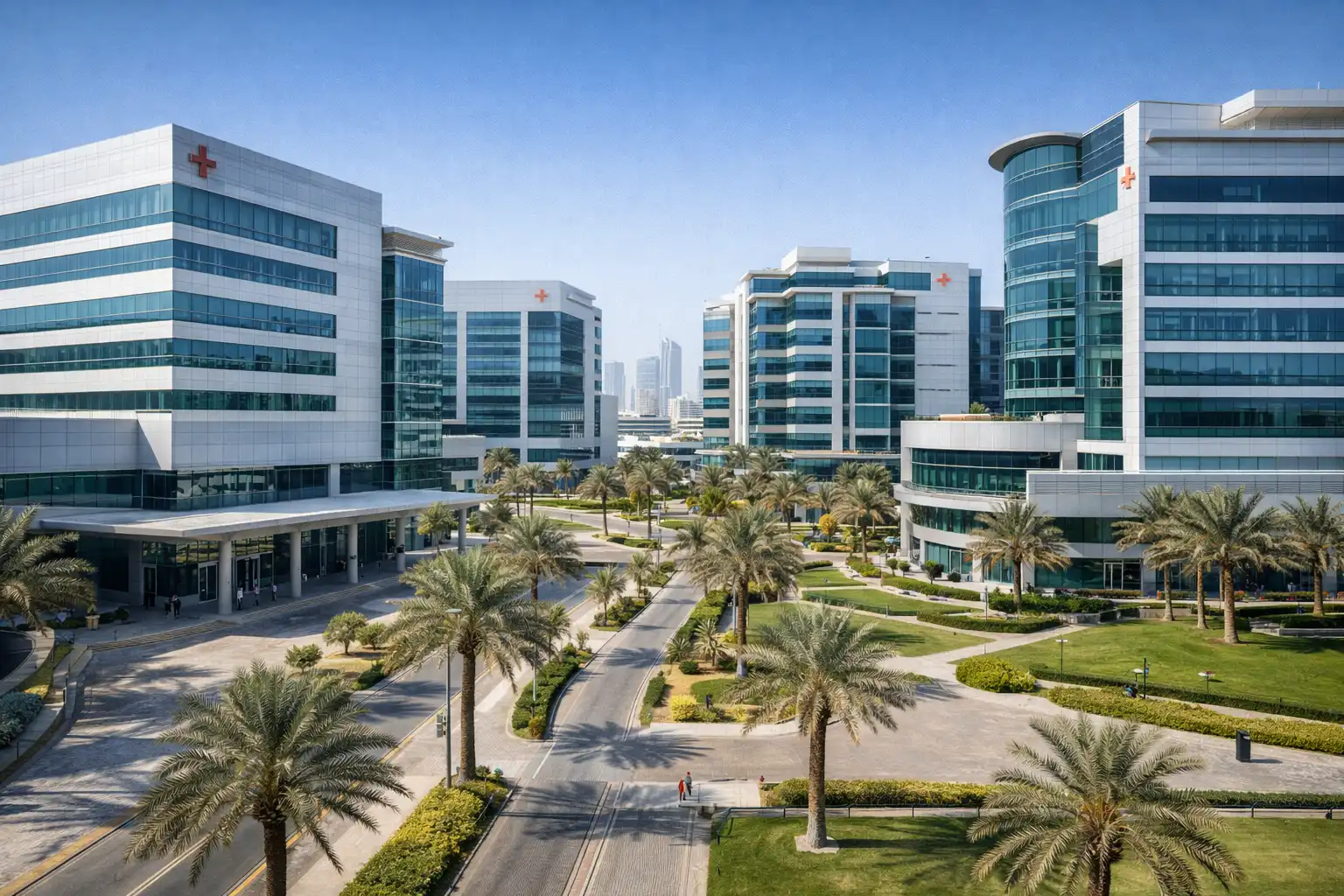
Quick answer: Setting up a hospital in Dubai is a capital-intensive, multi-year project licensed by the Dubai Health Authority (DHA), typically run as a mainland company (now eligible for 100% foreign ownership) alongside a separate healthcare facility license. From feasibility and DHA design approval through construction and final commissioning, the journey usually takes 3 to 5 years, with capital ranging from around AED 300 million for a 100-bed secondary-care hospital to over AED 1 billion for a tertiary or specialty facility. DHA preliminary approval of the design must be secured before construction permits are issued.
Building a Healthcare Institution in Dubai
Establishing a hospital in Dubai is a significant undertaking that requires visionary planning and meticulous regulatory compliance. The sections below cover options for healthcare investors, established hospital groups, and medical professionals seriously evaluating Dubai as a strategic platform for healthcare delivery. This process differs fundamentally from setting up a clinic or standard business; it is a multi-year, capital-intensive project that operates at the intersection of real estate, advanced medicine, and regulatory oversight.
Dubai's healthcare landscape is characterized by high patient expectations, a comprehensive regulatory environment led by the Dubai Health Authority (DHA), and a competitive market that rewards differentiation and quality. The sections below provide a step-by-step roadmap through this complex journey, addressing critical stages from initial feasibility studies to final commissioning, while being transparent about substantial investment requirements, timelines, and strategic decisions required.
Understanding the Framework: Licenses, Classifications, and Authorities
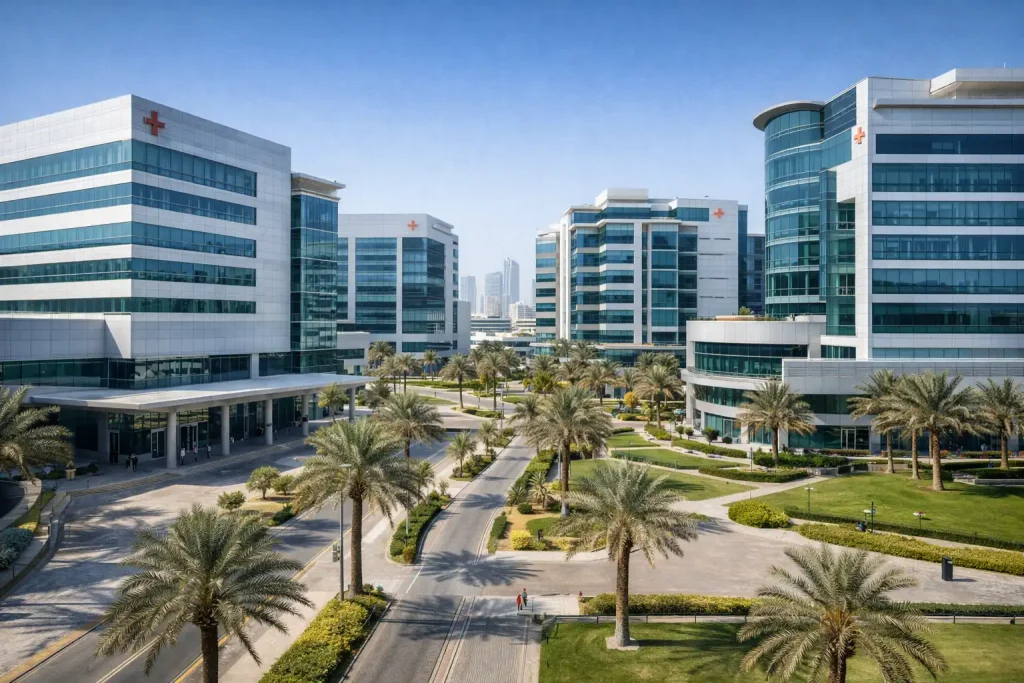
Hospital setup in Dubai requires two primary layers of approval: the commercial business license and the healthcare facility license. These are governed by separate authorities with distinct mandates.
The Dubai Health Authority (DHA) is the central healthcare regulator. Healthcare facilities require DHA licensing and regular oversight. The DHA classifies hospitals into levels that dictate the scope of services allowed and influence investment scale:
Secondary Care Hospital: Provides general acute care, including major specialties like internal medicine, general surgery, pediatrics, and obstetrics/gynecology. It has intensive care units and operates 24/7.
Tertiary Care/Specialty Hospital: Focuses on advanced, specialized medical fields such as cardiac surgery, neurosurgery, organ transplantation, or advanced oncology. It includes all secondary care capabilities plus highly specialized departments and technology.
Specialized Surgical Hospital: Typically a facility focused on elective surgeries in a specific domain, such as orthopedics, ophthalmology, or cosmetic surgery. It may not have full emergency department capabilities.
Concurrently, you must establish a legal business entity. This is typically done through the Dubai Department of Economy and Tourism (DED) for a mainland company, allowing you to serve the UAE population and access the public insurance network. Some investors also consider specific free zones like Dubai Healthcare City (DHCC), which operates under its own regulatory authority but is generally tailored for outpatient clinics and laboratories rather than full-scale inpatient hospitals.
The Phased Journey: From Concept to Commissioning
The process for hospital setup is milestone-driven. You typically cannot proceed to the next phase without formal approval from the previous one. The entire timeline, from initial planning to admitting the first patient, typically spans 3 to 5 years, though this can vary significantly based on project complexity.
Strategic Planning & Feasibility (6-9 Months)
This phase determines if your project is viable and aligned with Dubai's healthcare priorities.
Develop a Comprehensive Feasibility Study: This must include detailed market analysis, demand assessment for your proposed specialties, patient demographic study, full financial model (capex, opex, revenue projections), and health services plan.
Submit a Letter of Intent (LOI) to the DHA: You formally present your initial concept, including the proposed location, bed capacity, and key specialties. The DHA provides initial feedback on the proposed facility.
Secure Initial Investor Approvals and Land: Based on the feasibility study, secure funding commitments. Simultaneously, identify and secure a plot of land that complies with DHA zoning requirements for healthcare facilities. Hospital design cannot begin without a confirmed site.
Design & Preliminary Approvals (12-18 Months)
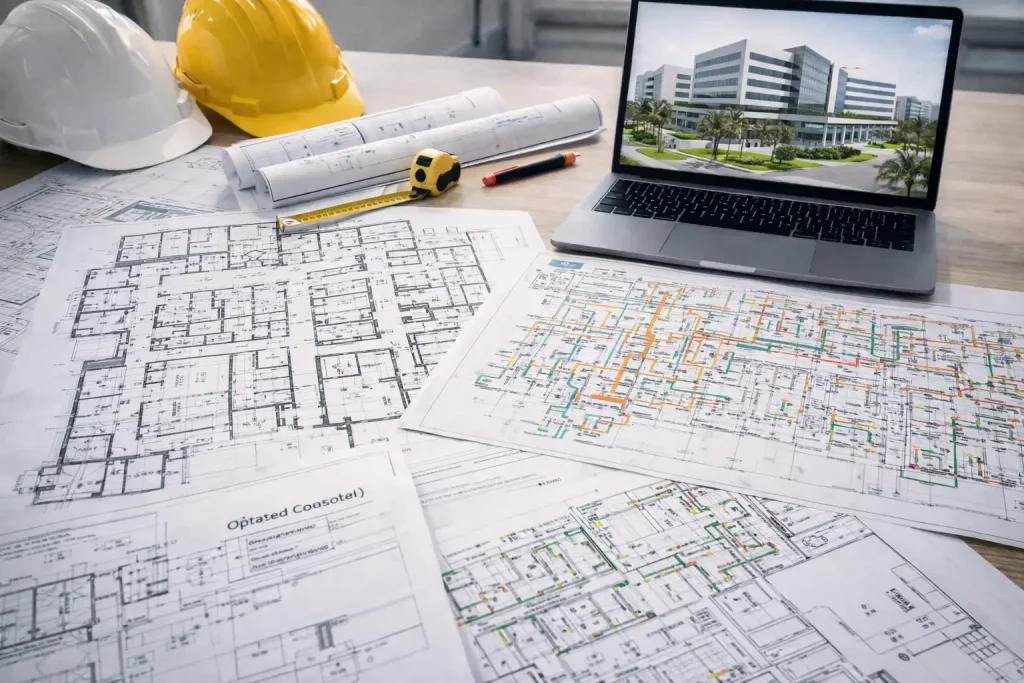
This phase transforms your concept into engineered plans.
Appoint a Design Team: Hire an architect, medical planner, and engineering consultants with demonstrated experience in DHA-compliant hospital design.
Develop Preliminary & Detailed Design: Create schematics that detail departmental layouts, patient flow, infection control zones, and engineering systems. These designs must align with DHA healthcare facility design requirements.
Obtain DHA Preliminary Approval (PA): Submit all design documents for review. DHA engineers and clinicians assess them for compliance with space, safety, and operational standards. This is typically an iterative process with multiple rounds of feedback.
Secure Dubai Municipality Building Permits: Once DHA PA is granted, you can apply for standard construction permits from Dubai Municipality and other entities like Civil Defence for safety plans.
Construction & Pre-Licensing (18-24 Months)
Commence Construction: The building is erected under supervision to ensure it matches approved designs.
Apply for a Healthcare Facility License (HFL): As construction nears completion, you apply for the operating license. This involves submitting comprehensive documentation including:
- Finalized policies and procedures for all clinical and administrative areas
- CVs and DHA licenses for all proposed key medical and administrative staff (CEO, Medical Director, Heads of Departments)
- Evidence of medical equipment procurement and service contracts
- Proof of IT and health information systems
DHA Final Inspection & Commissioning: A multidisciplinary team from the DHA conducts thorough on-site inspection. They verify that the built environment, staff, and procedures are ready for patient care. This inspection is comprehensive and often requires follow-up.
Operational Licensing & Launch
Receive Initial Operational License: Upon passing the final inspection, the DHA issues the Healthcare Facility License, which is typically valid for one year and subject to renewal.
Commence Operations: You can begin admitting patients. The first year involves monitoring by the DHA through regular performance and quality indicator reporting.
Costs: A Realistic Investment Breakdown
Have questions about this?
A 10-minute call with Mirza often saves weeks of research. No obligation — ask anything about your situation.
Setting up a hospital represents capital investment on a substantial scale. Costs vary significantly based on location, specialty, and technology level. The figures below are planning estimates for a mid-range facility. These are approximate figures and actual costs can vary considerably based on specific project requirements.
| Cost Component | Secondary Care Hospital (100 Beds) | Tertiary/Specialty Hospital (150 Beds) | Notes |
|---|---|---|---|
| Land Acquisition & Construction | AED 200 - 350 Million | AED 400 - 700 Million+ | Largest cost driver. Includes shell & core and basic MEP fit-out |
| Medical Equipment & IT Systems | AED 80 - 150 Million | AED 150 - 300 Million+ | Includes imaging (MRI, CT), surgical equipment, and hospital information system |
| DHA & Government Fees | AED 2 - 4 Million | AED 3 - 6 Million | Includes all design approvals, licensing, and inspection fees |
| Pre-Opening & Working Capital | AED 20 - 30 Million | AED 30 - 50 Million | Covers staffing, training, marketing, and 6-12 months of operating expenses before breakeven |
| Estimated Total Capital Requirement | AED 300 - 534 Million | AED 583 Million - 1.05 Billion+ | Excludes potential financing costs. Land may be leased to reduce upfront capex |
For context on broader business setup costs, a business setup cost calculator can provide baseline estimates, though hospital projects require substantially higher investment than standard commercial setups. Understanding healthcare financing options and UAE corporate tax implications for large healthcare investments is also important for financial planning.
Advantages and Strategic Benefits
- Access to a Growing Market: A substantial and increasingly affluent population with high healthcare expectations and growing health insurance penetration creates sustained demand.
- Regional Platform: A successful hospital in Dubai can serve as a reference for expansion across the Middle East, Africa, and South Asia regions.
- Regulatory Framework: The DHA provides a structured pathway. Their standards align with international best practices, which can facilitate international accreditation.
- Talent Attraction: Dubai's lifestyle and tax environment can help recruit internationally trained medical and nursing staff. Understanding UAE visa and immigration procedures is important for staff recruitment and sponsorship.
- Partnership Opportunities: There are opportunities for public-private partnerships with government health authorities, offering stable patient referrals.
Challenges and Operational Realities
- High Capital Intensity: The barrier to entry is substantial. Return on investment is long-term, often spanning 7-10 years or more.
- Market Competition: The market includes established public hospitals and prestigious private brands. Differentiation is critical.
- Complex Regulatory Process: The multi-phase approval process requires patience, expertise, and constant engagement with the DHA. Delays in any stage can cascade.
- Talent Retention Considerations: While attracting staff is possible, retaining them in a competitive labour market requires strong compensation, professional development, and work environment.
- Operational Complexity: Managing a hospital involves navigating insurance company relationships, medical malpractice considerations, and 24/7 operations.
Common Mistakes and How to Avoid Them
Mistake 1: Underestimating the Feasibility Study
Treating this as a superficial document is an error. The DHA and investors will scrutinize it carefully. It must be data-driven, validate the need for your specific services, and present a realistic financial model. Engage specialist healthcare consultancy firms.
Mistake 2: Designing Before Engaging the DHA
Beginning architectural design without DHA input leads to costly rework. The DHA's design requirements are specific. Involve the DHA planning department from the earliest conceptual stage and design to their standards from the outset.
Mistake 3: Appointing Key Leaders Too Late
Your CEO, Medical Director, and Director of Nursing should be hired during the design phase, not after construction. Their operational insights are valuable for designing an efficient, safe, and workflow-optimized facility.
Mistake 4: Under-Budgeting for Medical Technology
The equipment list represents a core capital cost. Technology changes rapidly. Budget for not just purchase, but installation, calibration, and long-term service contracts.
Mistake 5: Neglecting the Commissioning Plan
The transition from construction site to operational hospital is a major operational undertaking. Plan for a phased opening, extensive staff training simulations, and detailed commissioning protocol for every clinical department.
Who Might Consider Alternatives?
A full hospital setup may not be the right initial path for:
- Individual Doctors or Small Groups: For practicing physicians, establishing an outpatient Day Surgery Centre or Multi-Specialty Clinic under a DHA medical license is a more achievable and cost-effective entry point.
- Diagnostic Service Providers: Companies focused on imaging (MRI, PET-CT) or laboratory services should pursue a dedicated Diagnostic Centre License, which has a separate setup process.
- Healthcare Technology or MedTech Companies: Firms selling software, medical devices, or digital health solutions do not need a healthcare facility license. They require a standard commercial technology license.
- Home Healthcare Providers: This sector operates under a specific Home Healthcare License, which does not require constructing a physical inpatient facility.
Practical Use Cases and Scenarios
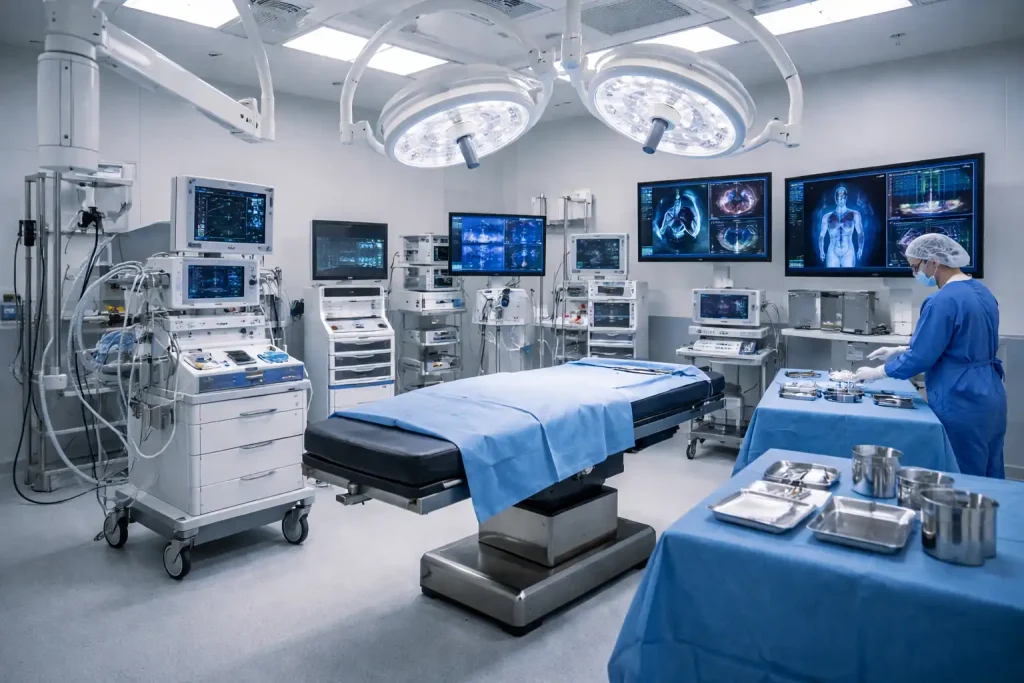
Case 1: The Asian Hospital Group Expanding Regionally
A reputable hospital chain from Southeast Asia wants to establish its first Middle East presence.
Action: They form a mainland LLC with 100% foreign ownership. They partner with a local real estate developer to lease a purpose-built building. They focus their feasibility study on introducing their specialized services that are in demand in Dubai. They hire a project manager with direct DHA experience.
Case 2: The Investor-Led Specialty Surgical Hospital
A consortium of private investors identifies an opportunity in orthopedics and sports medicine.
Action: They plan a specialized surgical hospital. Their feasibility study emphasizes outpatient and short-stay surgical volumes. They secure a location near residential communities. Their design focuses on efficient operating theatre turnover and advanced rehabilitation facilities.
Case 3: The Niche Pediatric Care Centre
A group of pediatric specialists aims to create a dedicated children's hospital.
Action: They pursue a tertiary care license with a focus on complex pediatric subspecialties. Their design process focuses on child-friendly environments, specialized pediatric equipment, and facilities for family accommodation. They plan partnerships with international pediatric centres for knowledge transfer.
Taking Your Next Steps
Your journey begins with assessment and expert guidance. Consider:
- Do you have access to long-term capital in the range of hundreds of millions of dirhams?
- What is your defensible niche or competitive advantage that the Dubai market needs?
- Do you have, or can you attract, the leadership team with the clinical excellence and regulatory experience to guide this project?
If these conditions are met, your immediate next step is to commission a rigorous, impartial feasibility study from a consultant with a track record in UAE healthcare projects. This report will serve as your strategic foundation.
Simultaneously, initiate preliminary dialogue with the DHA's healthcare planning department to validate your core concept. Begin identifying potential sites that meet zoning and accessibility requirements. Understanding UAE business banking requirements for large capital projects is also important for operational planning.
Finally, assemble your core project team: a healthcare-specific project manager, a design architect with DHA experience, and a financial advisor. In hospital setup, the quality of your preparation directly affects project viability. This is a substantial undertaking that rewards meticulous planning, deep expertise, and steadfast commitment to quality. The opportunity to create a healthcare institution in Dubai is significant, but it demands a foundation built on precision and regulatory compliance from the very first step.
Sources and official references
Frequently Asked Questions — Hospital Setup in Dubai
How is setting up a hospital different from opening a clinic in Dubai?
A hospital project involves inpatient facilities, advanced medical infrastructure, intensive care capacity, and 24/7 operations. It requires large-scale construction, complex engineering systems, and multi-stage DHA approvals. Clinics and day surgery centres follow a shorter, lower-capital pathway.
Which authority regulates hospital licensing in Dubai?
The Dubai Health Authority (DHA) is the primary healthcare regulator. Hospitals must obtain DHA approvals for planning, design, construction compliance, staffing, and final commissioning before operations can begin.
Can a hospital be established in a free zone like Dubai Healthcare City?
Dubai Healthcare City (DHCC) supports many healthcare facilities, particularly outpatient and specialty centres. However, full-scale inpatient hospitals are more commonly licensed on the mainland under DHA oversight due to broader operational scope and integration with the UAE healthcare system.
How long does it take to set up a hospital in Dubai?
The full process typically spans 3 to 5 years. This includes feasibility studies, DHA preliminary approvals, architectural design, construction, equipment installation, staffing, and final DHA inspection before licensing.
What level of investment is required to build a hospital in Dubai?
Hospital projects are capital-intensive. Mid-sized secondary hospitals may require investments in the hundreds of millions of dirhams, while tertiary or specialty hospitals with advanced departments and technology can require significantly higher capital commitments.
Is DHA approval required before construction begins?
Yes. DHA preliminary approval of the hospital design is required before construction permits are issued. Building without approved healthcare-compliant designs can lead to major delays and redesign costs.
Can foreign investors own 100% of a hospital in Dubai?
Yes, most healthcare activities now allow full foreign ownership under UAE regulations. However, the project must meet all healthcare licensing, zoning, and regulatory standards set by DHA and other relevant authorities.
When should key hospital leadership be hired?
Senior leadership such as the CEO, Medical Director, and Director of Nursing should ideally be appointed during the design and pre-construction phase. Their input is critical for operational planning and regulatory compliance.
Is hospital operation in Dubai heavily regulated after opening?
Yes. Hospitals are subject to ongoing DHA oversight, quality reporting, inspections, and renewal of facility licenses. Compliance with clinical standards, patient safety protocols, and operational policies is mandatory.
Who might choose an alternative healthcare setup instead of a hospital?
Individual physicians, small medical groups, diagnostic providers, or healthcare technology firms may opt for clinics, day surgery centres, diagnostic centres, or commercial licenses instead of undertaking a full hospital project.
Have a question about this?
Leave your details and a UAE expert will get back to you within 1 business day — free, no obligation.
Ready to take action?
Whether you're ready to start or still comparing options — we'll give you a straight answer.
Chat on WhatsApp
Usually replies within 2h
Get a Free Quote
Personalised in 60 seconds
Call Directly
Open daily, 10am–6pm UAE
About the Author
Dubai-based independent advisor on UAE visa, immigration, and offshore structuring. Founder of Henry Club UAE with 90+ published guides. Advisory-first — clarity before commitment.