
I help founders understand their options clearly before they commit to any structure, provider, or direction.
You've made the decision to launch your business in Dubai—congratulations. Now comes the choice that will shape everything from your market reach to your tax position: mainland or free zone?
This isn't a simple cost comparison. It's a strategic decision that affects where you can sell, how you scale your team, what tax rate you'll pay, and how much operational freedom you'll have. Get it right, and you set a solid foundation. Get it wrong, and you could find yourself locked out of your primary market or paying unnecessarily for infrastructure you don't need.
This guide breaks down the core differences, gives you a decision framework, and helps you choose the setup that matches your actual business model—not just the cheapest option.
Quick Summary: Dubai Mainland vs Free Zone in 2026
- Core difference: Mainland companies can trade anywhere in the UAE including with government and consumers; free zone companies trade internationally and within the zone freely but need a distributor for UAE mainland sales.
- Cost comparison: Free zone setup typically AED 5,000–35,000 first year; mainland LLC AED 15,000–50,000+ depending on activity, office and visas.
- Tax treatment: Mainland: 9% corporate tax on profits above AED 375,000. Free zone: 0% on qualifying free zone income (subject to Qualifying Free Zone Person rules).
- Ownership: 100% foreign ownership available in both since 2021 reforms — no local sponsor required for most commercial and professional activities.
- Visa allocation: Both can sponsor visas; mainland quotas tied to Ejari office size and activity; free zone tied to package tier and office type.
- Best for mainland: Restaurants, retail shops, government contractors, B2C services targeting UAE consumers. Best for free zone: international trading, consultancy, e-commerce, holding companies, game studios.
The Fundamental Difference: Market Access
Before diving into costs and logistics, understand this core distinction:
A mainland company, licensed through the Dubai Department of Economic Development (DET/DED), allows you to trade freely across the entire UAE. You can sell to local consumers, sign contracts with UAE-based businesses, bid on government tenders, and operate retail locations in shopping districts. If your customers are primarily in the UAE, mainland company setup is typically your path.
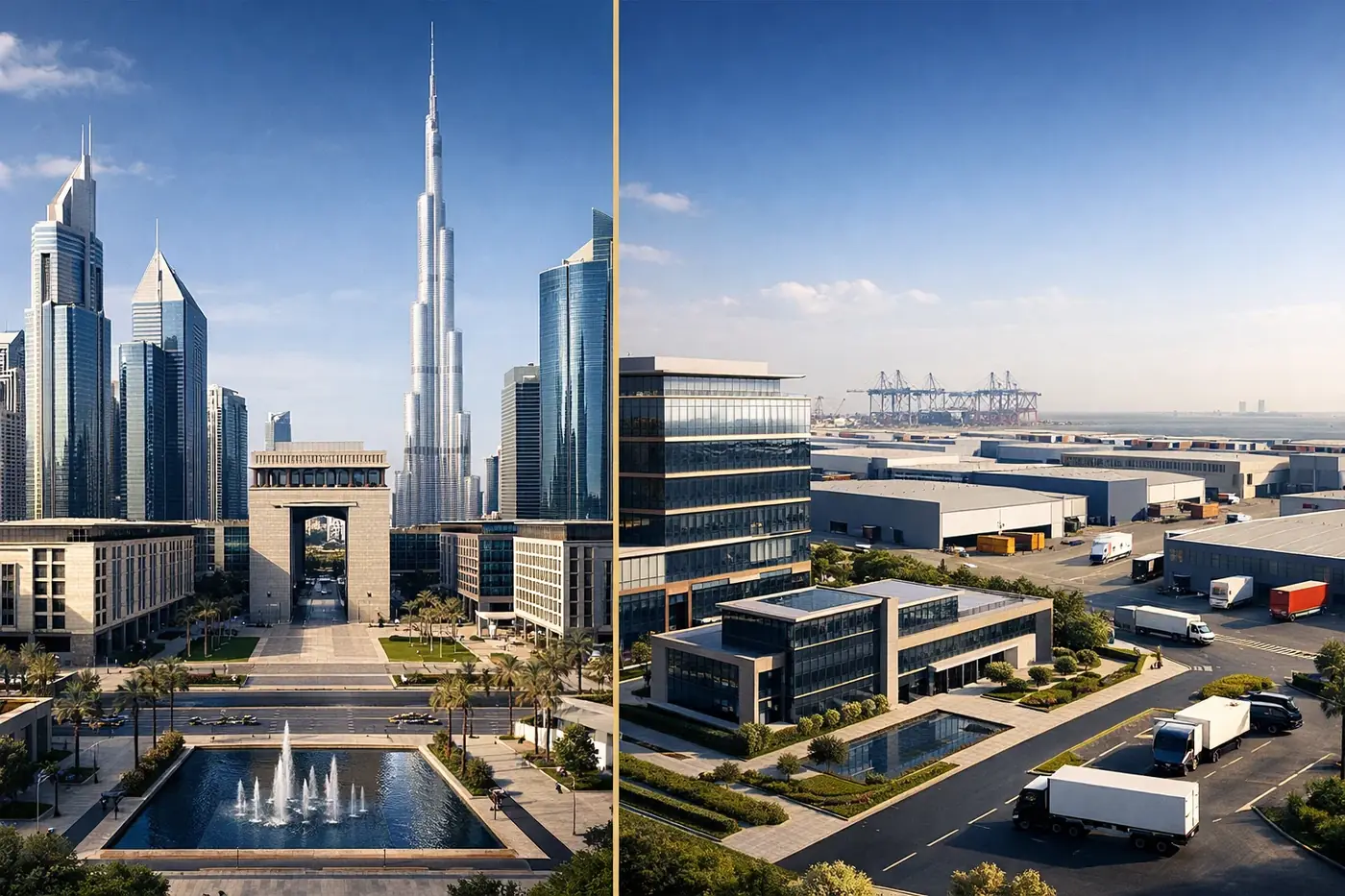
A free zone company is established within a designated economic zone (such as DMCC, DAFZA, or Dubai Internet City) and is designed primarily for international business or trade between free zones. While you gain significant benefits—streamlined setup, flexible office options, and potential tax advantages—you generally cannot conduct direct business with the UAE mainland market without appointing a local distributor or registering a separate mainland branch.
Understanding Dubai's free zones and their specific restrictions is critical before making this choice.
Complete Mainland vs Free Zone Comparison 2026
| Factor | Mainland Company | Free Zone Company |
|---|---|---|
| Market Access | Full access to UAE local market, government contracts, and mainland B2B trade | International trade and free zone-to-free zone business; mainland trade requires distributor or separate branch |
| Ownership Structure | 100% foreign ownership for most commercial and professional activities; local service agent may be required for specific activities (not a shareholder) | 100% foreign ownership guaranteed across all license types |
| Setup Cost (2026) | Typically AED 15,000–30,000+ depending on license type, office location, and initial visa requirements | Typically AED 5,000–20,000+ depending on free zone, license type, and office package (flexi-desk vs. private office) |
| Annual Renewal Cost | AED 12,000–35,000+ including license renewal, visa renewals, office lease, potential audit fees | AED 8,000–25,000+ depending on zone and visa quota; some zones require audits above certain revenue thresholds |
| Office Requirement | Physical leased office space mandatory (Ejari registration required); virtual offices not permitted | Flexible options: virtual office, flexi-desk, or private office depending on zone and business needs |
| Visa Quota System | Tied to office size (typically 1 visa per 10–12 sqm); larger office = more visa capacity | Set quota per license package (e.g., 1–6 visas); additional visas require package upgrade or extra fees |
| Corporate Tax (2026) | 9% on taxable profits exceeding AED 375,000; standard UAE corporate tax applies | Potential 0% rate as a Qualifying Free Zone Person (QFZP) if meeting strict conditions: adequate substance, qualifying activities, no mainland revenue (with exceptions) |
| Licensing Authority | Dubai Department of Economic Development (DED/DET) + federal entities (MOHRE, FTA) | Individual free zone authority (e.g., DMCC, JAFZA, DAFZA) offering one-window service |
| Administrative Process | Multi-step across various government portals; longer processing times in some cases | Streamlined single-window system within the zone; typically faster approvals |
| Banking & Credit Access | Full access to local banks; corporate accounts generally straightforward with proper documentation | Access to local and international banks; well-established zones (DMCC, DIFC) widely recognized by banks |
| Physical Retail/Warehouse Suitability | Ideal for retail stores, restaurants, medical clinics, showrooms, and warehouses serving local market | Suitable for warehousing (logistics zones) and some retail within zone premises; not for city-centre storefronts |
| Best Fit Business Types | Restaurants, retail stores, contracting firms, real estate agencies, professional services targeting UAE clients, government suppliers | E-commerce, software development, consulting, trading firms, holding companies, international service providers, logistics operations |
Understanding the 2026 Tax Landscape
One of the most significant changes in recent years is the introduction of the UAE corporate tax regime. Both mainland and free zone companies must understand their obligations.
Mainland Corporate Tax
Mainland companies are subject to the federal corporate tax at a straightforward rate:
- 0% on taxable income up to AED 375,000
- 9% on taxable income exceeding AED 375,000
This applies to profits, not revenue. Allowable business expenses reduce your taxable income. All mainland businesses must register with the Federal Tax Authority and file annual returns.
Free Zone Tax Treatment: The QFZP Opportunity (With Conditions)
Free zone companies can potentially benefit from a 0% corporate tax rate, but this is not automatic. To qualify as a Qualifying Free Zone Person (QFZP), your business must meet all of the following criteria:
- Adequate substance: Maintain a genuine physical presence in the UAE with employees, operating expenditure, and core income-generating activities conducted from the free zone
- Qualifying activities: Derive income from approved activities such as manufacturing, logistics, holding shares/securities, fund management, or headquarters services
- No mainland revenue: Generally, you cannot earn income from the UAE mainland. Limited exceptions exist for specific activities or if you operate through a separate taxable branch
If you fail to meet these conditions, your free zone company will be taxed at the standard 9% rate on income exceeding AED 375,000.
Important: The 0% benefit requires ongoing compliance. Many businesses assume free zone automatically means zero tax—this is incorrect in 2026. Work with a licensed tax advisor to structure your operations correctly.
Cost Breakdown: What You'll Actually Pay
Setup costs vary widely based on your license type, office location, visa needs, and business activity. Here's a realistic framework:
Initial Setup Costs
Mainland Setup:
- License fees, registration, and approvals: AED 5,000–15,000
- Office lease (Ejari mandatory): AED 8,000–50,000+ annually depending on location and size
- Initial visa processing (per person): AED 3,000–5,000
- Service agent fees (if required): AED 2,000–5,000 annually
- Total first-year investment: Typically AED 20,000–70,000+ depending on office choice and team size
Free Zone Setup:
- License fees: AED 5,000–18,000 depending on zone and activity
- Office options: Flexi-desk from AED 4,000/year; private office from AED 15,000+/year
- Visa quota and processing: AED 3,000–5,000 per visa
- Total first-year investment: Typically AED 10,000–35,000+ depending on zone prestige and office needs
Annual Renewal and Operating Costs
Budget for ongoing expenses beyond the first year:
- License renewal: AED 4,000–15,000
- Visa renewals: AED 2,500–4,000 per person
- Office lease renewal: Variable based on location
- Audit fees (if required): AED 5,000–20,000+ for companies above certain revenue thresholds or in specific zones
- PRO services and compliance support: AED 3,000–10,000
Realistic annual operating cost: AED 15,000–50,000+ for a lean operation, scaling significantly with team size and office requirements.
Visa Allocation: How Many Employees Can You Sponsor?
Your ability to bring in talent directly impacts your growth trajectory.
Mainland Visa Quota
Mainland companies link visa quotas to office size. The calculation typically allows approximately 1 visa per 10–12 square metres of leased office space. This means:
- Small office (50 sqm): ~4–5 visas
- Medium office (100 sqm): ~8–10 visas
- Large office (200 sqm): ~16–20 visas
The benefit: visa capacity scales flexibly with your office. The cost: you must maintain and pay for physical space even if remote work is your preference.
Free Zone Visa Quota
Free zones assign a fixed visa quota to each license package. Entry-level packages often include 1–3 visas. If you need more, you either:
- Upgrade to a higher-tier package with more visas
- Increase your office space within the zone
- Pay additional per-visa fees (if the zone permits)
This structure works well for small, stable teams but can become expensive if you're scaling rapidly.
Office and Physical Presence Requirements
Have questions about this?
A 10-minute call with Mirza often saves weeks of research. No obligation — ask anything about your situation.
Mainland: Physical Office is Mandatory
All mainland companies must lease a physical office space and register it through Ejari (the official tenancy registration system). Virtual offices, P.O. boxes, or flexi-desks do not satisfy the legal requirement. Your office location also determines your license issuing authority within Dubai.
Free Zone: Maximum Flexibility
Most free zones offer tiered office solutions:
- Virtual office: Business address and mail handling; no physical workspace
- Flexi-desk: Shared coworking space with hot-desking access
- Private office: Dedicated office space within the free zone
This flexibility makes free zones ideal for digital businesses, consultants, or startups with minimal physical infrastructure needs. However, some banks may require proof of a physical office (not just virtual) before approving corporate accounts.
Decision Tree: Finding Your Right Setup

Use this logical framework to narrow down your best option:
Step 1: Define Your Primary Customer Base
IF your main revenue comes from UAE-based clients, government contracts, or mainland B2B sales,
THEN → Mainland is your likely choice.
IF your customers are international, or you trade exclusively with other free zone companies,
THEN → Free Zone is your likely choice.
Step 2: Assess Your Physical Presence Needs
IF you need a retail storefront, restaurant, clinic, or client-facing office in a Dubai city location,
THEN → Mainland is required.
IF you operate digitally (SaaS, consulting, e-commerce) or can work from a flexible workspace,
THEN → Free Zone offers cost efficiency.
Step 3: Evaluate Your Team Growth Plan
IF you plan to hire 10+ employees within 1–2 years,
THEN → Mainland offers more scalable visa capacity tied to office size.
IF you're starting solo or with a small team (1–5 people) and growth is gradual,
THEN → Free Zone provides predictable, fixed-quota simplicity.
Step 4: Conduct a Tax Optimization Check
IF your business activity qualifies for QFZP status (manufacturing, logistics, holding company) AND you can meet substance requirements AND you will not earn mainland UAE revenue,
THEN → Free Zone offers potential 0% corporate tax benefit.
IF you will derive significant income from mainland clients or cannot meet QFZP conditions,
THEN → Tax treatment will be similar regardless of structure (9% on profits above AED 375,000).
Step 5: Consider a Hybrid Structure
IF you have both international operations and UAE mainland clients (e.g., IT consultancy with global SaaS product + UAE government contract),
THEN → Consider a dual setup: Free zone company for international operations + mainland branch or separate mainland entity for local contracts. Consult a business setup advisor to structure this correctly.
Recommended Direction Based on Business Type
- E-commerce (global sales): Free Zone
- Restaurant or café: Mainland
- Software consultancy (international clients): Free Zone
- Construction or contracting (UAE projects): Mainland
- Trading company (import/export): Free Zone (logistics zones like JAFZA or DAFZA)
- Medical clinic or dental practice: Mainland (or Dubai Healthcare City free zone with specific permissions)
- Holding company for international assets: Free Zone (if qualifying for QFZP)
- Digital marketing agency (UAE clients): Mainland
Common Mistakes to Avoid
1. Choosing Based Only on Lowest Setup Cost
The cheapest free zone package might save you AED 8,000 initially, but if it locks you out of the UAE market where your customers actually are, you've made a costly strategic error. Always prioritize market access and operational fit over initial price.
2. Assuming Free Zone Equals Automatic Zero Tax
This is one of the most widespread misconceptions in 2026. The 0% QFZP rate is conditional and requires:
- Ongoing substance in the UAE (real office, real employees, actual operations)
- Income only from qualifying activities
- No mainland revenue (with limited exceptions)
Many businesses set up in free zones expecting zero tax and later discover they don't meet the criteria. Consult a licensed tax advisor before assuming this benefit applies to you.
3. Underestimating Annual Compliance Costs
Setup cost is just the entry ticket. Budget for:
- Annual license renewals
- Visa renewals (per person)
- Audit fees (mandatory in some free zones above certain revenue thresholds, or for any UAE company with taxable income above AED 50 million)
- PRO and compliance services
- Office lease renewals
Annual operating costs for a lean 2–3 person business typically range from AED 18,000–40,000+. Plan accordingly.
4. Delaying Bank Account Preparation
Corporate bank account opening in the UAE has become more stringent. Banks require:
- Comprehensive business plan
- Source of funds documentation
- Proof of business address (physical office, not virtual, for many banks)
- CVs and proof of address for shareholders and signatories
- Expected transaction volume and client profiles
Start preparing these documents while your license is being processed. A 2–3 month delay in banking can paralyse operations even if your license is ready.
5. Ignoring Free Zone-Specific Restrictions
Not all free zones are equal. Some specialize in certain industries (media, tech, logistics), and this can affect your license approval, visa processing speed, and operational permissions. When comparing free zones, consider:
- Allowed business activities
- Visa quota structures
- Renewal costs
- Proximity to your operational needs (port access, airport, city centre)
- Reputation with banks and clients
Banking Considerations for Both Structures

Both mainland and free zone companies can open corporate bank accounts in the UAE, but the process and requirements have tightened significantly.
What Banks Look For
- Business legitimacy: Clear business model, realistic revenue projections, and defined client base
- Source of funds: Documented proof of where your capital is coming from (salary history, business sale, investment, etc.)
- Physical presence: Increasingly, banks prefer to see a physical office, not just a virtual address, especially for higher-risk industries
- Anticipated transaction volumes: Be prepared to explain your expected monthly turnover and transaction patterns
Mainland vs Free Zone: Does It Matter?
In practice, both structures can access the full range of UAE banks (Emirates NBD, ADCB, Mashreq, FAB, HSBC, etc.). Well-established free zones like DMCC, DIFC, and JAFZA are widely recognized and respected by banks.
The real determining factor is not your license type but the quality of your documentation, the clarity of your business model, and your ability to demonstrate compliance and transparency.
When Each Option is NOT Suitable
Mainland is Likely Wrong If:
- You're a solo freelancer offering services exclusively to international clients
- You run an e-commerce store dropshipping globally
- You're setting up a holding company for foreign investments with no UAE operations
- Your business is entirely digital with no need for local market presence
- You want to minimize initial costs and don't need UAE market access
The mandatory physical office and higher setup costs make mainland inefficient for these scenarios.
Free Zone is Likely Wrong If:
- You're opening a restaurant, café, or retail store serving UAE residents
- You're a contracting or construction firm bidding on UAE projects
- You operate a medical clinic, dental practice, or healthcare facility for local patients (unless using a healthcare-specific free zone with appropriate approvals)
- You need to supply goods or services directly to UAE government entities
- Your primary revenue is from mainland UAE B2B or B2C clients
The market access restriction makes free zone setup impractical for businesses whose customers are in the UAE local market.
Making Your Final Decision
By now, you should have a clearer picture of which structure aligns with your business model, target market, team size, and tax situation.
If your analysis points decisively toward one option, your next step is to engage a licensed business setup consultant who specializes in that jurisdiction. If your business has elements of both—for example, a tech company with global SaaS sales but also a key UAE government client—discuss a dual-structure approach with your advisor.
For more guidance on the complete Dubai business setup process, including documentation checklists, timeline expectations, and authority-specific requirements, explore our dedicated resources.
This decision is the foundation of your UAE business journey. Take the time to evaluate it properly, consult with professionals who understand both the regulatory and commercial realities, and structure your company to support sustainable growth in one of the region's most dynamic business hubs.
Sources & Official References
The information in this guide reflects current UAE federal and emirate-level regulations. For the most up-to-date figures and procedures, consult the official sources below:
- Dubai Department of Economy and Tourism (DET) — Official Dubai mainland licensing authority.
- UAE Government Portal — Free Zones — Federal portal listing free zones and their authorities.
- Federal Tax Authority — Corporate Tax — UAE Corporate Tax regulations and Free Zone Person rules.
Frequently Asked Questions (Dubai Mainland vs Free Zone)
1) Is Dubai mainland better than free zone?
Neither option is “better” overall—each is better for different business models. Mainland is typically the right choice if you want full UAE market access, local B2B/B2C sales, government tenders, or retail activity. Free zone is often better for international business, lean operations, and zone-to-zone trading.
2) Can a free zone company sell to UAE mainland customers?
In most cases, a free zone company cannot directly trade with the UAE mainland market unless it uses a local distributor, works through approved structures, or sets up a mainland branch/permit arrangement depending on the activity and authority rules.
3) Do I need a physical office for Dubai mainland licensing?
Yes. Mainland companies generally require a leased physical office with Ejari registration in Dubai. Virtual office models are typically not accepted for mainland licensing requirements.
4) Can I open a corporate bank account with a free zone license?
Yes, free zone companies can open UAE corporate bank accounts. However, banking approval depends more on your documentation, substance (real operations), business activity, and compliance profile than on whether you are mainland or free zone.
5) Is corporate tax 0% in Dubai free zones?
Not automatically. Free zone companies may qualify for 0% corporate tax on qualifying income only if they meet the requirements to be treated as a Qualifying Free Zone Person (QFZP), including substance requirements and qualifying activities. Otherwise, standard UAE corporate tax rules may apply.
6) Can a mainland company be 100% foreign-owned in Dubai?
For most commercial and professional activities, Dubai mainland companies can be 100% foreign-owned. Some specific regulated activities may require additional conditions such as local service agent arrangements, approvals, or special licensing structures.
7) Which setup is better for visas and hiring employees?
Mainland visa allocations generally scale with office size (larger leased space allows more visas). Free zones typically follow package-based visa quotas, where the number of visas depends on the chosen license package and office option.
8) What is a hybrid structure and who should consider it?
A hybrid structure usually means using a free zone company for international operations while using a mainland entity or branch for UAE market access. It can be useful for businesses that have both UAE mainland clients and international customers, but it must be structured carefully to avoid compliance issues.
Before committing to mainland setup, review the detailed fee breakdown in our Dubai mainland license cost 2026 guide. Founders structuring an LLC should also understand the UAE share capital requirements before drafting their memorandum of association.
Have a question about this?
Leave your details and a UAE expert will get back to you within 1 business day — free, no obligation.
Ready to take action?
Whether you're ready to start or still comparing options — we'll give you a straight answer.
Chat on WhatsApp
Usually replies within 2h
Get a Free Quote
Personalised in 60 seconds
Call Directly
Open daily, 10am–6pm UAE
About the Author
Dubai-based independent advisor on UAE visa, immigration, and offshore structuring. Founder of Henry Club UAE with 90+ published guides. Advisory-first — clarity before commitment.