

I help founders understand their options clearly before they commit to any structure, provider, or direction.
Quick Summary: MOA in the UAE
- What it is: An MOA (Memorandum of Association) is the constitutional document of a mainland UAE limited liability company, setting out ownership shares, management authority, and profit distribution.
- Mandatory and notarised: It is mandatory for mainland companies, must be notarised by a UAE Notary Public, and is then submitted to the Department of Economic Development, becoming part of the permanent public record.
- Key customisable clauses: Company name and objectives, share capital and ownership, liability of partners, management structure, profit distribution, share transfer and pre-emptive rights, and dissolution.
- Mainland vs free zone: Mainland companies use a notarised MOA under federal law, while free zone companies are issued incorporation documents approved internally by the free zone authority.
- Arabic version governs: The legally binding version is drafted in Arabic; an English translation is attached for reference, but the Arabic text prevails in any inconsistency.
- Can be amended: An MOA can be amended after registration, but this requires formal approval, notarisation of the amended document, and submission to the licensing authority, with possible added fees and time.
Quick answer: An MOA (Memorandum of Association) is the constitutional document of a UAE mainland LLC – it sets out ownership shares, management authority and profit distribution, and is mandatory for mainland companies. It must be notarised by a UAE Notary Public and filed with the Department of Economic Development, and it governs shareholder relationships for the life of the company.
You’ve chosen your business activity, sorted out the initial approvals, and you’re ready to make your UAE company a legal reality. At this point, you’ll hear your consultant or legal advisor mention the MOA. It can sound like just another document in a long list. In reality, this single agreement often determines whether shareholder relationships stay smooth or become difficult later on.
What is an MOA in the UAE?
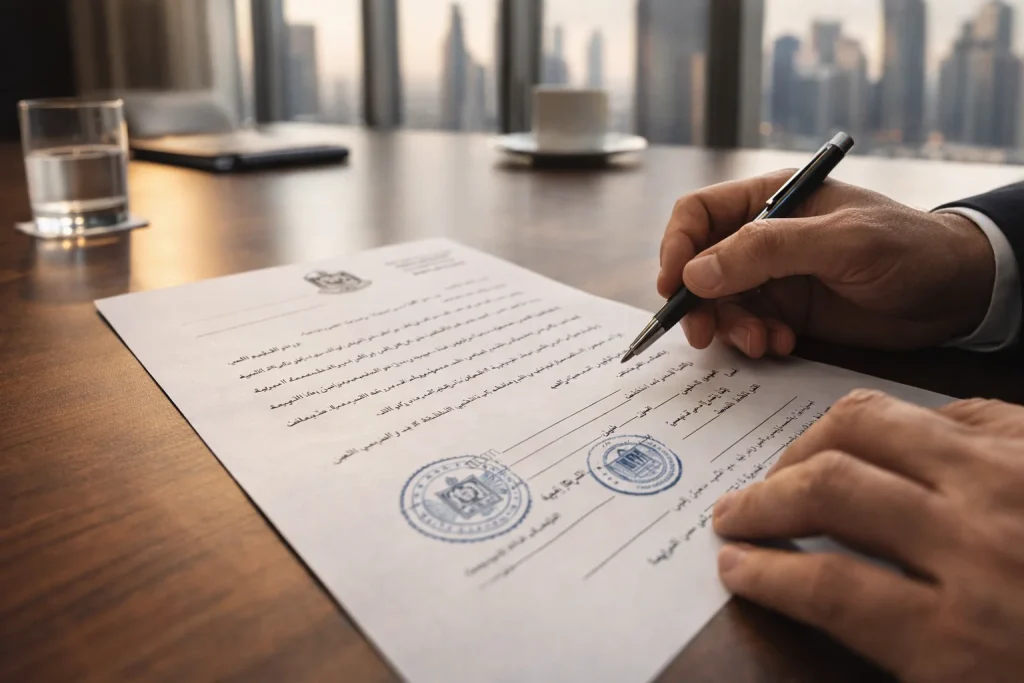
An MOA, or Memorandum of Association, is the constitutional document of a mainland UAE limited liability company. It formally establishes the company and sets out the core rules that govern ownership, management authority, and profit distribution.
This document is mandatory for mainland companies and is notarized by a UAE Notary Public before being submitted to the Department of Economic Development. It sits at the centre of the mainland company formation process and becomes part of the company’s permanent public record.
Why Your MOA Deserves Careful Attention
Many founders treat the MOA as a procedural step rather than a strategic one. In practice, this is where the real commercial understanding between shareholders is recorded. The MOA controls how capital is structured, how profits are shared, and how decisions are made when interests do not fully align.
While authorities provide a standard template, several clauses allow customization. Leaving those sections untouched may seem convenient at setup, but it often creates friction later—especially when partners want to exit or disagree on control. These risks become clearer when viewed through a broader risk and due diligence framework.
Key Clauses Explained in Practical Terms

Company Name and Objectives: This section lists the approved trade name and licensed business activities. Any activity not listed here cannot be legally carried out without a formal amendment.
Share Capital and Ownership: It defines total capital, ownership percentages, and how capital is contributed. If capital is provided in kind rather than cash, a formal valuation is usually required.
Liability of Partners: For an LLC, liability is limited to the value of the shareholding. This clause confirms that protection.
Management Structure: This section names the manager or managers and defines their authority. Poorly drafted management clauses are a common source of internal conflict.
Profit Distribution: Profits are typically distributed in proportion to ownership unless the MOA specifies otherwise. If a different arrangement is intended, it must be clearly written here.
Share Transfer and Pre-emptive Rights: This clause governs what happens if a shareholder wants to sell. Clear valuation and right-of-first-refusal provisions help avoid disputes.
Dissolution and Liquidation: It explains how assets are distributed if the company is closed. Default rules apply unless another method is agreed and documented.
Mainland MOA vs. Free Zone Incorporation Documents
Have questions about this?
A 10-minute call with Mirza often saves weeks of research. No obligation — ask anything about your situation.
Mainland companies rely on a notarized MOA governed by federal commercial company law. The format and process are largely consistent across emirates.
Free zone companies, by contrast, operate under their respective authority’s regulations. Their incorporation documents serve a similar purpose but are typically approved internally by the free zone rather than notarized. This difference becomes relevant when comparing mainland and free zone company structures.
The Notarization Process: What to Expect
For mainland companies, notarization is a mandatory legal step. Shareholders—or their legally authorized representatives—appear before a Notary Public to confirm agreement with the MOA’s contents.
The legally binding version of the MOA is drafted in Arabic. An English translation is usually attached for reference, but accuracy between versions is essential. Errors at this stage can delay licensing or cause complications later, particularly during license renewal or restructuring.
Common Drafting Oversights That Cause Issues Later
Using the standard template without reviewing customizable clauses.
Leaving management authority vague, which can restrict operations or enable overreach.
Failing to define a clear share transfer mechanism.
Allowing inconsistencies between the MOA and any private shareholder agreements.
Submitting incorrect shareholder or capital details, leading to rejection or delays.
A Practical MOA Drafting Checklist for Founders
Before proceeding to notarization, review your MOA carefully using the following checklist.
- Verify all shareholder details: Names, passports, nationalities, and ownership percentages must match official documents.
- Confirm business activities: Ensure all intended activities are listed accurately.
- Review capital structure: Check currency, total amount, and contribution method.
- Define management authority: Confirm signing powers and operational limits.
- Confirm profit-sharing terms: Ensure they reflect the real agreement.
- Clarify exit mechanisms: Review valuation and transfer procedures.
- Review dispute resolution: Most mainland MOAs rely on UAE courts, which should be clearly stated.
- Check language accuracy: Ensure the Arabic version aligns with the agreed terms.
A carefully drafted MOA is not about legal formality; it is about commercial clarity. When aligned with broader considerations such as ownership risk and long-term planning, it supports stable operations and reduces uncertainty—particularly for founders building businesses with future investment or expansion in mind within a wider investment strategy framework.
Sources and official references
Frequently Asked Questions
Is an MOA mandatory for all companies in the UAE?
An MOA is mandatory for mainland limited liability companies registered with the Department of Economic Development. Free zone companies do not use a traditional MOA; instead, they are issued incorporation or constitutional documents by the relevant free zone authority.
Can the standard MOA template be customized?
Yes. While authorities provide a standard MOA template, several clauses can be customized by agreement between shareholders. These commonly include management authority, profit distribution, and share transfer mechanisms. If these sections are left unchanged, default provisions apply.
Does the MOA need to be notarized in the UAE?
For mainland companies, notarization of the MOA before a UAE Notary Public is a mandatory legal step. Free zone incorporation documents are generally approved internally by the free zone authority and do not follow the same notarization process.
Which language version of the MOA is legally binding?
The Arabic version of the MOA is the legally binding document in the UAE. English translations are usually provided for reference, but in the event of any inconsistency, the Arabic text prevails.
Can an MOA be amended after company registration?
Yes. An MOA can be amended after registration, but the process requires formal approval, notarization of the amended document, and submission to the relevant licensing authority. Amendments may involve additional fees and processing time.
Is a private shareholder agreement enough without updating the MOA?
No. While private shareholder agreements can add clarity and confidentiality, they do not override the MOA. If there is a conflict between the two, authorities and courts generally rely on the MOA as the controlling document.
The share capital figure declared in your MOA has implications beyond the document itself — for a clear breakdown of what you need to declare, deposit, and maintain across mainland and free zone structures, see our guide on share capital UAE 2026.
Have a question about this?
Leave your details and a UAE expert will get back to you within 1 business day — free, no obligation.
Ready to take action?
Whether you're ready to start or still comparing options — we'll give you a straight answer.
Chat on WhatsApp
Usually replies within 2h
Get a Free Quote
Personalised in 60 seconds
Call Directly
Open daily, 10am–6pm UAE
About the Author
Dubai-based independent advisor on UAE visa, immigration, and offshore structuring. Founder of Henry Club UAE with 90+ published guides. Advisory-first — clarity before commitment.